
Movie sets are magical places: fake rain falls on command, entire cities exist inside warehouses, and somewhere in the corner, a nervous prop master is watching an actor slowly “forget” to return a priceless souvenir. Welcome to the wonderfully sneaky world of famous movie props and the actors who stole themor, in many cases, “borrowed forever,” “were later allowed to keep,” or “joked about stealing while the studio quietly looked the other way.”
Props are not just objects. A pair of glasses can turn a kid into Harry Potter. A red suit can turn Ryan Reynolds into Deadpool. A hat can transform a chemistry teacher into Heisenberg. These pieces of film history often become so connected to the actors who use them that taking one home feels less like theft and more like emotional custody. Still, let’s be clear: do not try this at your school play, office party, or local escape room. Hollywood has lawyers. Your drama teacher has a whistle.
Below are 10 famous props and the actors who took them home, plus the stories behind why these keepsakes became legendary among film fans, collectors, and pop-culture detectives.
Why Actors Take Props From Movie Sets
Actors spend months, sometimes years, living with a character. They repeat lines until the dialogue becomes muscle memory. They wear the same costume under hot lights. They hold the same prop in emotional scenes, action scenes, and those awkward moments where everyone waits for lunch but pretends to be “in character.” By the end of filming, a prop can feel like a scrapbook, a trophy, and a tiny ghost of the role all at once.
Studios usually keep strict control over props because the items may be reused, archived, exhibited, auctioned, or insured for enough money to make your wallet cough. But actors are human. When the final day arrives, someone may pocket a ring, carry off a jacket, or casually request a 30-foot letter “A” as if asking for leftover sandwiches.
10 Famous Props And The Actors Who Took Them Home
1. Daniel Radcliffe: Harry Potter’s Glasses
Few movie props are more instantly recognizable than Harry Potter’s round glasses. Daniel Radcliffe reportedly kept two pairs from the franchise: one from the first film and another from later in the series. That is not just a souvenir; that is a timeline in eyewear.
The glasses worked because they were simple. No glowing buttons, no dragon-scale leather, no mysterious sci-fi hum. Just round frames that helped turn a young wizard into a worldwide icon. For Radcliffe, keeping them makes perfect sense. He grew up with the role, and those frames practically grew up with him. They also prove that sometimes the most powerful prop in a fantasy franchise is not a wand, a sword, or a spellbook. Sometimes it is a pair of tiny, lens-light glasses that says, “Yes, this child is about to have the strangest school year imaginable.”
2. Rupert Grint: The Number 4 From Privet Drive
Rupert Grint, who played Ron Weasley, has one of the funniest Harry Potter prop stories. He admitted that he got away with the door number from Harry’s house at Number 4 Privet Drive. The detail is wonderfully ridiculous: while security was tight, Grint still managed to walk away with the number that marked one of the most famous fictional addresses in modern movies.
Why is this prop so charming? Because it is not glamorous. It is not a wand or a cloak. It is a house number. But that number represents the place where Harry’s story begins: the ordinary suburban doorway before the owls, letters, platform magic, and chaos of Hogwarts. In a franchise filled with enormous fantasy imagery, a simple “4” becomes a perfect symbol of the series’ first great contrast: boring real life outside, impossible magic waiting nearby.
3. Ryan Reynolds: The Deadpool/Welshpool Costume
Ryan Reynolds and Deadpool are so tightly linked that separating the actor from the red suit feels like trying to separate peanut butter from jelly with a laser pointer. Reynolds has joked about taking Deadpool-related costumes from set, including the Welshpool costume from Deadpool & Wolverine. That particular suit, connected to Wrexham AFC and the Welsh dragon design, reportedly ended up on display at the Racecourse Ground in Wales.
This is a perfect Reynolds prop story because it combines brand loyalty, comedy, soccer, and Marvel mischief into one very red package. The Deadpool suit is more than a costume; it is the visual punchline of an entire career comeback. Reynolds fought for years to make the character work on-screen, so keeping a suit is almost poetic. It is also very Deadpool: dramatic, self-aware, and somehow both illegal-sounding and approved by adults in expensive offices.
4. Robert Downey Jr.: The Giant Avengers “A”
Robert Downey Jr. did not settle for a ring, a glove, or a small desk-friendly trinket. He wound up with the massive Avengers “A” from the Marvel universe. According to interviews and entertainment reports, the oversized prop was connected to the Avengers tower imagery and made its way to him after he joked that he wanted it.
This is a billionaire-level souvenir, which is fitting for the actor who made Tony Stark one of the defining characters of modern blockbuster cinema. Most people bring home a coffee mug from work. Downey brought home architectural punctuation. The giant “A” is also symbolic: Marvel Studios built a universe around the Avengers, and Downey’s Iron Man helped launch the whole machine. If any actor could plausibly have a giant superhero logo in his office without it feeling strange, it is the guy who made “genius, billionaire, playboy, philanthropist” sound like a job description.
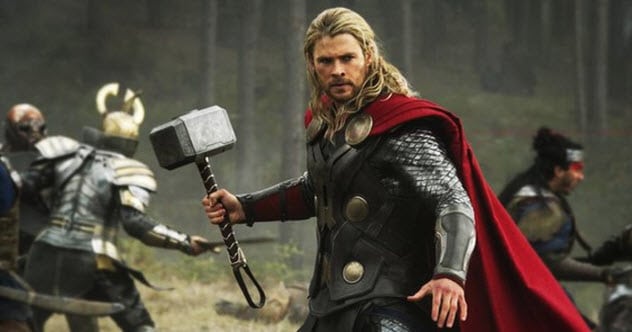
5. Chris Hemsworth: Thor’s Mjolnir And Stormbreaker
Chris Hemsworth has spoken more than once about taking home Thor-related props, including versions of Mjolnir and Stormbreaker. In normal life, keeping a giant mythic hammer around the house would raise questions. In Hemsworth’s life, it is basically interior design.
Mjolnir matters because it is not just Thor’s prop; it is part of his identity. The hammer represents worthiness, power, comedy, family drama, and the occasional living-room storage dispute. Stormbreaker later became another signature prop, especially after Thor’s visual style expanded across the Marvel Cinematic Universe. These items also show how superhero props become emotional bookmarks. Hemsworth has played Thor across many films, and each prop carries a different phase of that journey: young prince, reluctant hero, cosmic goofball, grieving survivor, and still somehow the guy most likely to look majestic while confused.
6. Chris Evans: Captain America’s Shield And Cowl
Chris Evans reportedly kept Captain America’s shield and cowl, two of the most iconic items in the Marvel universe. This may not be a classic “sneak it out under your jacket” situation, but it belongs on the list because the emotional weight is enormous.
The shield is one of those rare props that communicates a character instantly. You do not need a line of dialogue. You see the star, the circle, the colors, and you know exactly who has entered the room. The cowl, meanwhile, completed the transformation from Steve Rogers to Captain America. Evans brought warmth and humility to a role that could have become stiff in the wrong hands. Taking home these pieces feels like receiving the uniform after years of service. Also, let’s be honest: if you played Captain America for nearly a decade, you would want the shield too. You might pretend to be casual about it, but your basement wall would already be measured.
7. Bryan Cranston: Heisenberg’s Hat And Sunglasses
On Breaking Bad, Bryan Cranston’s Walter White did not fully become Heisenberg until the hat and sunglasses arrived. The pork pie hat, especially, became visual shorthand for the character’s darker alter ego. Cranston reportedly kept the hat and sunglasses as prized possessions after the series ended.
That is the power of a perfect prop. Before the hat, Walter was a desperate man making terrible choices. With the hat, he became a mythic figure in his own mind. The prop helped signal a psychological shift without needing a speech, although the show had plenty of speeches that could make a room stop breathing. Cranston’s keepsake is meaningful because it represents one of television’s greatest transformations. It is small enough to fit in a case, but big enough to carry the weight of an entire character arc.
8. Aaron Paul: Jesse Pinkman’s “THE CAPN” License Plate
Aaron Paul, who played Jesse Pinkman on Breaking Bad, reportedly took Jesse’s license plate from his first car: “THE CAPN.” It is a small prop, but for fans of the series, it instantly calls up Jesse’s chaotic energy, humor, vulnerability, and tragic growth.
The license plate works as a keepsake because Jesse’s cars were part of his identity. They were loud, expressive, and very much not subtlejust like early Jesse. Over time, the character became one of the show’s emotional centers, and an object like that license plate becomes a snapshot of who he was before everything got heavier. It is also the kind of prop that would look fantastic on a wall without requiring you to explain to guests why there is a giant superhero logo blocking the hallway.
9. Jeffrey Dean Morgan: Lucille From The Walking Dead
Jeffrey Dean Morgan, who played Negan on The Walking Dead, has said he has Lucille, Negan’s infamous bat prop, displayed in a glass case. In the show, the prop is central to Negan’s identity, functioning less like an accessory and more like a terrifying business card. For this article, we will keep it safely in the category of “screen prop with dramatic meaning,” because nobody needs real-life lessons from Negan. Truly, nobody.
As a prop, Lucille is unforgettable because it tells viewers who Negan is before he even finishes speaking. It also shows how television props can become character partners. Morgan’s attachment to it makes sense: the prop shaped posture, rhythm, and presence. Holding it changed how Negan moved through a scene. That is why famous props matter. They are not background decoration. In the right hands, they become part of the performance.
10. Paul Bettany: Vision’s Prop Head
Paul Bettany shared a very modern Marvel keepsake story when he revealed that he had taken a model head of Vision used for filming setups. The prop was reportedly used by lighting and camera departments so they could prepare shots without the actor physically standing there. Bettany later joked about using it for a family prank, because apparently even android heads deserve a second career.
This is one of the strangest and funniest props on the list. Unlike a costume or a shield, it is not really designed for glamour. It is a technical tool that helped the crew do their job. But because it looks like Vision, it becomes instantly fascinating. It reminds fans that movie magic is not only actors and visual effects. It is also foam, busts, stand-ins, lighting tests, and crew members solving problems before the cameras roll. Bettany’s prop head is a perfect reminder that behind every sleek superhero scene is a very practical object waiting just out of frame.
What These Stolen Prop Stories Reveal About Hollywood
These stories are funny, but they also reveal something important about film and television production. Props become emotional shortcuts. Audiences may remember a line, but they often recognize a character through an object first: Harry’s glasses, Cap’s shield, Thor’s hammer, Heisenberg’s hat, Deadpool’s suit. The object compresses hours of storytelling into one image.
For actors, these items can mark the end of a chapter. When filming wraps, the set disappears. Costumes go into storage. Crews move on to the next production. But a prop can preserve the role in physical form. It is proof that the experience happened. It is a tiny museum exhibit from a fictional world that once required hundreds of real people to build.
Are Actors Really Allowed To Keep Props?
Sometimes, yes. Sometimes, absolutely not. The rules depend on the studio, the value of the item, insurance requirements, whether the prop will be reused, and whether the actor has enough charm to make a producer sigh and say, “Fine, take the thing.”
Hero propsthe main version used in close-up shotsare often carefully protected. Duplicates, stunt versions, wardrobe copies, or damaged pieces are more likely to become gifts. In some cases, actors ask politely and receive permission. In others, they joke about stealing only after everyone involved has clearly survived the incident financially and legally.
For regular people, the lesson is simple: do not steal from your workplace. For Hollywood stars, the lesson appears to be: become beloved in a billion-dollar franchise and maybe someone will let you keep the hat.
Fan Experience: Why We Love Stories About Actors Stealing Props
There is a special kind of joy in learning that actors are just as attached to famous props as fans are. Viewers spend years watching these objects on screen, pausing trailers to analyze them, buying replicas, discussing them online, and pointing at them in museums like they have spotted a celebrity at the grocery store. When an actor takes a prop home, it confirms something fans already feel: that the object mattered.
The experience is especially powerful because props make fictional worlds feel touchable. You cannot visit Hogwarts as a student, but you can understand why Harry’s glasses matter. You cannot join the Avengers, but you can instantly recognize the shield. You cannot step into the world of Breaking Bad, and honestly, please do not try, but you can understand why Heisenberg’s hat belongs in a display case. Props are the bridge between imagination and reality.
For pop-culture writers, collectors, and everyday fans, these stories also create a fun detective game. A tiny object suddenly opens a huge conversation. Who made it? How many versions existed? Was it used in a close-up? Did the actor ask permission? Did the studio pretend not to notice? The prop becomes a doorway into production design, costume departments, set security, actor memories, and fan culture.
There is also humor in the contrast between the glamorous image of Hollywood and the very ordinary behavior of wanting a souvenir. Movie stars may walk red carpets, but at the end of a long shoot they still think, “Would this look cool in my office?” That is wonderfully human. It turns giant franchises into workplace stories. The only difference is that your office does not usually contain a superhero helmet, a wizard’s house number, or a 30-foot Avengers logo.
These experiences remind us that film history is not only stored in studio archives. It also lives in actors’ homes, glass cases, closets, garages, and occasionally on display in places fans can visit. Every prop has two lives: the fictional one we saw on screen and the real one it has after the director calls cut. That second life is often messy, funny, sentimental, and full of stories that make fans love the first life even more.
Conclusion
The best famous prop stories are not really about stealing. They are about memory. A prop is a physical piece of a performance, a reminder of long filming days, beloved characters, and fictional worlds that became real enough for audiences to care about. Whether it is Harry Potter’s glasses, Deadpool’s suit, Thor’s hammer, Captain America’s shield, or Heisenberg’s hat, each object carries a little piece of entertainment history.
Actors take props because fans do the same thing emotionally. We all keep pieces of the stories that changed us. The actors just happen to have better access to the storage room.














