There are ordinary moments, and then there are tiny miracles wearing sneakers. One of those miracles happens when you walk into a coffee shop, airport counter, bakery, pharmacy, food truck zone, bathroom hallway, movie theater lobby, or any mysterious human cluster and politely ask, “Are you in line?” Then the people in front of you say the magic words: “No, go ahead.”
Suddenly, the clouds part. The fluorescent lights feel warmer. Your tired little errand-running soul gets promoted from “confused bystander” to “next customer.” This is not winning the lottery, but it is absolutely winning the scratch-off ticket of daily life. That is why when you ask the people in front of you if they’re in line and they’re not deserves its place among the greatest small joys in the universe.
The beauty of this awesome thing is that it is quick, polite, oddly suspenseful, and surprisingly emotional. It proves that public life is not always chaos with receipts. Sometimes it is a brief social negotiation that ends with free forward motion.
The Tiny Drama of the Almost-Line
Every line begins with a question: “Where does this thing start?” Unfortunately, humans are not traffic cones. We lean, hover, scroll, wander, and stand near counters with the energy of people who might be waiting for service, might be waiting for a friend, or might simply be reconsidering every choice that led them to a Tuesday afternoon at the DMV.
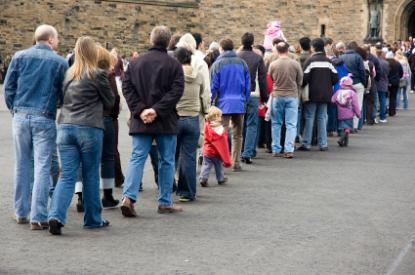
This is where the almost-line appears. The almost-line is not officially a line, but it looks enough like one to threaten your schedule. It may be two people standing near a register. It may be one person staring into the pastry case like the croissants owe them money. It may be a family gathered near the airport kiosk with seven suitcases, three backpacks, and the emotional weather system of a delayed flight.
You pause. You calculate. You look for clues. Are their bodies angled toward the counter? Are they holding wallets? Are they making eye contact with employees? Are they just blocking the path with the confidence of a decorative statue? At this point, the only tool left is courage wrapped in courtesy: “Excuse me, are you in line?”
When they answer, “No,” the whole scene changes. You were not trapped behind them. You were simply waiting behind a mirage. Congratulations: you have escaped the ghost queue.
Why This Moment Feels So Good
Waiting in line is not just about time. It is about fairness, uncertainty, social order, and the ancient fear that someone else understands the rules better than you do. A clear line says, “Relax, citizen. Everyone knows what is happening.” A messy cluster says, “Good luck, and may your elbows be ethical.”
That is why discovering that the people in front of you are not actually in line feels so satisfying. The obstacle disappears without conflict. You did not cut. You did not scheme. You did not perform advanced grocery-store geometry. You simply asked a polite question and received a small gift: permission to proceed.
The moment also rewards social bravery. Talking to strangers can feel awkward, even when the stakes are as low as buying a muffin. But once you ask, you discover that most people are happy to clarify. They may even smile, step aside, and say, “Oh no, sorry, we’re just waiting for someone.” In five seconds, strangers become collaborators in the shared project of not making public spaces terrible.
Line Etiquette: The Invisible Technology Holding Society Together
Lines are one of humanity’s quiet masterpieces. They require no app, no password, no meeting invite, and no laminated instruction manual. People simply agree that first come, first served is better than a stampede over iced coffee.
In the United States, line etiquette is especially powerful. We may disagree about sports teams, pizza toppings, and whether the office thermostat is set by a lizard, but most people agree that cutting in line is a civic offense. The line is a fragile treaty. Everyone sacrifices a little time in exchange for fairness.
Asking, “Are you in line?” respects that treaty. It says, “I do not want to steal your place, but I also do not want to spend six minutes waiting behind someone who is comparing lip balm flavors.” It is direct without being rude, efficient without being pushy, and humble without being helpless.
The Best Version of the Question
The perfect line question is short, warm, and easy to answer. Try: “Excuse me, are you in line?” That is it. No courtroom tone. No suspicious eyebrow. No dramatic pointing at the counter like you are solving a murder. Just a simple question.
If they are in line, you smile and say, “Thanks.” If they are not, you smile and move forward. Either way, you have made the invisible visible. The line now has borders. Civilization survives another day.
The Psychology of the Not-Line
One reason waiting feels frustrating is that uncertainty stretches time. A two-minute wait with clear progress can feel manageable. A thirty-second wait in a confusing cluster can feel like being trapped in a social escape room. You are not just waiting; you are trying to decode everyone’s intentions using posture, shoes, and vibes.
When the people ahead of you say they are not in line, your brain gets instant relief. The uncertainty vanishes. You are not being delayed; you were simply missing information. That little update makes the world feel more navigable.
There is also a tiny status boost. A moment ago, you were behind someone. Now you are next. You have advanced without rushing, arguing, or downloading a premium subscription. That is premium joy at the free-user level.
Everyday Awesome Things Are Usually Small
The genius of “1000 Awesome Things” is that it celebrates moments we usually forget to celebrate: the first scoop from a new jar of peanut butter, finding money in an old coat, peeling a sticker cleanly, or realizing the people in front of you are not in line. These are not life-changing events, but they change the temperature of a day.
Small joys matter because daily life is made mostly of small things. Big vacations, promotions, weddings, and milestone birthdays are wonderful, but they do not happen every afternoon. Tiny wins are different. They hide in errands, commutes, checkout counters, and awkward public pauses. Notice enough of them, and the day becomes less like a list of chores and more like a scavenger hunt for delight.
That is the secret: the world does not need to become perfect to become funny, warm, and occasionally awesome. Sometimes it only needs two strangers and a cleared path to the register.
Specific Places Where This Awesome Thing Shines
At the Coffee Shop
The coffee shop almost-line is a classic. One person stands near the pickup counter. Another stares at the menu board. Someone is waiting for oat milk foam justice. You ask, “Are you in line?” They say, “No, I already ordered.” Boom. You are next. Your latte future just improved by four minutes.
At the Airport
Airports are professional confusion factories. People stand everywhere: near kiosks, beside ropes, around counters, in front of signs, and occasionally in emotional puddles near gate changes. When someone says, “No, we’re just waiting for our group,” it feels like finding a secret shortcut in a video game.
At the Grocery Store
Grocery stores create advanced line puzzles. Is that person in line, or are they reading gum ingredients? Is the cart abandoned, or is it holding a place? When you discover the person is not waiting, you glide forward with your basket of bananas and dignity intact.
At the Bathroom
This is the highest-stakes version. No one wants ambiguity near a restroom. Asking politely can save precious time and prevent the deeply awkward experience of waiting behind someone who is just checking their phone while standing in the worst possible location.
Why Politeness Makes the Moment Better
The question works because it is respectful. You are not accusing anyone of blocking the way. You are not demanding service. You are inviting clarity. In a world where people often move through public spaces wearing invisible stress backpacks, a polite question can feel like a tiny handshake.
That is why tone matters. “Are you in line?” can be friendly or sharp depending on delivery. Add “excuse me,” soften your face, and keep your voice relaxed. The goal is not victory. The goal is shared understanding, with optional muffins.
When the answer is “No,” a quick “Thanks!” completes the ritual. It acknowledges that the other person helped you. They did not perform open-heart surgery, but they did contribute to your forward momentum, and that deserves recognition.
The Joy of Being Next
There is a special happiness in becoming next unexpectedly. It is different from arriving first. Arriving first is clean and obvious. Becoming next after assuming you were third or fourth feels like a surprise upgrade. It is the economy seat with extra legroom of errands.
Your shoulders drop. Your phone goes back into your pocket. Your internal narrator whispers, “Look at us, thriving.” The cashier looks up, and instead of waiting behind a human question mark, you are placing your order, returning your package, buying your ticket, or getting your prescription.
The entire episode may last less than ten seconds, but it gives you a story your nervous system understands: sometimes asking helps. Sometimes the barrier is not real. Sometimes the line was never the line.
How to Handle the Opposite Answer
Of course, sometimes the people are in line. That is fine. You have not lost anything except a fantasy. Smile and take your place. In fact, asking still helps because now you know the truth. The line is confirmed. The treaty is intact. You can wait without silently resenting someone who may or may not be ahead of you.
If the setup is unclear, you can ask a follow-up: “Is this the end of the line?” That question is especially useful in crowded places. It signals that you are trying to follow the rules, not bend them. Most people appreciate that. Nobody wants to become the villain in another person’s airport memory.
What This Moment Teaches Us About Public Life
This awesome thing is bigger than lines. It is about the little negotiations that make society work. We share sidewalks, elevators, checkout counters, parking lots, and waiting rooms with people we may never see again. Most of the time, there is no official referee. We rely on small gestures: stepping aside, holding doors, saying “you first,” giving directions, and answering simple questions kindly.
When someone says, “No, go ahead,” they are doing more than clarifying their status. They are making space. They are removing friction. They are proving that strangers can be generous in tiny, ordinary ways.
That is why the moment feels awesome. It is not just faster service. It is evidence. Evidence that public manners still exist. Evidence that asking politely still works. Evidence that not every crowded place has to become a low-budget survival show.
Extra Experiences: Tiny Line Victories From Real Life
One of the most relatable versions of this moment happens during the morning coffee rush. You walk in sleepy, under-caffeinated, and spiritually held together by one sock that may or may not match the other. Near the register, three people are standing in a loose triangle. One has a phone. One has sunglasses on indoors. One is looking at the pastry case with the seriousness of a judge. You assume they are all ahead of you. Then you ask, “Excuse me, are you in line?” They laugh and say, “No, we’re waiting for our drinks.” Suddenly, you are first. The day has not even started, and you have already defeated confusion.
Another excellent example comes from airports, where every line looks like it was designed by someone who lost a bet. You may see a group standing near a check-in kiosk with luggage arranged like a small furniture showroom. You wait politely because you are not a monster. Then one person notices your hesitation and says, “Oh, we’re not in line.” That sentence should come with angelic background music. You roll forward, print your boarding pass, and feel like you just discovered a hidden airport level called “Common Sense.”
Pharmacies produce a quieter version. People often stand near the counter while waiting for prescriptions, insurance approvals, or the pharmacist to explain why one tiny tube costs more than a used bicycle. You hover behind them, unsure. When they tell you they are not in line, the relief is immediate. It is not dramatic, but it is deeply practical. You can ask your question, pick up your medicine, or buy cough drops without accidentally joining someone else’s medical side quest.
Food trucks may offer the most chaotic version. There is the ordering line, the pickup cloud, the condiment zone, and the person who is simply standing there eating fries like a majestic statue. Asking who is actually in line can save you from waiting behind the ketchup community. Even better, it may start a friendly exchange. Someone might say, “You order over there,” and point you in the right direction. Suddenly a stranger has become your street-food guide, and your tacos are closer than expected.
The restroom scenario is the most urgent and therefore the most heroic. Someone is standing near the door, looking at their phone. Are they waiting? Are they texting? Are they guarding the bathroom like a medieval bridge troll? You ask. They say, “No, go ahead.” This is not merely awesome. This is public service.
These experiences all share the same little pattern: confusion, courage, clarity, relief. You do not need a grand adventure to feel better about the world. Sometimes you only need to ask a stranger a polite question and discover that the path is open.
Conclusion: A Small Question, A Big Little Win
#146 When you ask the people in front of you if they’re in line and they’re not is a perfect everyday awesome thing because it turns uncertainty into progress. It captures the charm of public life at its best: strangers being decent, rules being respected, and small frustrations dissolving before they become full-grown complaints.
The next time you see a suspicious human cluster near a counter, do not panic. Do not silently suffer behind someone who may simply be waiting for a friend named Trevor. Smile, say “Excuse me,” and ask. Maybe they are in line. Maybe they are not. But if they are not, enjoy that tiny rush of victory. You have found one of life’s smallest shortcuts, and it is absolutely awesome.