
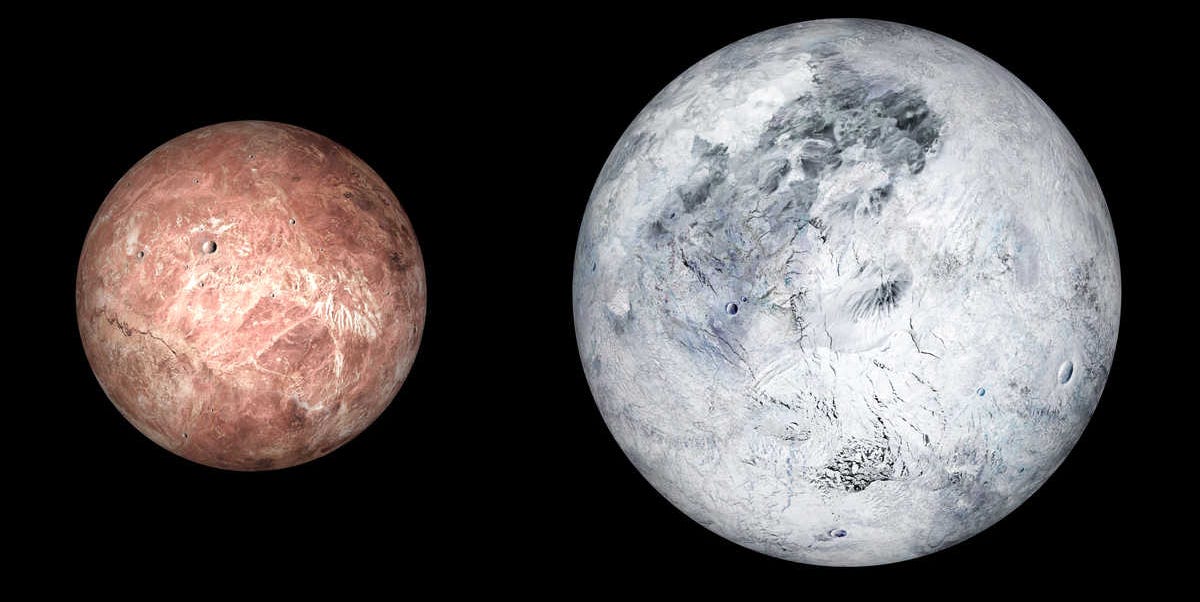
Pluto has spent decades acting like the lonely celebrity of the outer solar system: famous, photogenic, and still mildly offended about that 2006 reclassification. Yet farther into the cold, dim reaches beyond Neptune, two other dwarf planets may be guarding an even stranger secret. Eris and Makemakeworlds so distant that sunlight arrives as a weak, delayed whispershow chemical clues that their interiors may once have been, or may still be, surprisingly warm.
The most provocative possibility is that heat inside these icy bodies has supported geochemical reactions, cryovolcanic activity, and perhaps buried liquid-water oceans. That does not mean astronomers have photographed alien whales beneath Makemake’s crust. The evidence is indirect, the models are evolving, and rival explanations remain in play. Still, the idea that “frozen leftovers” can be active worlds has become one of planetary science’s most exciting reversals.
Meet Eris and Makemake, Pluto’s Distant Neighbors
Eris and Makemake belong to the population of trans-Neptunian objects in and around the Kuiper Belt, a broad, doughnut-shaped region beyond Neptune. The main belt begins near 30 astronomical units, or AU, from the Sun and extends to roughly 50 AU, while scattered objects can travel far beyond that boundary. An AU is the average Earth-Sun distance, so even the local neighborhood out there is aggressively spacious.
Eris: The Dwarf Planet That Started an Argument
Eris is roughly comparable in size to Pluto but more massive and denser. It orbits the Sun at an average distance of about 68 AU and requires approximately 557 Earth years to complete one revolution. Its moon, Dysnomia, helped astronomers estimate Eris’s mass. The discovery of Eris also intensified the debate that ultimately led to the modern dwarf-planet category, making its nameborrowed from the Greek goddess of discordalmost suspiciously perfect.
Makemake: Bright, Methane-Rich, and Not So Quiet
Makemake is smaller, with a diameter of roughly 890 miles, and circles the Sun at an average distance near 45.8 AU. Its bright surface is rich in frozen methane, and it has a small moon informally known as MK2. For years, Makemake looked like a polished cosmic snowball: reflective, frigid, and apparently inactive. James Webb Space Telescope observations have made that description much harder to defend.
What the James Webb Space Telescope Actually Detected
The breakthrough did not come from a close-up photograph. No spacecraft has visited Eris or Makemake. Instead, researchers used JWST’s Near-Infrared Spectrograph, or NIRSpec, to split reflected sunlight into wavelengths and identify subtle absorption features produced by surface chemicals. NIRSpec covers near-infrared wavelengths extending to approximately 5.3 microns, allowing it to detect molecular signatures that are difficult or impossible to measure with ordinary visible-light observations.
The spectra revealed methane ice containing uncommon isotopic forms. An isotope is a version of an element with a different number of neutrons. In this case, scientists measured methane containing deuterium, a heavy form of hydrogen, and methane containing carbon-13. These chemical variations work like tiny archival labels. Their ratios can preserve information about where a molecule formed and what processes altered it.
Researchers measured deuterium-to-hydrogen ratios in methane of about 2.5 × 10⁻⁴ on Eris and 2.9 × 10⁻⁴ on Makemake in the original analysis. Those values were lower than expected for methane assumed to have been preserved unchanged from primordial comet-like material. They were also similar to deuterium-to-hydrogen ratios found in water from several outer-solar-system reservoirs.
Why Methane Could Point to Warm Interiors
The 2024 geochemical interpretation proposed that hydrogen from internal water participated in reactions that generated methane. Under this scenario, Eris and Makemake either lost much of their original methane or never accumulated a large primordial supply. Later, heat-driven chemistry inside their rocky cores manufactured replacement methane.
That chemistry may require temperatures above roughly 150 degrees Celsius, astonishingly warm compared with surfaces that sit only a few dozen degrees above absolute zero. The likely heat source is radioactive decay in rock. Isotopes of elements such as uranium, thorium, and potassium release energy over immense spans of time. A sufficiently rock-rich body can therefore keep cooking internally even while its exterior impersonates a freezer abandoned at the edge of town.
Hydrothermal Methane
One proposed pathway is abiotic methane production. Water circulating through warm rock can react with carbon-bearing compounds and produce methane without biology. Similar water-rock chemistry is studied at hydrothermal systems on Earth, although the pressures, ingredients, and reaction pathways inside a dwarf planet would be different.
Thermogenic Methane
Another pathway involves heat altering complex organic material trapped in the interior. This thermogenic process could release methane as buried organics undergo metamorphic reactions. Again, “organic” does not automatically mean “alive.” In planetary science, organic chemistry includes carbon-rich molecules that can form without organisms.
Could Eris and Makemake Contain Hidden Oceans?
If their rocky interiors became warm enough to generate methane, water ice above those cores may also have melted. That creates the possibility of a layered structure: an outer shell of solid ice, a buried ocean or slushy liquid zone, and a rocky core below. Hydrothermal circulation at the ocean floor could then produce methane that later migrated upward.
How would that methane reach the surface? Cryovolcanism is one possibility. Instead of erupting molten rock, an icy world can vent water, ammonia, methane, or other volatile material. Fractures, slowly rising pockets of warm ice, or plume-like eruptions could transport internally produced compounds through the crust. Seasonal sublimation and condensation might then redistribute methane across the surface, keeping it bright and chemically refreshed.
A 2026 thermal-orbital study strengthened the ocean case for Eris. Models coupling Eris’s internal temperature history with the orbital evolution of Dysnomia found that a subsurface ocean made it easier to explain the system’s present spin and tidal behavior. Between 77% and 100% of successful model runs included an ocean under the tested assumptions. However, many models also predicted that the ocean would freeze by the present unless insulating layers or antifreeze compounds such as ammonia helped it survive.
A Major Scientific Caution: The Methane Story Is Debated
The internal-chemistry explanation is compelling, but it is not the only model that can fit the observations. A 2025 study used a time-dependent model of chemistry in the young solar nebula and concluded that the measured methane isotope ratios could be consistent with primordial methane after all. In that scenario, Eris and Makemake inherited methane in their original building blocks, possibly trapped as pure ice or inside cage-like water-ice structures called clathrates.
This disagreement is not a scientific failure. It is science functioning normally. JWST supplied precise new measurements; researchers then tested different histories against those measurements. The debate now centers on assumptions about early solar-system chemistry, isotope exchange, volatile loss, and internal evolution. Better spectra, improved laboratory data, and eventually spacecraft observations can narrow the options.
The responsible conclusion is therefore more interesting than a simple yes-or-no headline: Eris and Makemake contain methane whose history is unexpectedly informative. It may record hot internal chemistry, primordial preservation, or a combination of ancient inheritance and later processing. Each answer would change our understanding of how large icy bodies form and evolve.
Makemake Became Even More Interesting in 2025
Follow-up JWST work reported methane gas above Makemake, making it only the second trans-Neptunian object after Pluto with confirmed volatile release. Researchers detected fluorescence from methane molecules energized by sunlight. The signal could come from an extraordinarily thin atmosphere in equilibrium with surface methane ice, or from localized outgassing resembling a weak coma or plume.
The atmospheric interpretation suggests a surface pressure near 10 picobarsabout 100 billion times lower than Earth’s sea-level pressure. The plume interpretation allows methane production rates reaching hundreds of kilograms per second. Current data cannot cleanly distinguish between these scenarios, but either one makes Makemake more dynamic than the traditional picture of a dead, untouched relic.
This newer result does not prove a subsurface ocean. Surface ice can sublimate directly into gas when local temperatures and illumination permit. Yet active methane release provides another reason to investigate how Makemake stores, cycles, and replenishes volatile material.
Why These Dwarf Planets Matter Far Beyond Their Size
They Rewrite the Meaning of “Frozen”
Before spacecraft explored the outer solar system, small icy worlds were often treated as inert leftovers. New Horizons transformed Pluto into a complex world with mountains, flowing nitrogen ice, haze layers, and evidence consistent with a possible subsurface ocean. Studies of Eris and Makemake extend that lesson: low surface temperature does not guarantee a simple interior.
They Expand the Ocean-World Search
Europa and Enceladus remain leading ocean-world targets because strong evidence indicates liquid reservoirs beneath their crusts. Pluto and Ceres are also considered possible ocean worlds. If Eris retained liquid water, it would rank among the most distant plausible ocean environments in the solar system. Distance from the Sun matters less when internal radioactive heat, insulation, pressure, and antifreeze chemistry can delay freezing.
They Preserve the Solar System’s Chemical Memory
Whether the methane is primordial or internally manufactured, its isotopes record history. A primordial origin would help scientists reconstruct temperatures and chemical exchange in the planet-forming disk. An internal origin would reveal that dwarf planets underwent differentiation, water-rock reactions, and resurfacing. Either way, these bodies are not cosmic footnotes. They are evidence lockers.
Does a Hidden Ocean Mean Life?
No. Liquid water is important, but habitability also depends on energy, chemical ingredients, stability, and time. A buried ocean trapped between thick ice layers may have limited access to useful oxidants from the surface. An ocean that froze billions of years ago would tell a dramatic geological story without hosting anything today.
Methane is also not a biosignature by itself. It can form through nonbiological processes, especially where water and rock interact. The discovery matters because it points toward chemical activity and possible liquid environmentsnot because it constitutes evidence of organisms.
What Scientists Need Next
Higher-resolution JWST spectroscopy could refine isotope ratios, map methane and nitrogen more accurately, and test whether Makemake’s gas is a global atmosphere or localized plume. Stellar occultationsevents in which a dwarf planet passes in front of a distant starcan reveal thin atmospheres by measuring how starlight bends, dims, or changes color.
Thermal models also need better constraints on interior composition, ice viscosity, porosity, ammonia abundance, and the masses of these worlds. Makemake’s moon is especially valuable because a well-determined orbit can improve estimates of Makemake’s mass and density.
Ultimately, a spacecraft flyby would turn chemical hints into geology. Cameras could search for smooth young terrain, fractures, pits, deposits, or cryovolcanic structures. Spectrometers could map surface compounds, while radio science could probe mass distribution and internal structure. The journey would be long, but New Horizons already proved that distant flybys can repay decades of patience with revolutionary data.
The Experience of Following a Discovery at the Edge of the Solar System
There is a peculiar experience in learning about Eris and Makemake: almost everything important is invisible. Through an ordinary backyard telescope, neither world offers mountains, clouds, or a satisfying little disk. At best, a skilled observer with serious equipment records a point of light moving slowly against the stars. The human eye gets a dot; spectroscopy gets a geological thriller.
That gap changes how a person thinks about evidence. We are accustomed to believing what we can see directly. Planetary scientists often work differently. They read a missing wavelength, a slight shift in an absorption band, or the orbit of a moon. The result feels less like looking through a window and more like investigating a locked house by studying heat leaking under the door.
Following the Eris and Makemake story also teaches patience. Their orbital periods are measured in centuries, their seasons can outlast careers, and a mission proposal launched today might not return data until a new generation is running the laboratory. Nothing about these worlds matches the speed of an online headline. Even the “incredible secret” is not a single reveal. It is a chain of observations, models, rebuttals, and improved observations.
That can initially feel frustrating. One paper says internally produced methane may imply hot cores and possible oceans. Another demonstrates that primordial methane may explain the same isotope ratios. Then a newer Makemake spectrum detects gas and reopens questions about activity. The story refuses to sit still. Yet that uncertainty is exactly what makes the experience authentic. Science is not a vending machine where data goes in and certainty drops out with a cheerful clunk.
For students, amateur astronomers, and curious readers, these dwarf planets offer a useful exercise: separate observation from interpretation. The observation is that specific methane isotopologues and isotope ratios were measured. The interpretation is that those ratios may reflect interior chemistry or primordial formation. The observation is that methane gas was detected above Makemake. The interpretation is that it may form a tenuous atmosphere or emerge from localized outgassing. Keeping those layers separate makes the wonder stronger, not weaker.
There is also a humbling sense of scale. Sunlight takes more than nine hours to reach Eris at its average distance. A signal sent from a future spacecraft would crawl back across billions of miles before appearing on a monitor as numbers. Yet those numbers could tell us whether water remained liquid beneath ice in one of the coldest inhabitedor uninhabitedcorners of our cosmic neighborhood.
Perhaps the best experience this topic provides is a renewed suspicion of appearances. A world can look frozen and still have a warm history. A faint point can contain an ocean. A molecule can remember conditions billions of years old. Pluto is not lonely after all; it is simply the most famous member of a strange community whose stories are only beginning to come into focus.
Conclusion
Eris and Makemake are hiding something incredible, although scientists are still defining exactly what it is. JWST’s methane measurements opened a credible path toward warm interiors, hydrothermal or metamorphic chemistry, cryovolcanism, and buried oceans. Competing research shows that primordial methane remains a viable explanation, while newer observations of gas above Makemake demonstrate that at least one of these worlds is actively cycling volatile material today.
The lasting discovery is broader than any single ocean claim. The Kuiper Belt is not merely a museum of frozen debris. It is a population of chemically rich, evolving worlds where ancient heat, volatile ice, orbital dynamics, and deep time interact. Eris and Makemake may be cold enough to freeze almost anything, but they have already melted one old assumption: small worlds at the solar system’s edge are boring.
Note: The existence of present-day subsurface oceans on Eris and Makemake has not been directly confirmed. This article reflects peer-reviewed research and official scientific updates available through July 2026, including competing interpretations of the methane isotope data.














