Some childhood photos need no grand stage. No matching outfits. No studio lights. No tiny chair placed next to a fake cloud while a toddler negotiates with gravity. The most memorable images often happen outdoors, where a child’s hand rests on a dog’s head, a pony waits with patient eyes, and the whole scene feels like a small, honest poem.
“29 Heartfelt Photos Of Irish Traveler Kids Growing Up With Animals” is the kind of visual story that invites readers to slow down. The photo series, associated with photographer Michele Zousmer’s work documenting Irish Traveller communities, focuses on children whose everyday lives are deeply connected with animals: dogs, ponies, horses, and the living world around them. These are not glossy lifestyle images designed to sell a fantasy. They are portraits of childhood, belonging, resilience, and the quiet language shared between children and animals.
For American readers, the title may use “Irish Traveler,” but the community is commonly referred to as Irish Travellers in Ireland and the United Kingdom. They are a distinct ethnic minority with their own traditions, family structures, language heritage, and long history. Any article about them should avoid turning real people into a curiosity cabinet. These photos work best when viewed not as “look how different they are,” but as “look how deeply human this is.”
Why These Photos Feel So Powerful
The emotional pull of these 29 photos comes from a simple truth: children and animals understand each other before adults finish overexplaining everything. A child does not need a lecture on loyalty to understand a dog that follows them around. A pony does not care about social status, housing debates, online arguments, or whether a camera is expensive enough to impress photography people at dinner parties.
In many of the images, the animals are not props. They appear as companions, playmates, teachers, and sometimes tiny chaos machines with paws or hooves. A child holding a puppy becomes a picture of tenderness. A young rider near a pony becomes a picture of confidence. A group of kids playing beside animals becomes a scene of community life, where growing up includes responsibility, risk, affection, and plenty of mud. Mud, as every parent knows, is childhood’s unofficial signature.
Who Are Irish Travellers?
Irish Travellers are an indigenous minority group historically associated with nomadism, close kinship networks, trading, music, storytelling, and strong family identity. Their culture has often been misunderstood by settled society, and many Traveller families have faced discrimination in housing, education, employment, and public life. In 2017, Ireland formally recognized Travellers as a distinct ethnic group, an important step that acknowledged what Traveller advocates had long said: this is not merely a lifestyle, but a culture and identity.
Traveller history is complex. Older stereotypes often reduced the community to roadside camps or horse fairs, but that narrow view misses the richness of family life, oral tradition, craftsmanship, religious devotion, and survival through social exclusion. Like any community, Irish Travellers are not one single story. They include families with different experiences, different levels of mobility, different relationships to tradition, and different hopes for the next generation.
That is why photography can be both powerful and risky. A camera can humanize, but it can also flatten. The best documentary work does not shout, “Look at these people.” It whispers, “Look with care.” Michele Zousmer’s images are most meaningful when approached through that second lens.
The Animal Connection: More Than Cute Photos
Yes, the photos are adorable. There are children with dogs, children with ponies, children surrounded by the sort of outdoor freedom that makes indoor screen time look like a very boring sandwich. But the deeper story is about how animals fit into Traveller life.
Horses have long held cultural importance for Irish Travellers. Historically, horses helped make mobility possible. They were used for travel, trade, work, fairs, and family livelihood. Horse-drawn wagons became one of the best-known symbols associated with Traveller culture. Even as modern vehicles and changing laws reshaped Traveller life, horses remained deeply meaningful for many families.
For Traveller children, animals can become part of growing up in a direct, hands-on way. A pony is not just something seen through a fence at a farm-themed birthday party. A dog is not just a “pet content” accessory for social media. Animals may be woven into daily routines: feeding, grooming, watching, playing, and learning boundaries. Anyone who has ever been gently humbled by a stubborn pony knows that animals teach patience faster than most adults can say, “Use your listening ears.”
What the 29 Photos Reveal About Childhood
The collection captures childhood in motion. Some images suggest wild confidence; others show softness. A child might stand proudly beside an animal almost as big as a small car. Another may cradle a puppy with the seriousness of a royal guard protecting treasure. These contrasts are what make the series memorable.
1. Freedom Without Pretending Life Is Easy
The photos often show open spaces, caravans, fields, animals, and children moving through the world with independence. That freedom is visually beautiful, but it should not be romanticized into a fairy tale. Traveller communities have faced real hardship, including prejudice and limited access to resources. A child running freely in a field can be joyful and still belong to a community dealing with serious social barriers.
2. Responsibility Arrives Early
Children who grow up around animals often learn responsibility in practical ways. Food must be given. Water must be checked. Animals must be handled calmly. A pony does not care that a child is “not in the mood.” It still needs care. In Traveller families where horses and dogs are part of daily life, children may learn early that love is not just a feeling. It is a chore list with fur on it.
3. Animals Become Emotional Anchors
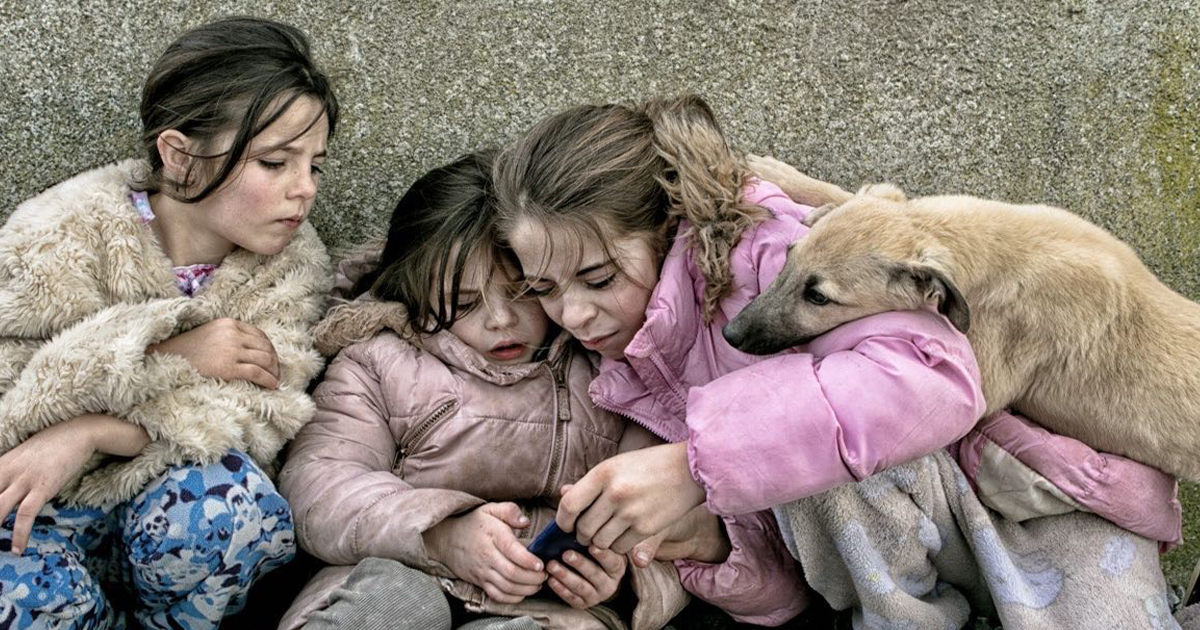
Child development experts often note that positive relationships with animals can support empathy, confidence, nonverbal communication, and emotional comfort. In these photos, that idea becomes visible. A child leaning into a dog, holding a puppy, or standing close to a horse shows a kind of trust that does not need translation. Animals can become safe listeners, steady friends, and quiet witnesses to childhood.
Horses, Dogs, and the Culture of Care
One of the strongest themes in Irish Traveller animal culture is the relationship with horses. Horse fairs, including long-established fairs such as Ballinasloe, have historically been important gathering places where families meet, trade, socialize, and maintain tradition. For children, these events can be more than markets. They are living classrooms where identity, skill, family reputation, and community memory are passed down.
Dogs also appear as close companions in many Traveller childhood images. They fit naturally into outdoor family life: running beside children, guarding spaces, joining games, and occasionally looking into the camera as if they understand documentary photography better than the rest of us. Dogs bring warmth to the images because they make intimacy visible. A child with a dog rarely looks completely alone.
Still, the best reading of these photos is not “animals make everything perfect.” Animals require proper care, safe handling, and adult guidance. The heartwarming part is not merely that children are near animals. It is that many images suggest relationships: eye contact, touch, familiarity, and shared space. That is where the magic lives.
Seeing Irish Traveler Kids Without Stereotypes
The phrase Irish Traveler kids may attract search traffic, but the children in these photographs should never be treated as search-engine objects. They are real children from a real community. That matters. Too often, minority communities are photographed through extremes: poverty, conflict, exoticism, or spectacle. A more respectful approach recognizes ordinary beauty.
These children laugh, pose, play, care for animals, test boundaries, show pride, get dusty, and carry themselves with a confidence that many adults spend half their lives trying to rediscover. The photos invite viewers to notice dignity rather than difference. They also challenge the comfortable assumption that a “good childhood” must look the same everywhere.
For some families, childhood is organized around scheduled activities, school pickups, tablets, and soccer snacks in tiny plastic bags. For Traveller children in these images, childhood may be more visibly connected to animals, extended family, outdoor spaces, and tradition. Neither version is automatically simple. Both contain love, stress, rules, laughter, and someone somewhere asking, “Where are your shoes?”
Why Photo Essays Like This Matter
A photo essay can do what statistics cannot. Data can tell us that a community faces discrimination. A portrait can make us care about the person living inside that sentence. When a photographer spends years building trust, the resulting images may offer access to moments outsiders rarely see.
That trust is especially important with Irish Travellers, who have often been misrepresented. A respectful photographer must do more than arrive, shoot, and leave with dramatic images. The work depends on relationship: being welcomed, returning, listening, and showing people with complexity. The strongest images in a project like this feel collaborative, not stolen.
For readers, the responsibility is similar. We should not consume the photos as if they are charming decorations from someone else’s life. We should ask what they reveal about family, culture, inequality, joy, and the way children find companionship in animals even when adult society makes life complicated.
Lessons From Children Growing Up With Animals
There is a reason the child-animal bond appears again and again in art, literature, and family albums. Animals help children practice gentleness. They teach patience because they do not respond well to shouting, grabbing, or rushing. They teach courage because a horse is large, a dog has moods, and even a tiny puppy can produce a surprisingly large amount of trouble.
These photos show several lessons that travel beyond one culture:
- Compassion is learned through practice. Feeding, brushing, comforting, and respecting animals can help children understand care as action.
- Confidence grows through responsibility. A child trusted with age-appropriate animal care often stands a little taller.
- Nature gives childhood texture. Grass, mud, weather, and animals create memories no app can fully imitate.
- Belonging is built in relationships. Children bond not only with parents and siblings, but also with animals that share their everyday world.
The Beauty of Imperfect, Honest Childhood
The charm of 29 heartfelt photos of Irish Traveler kids growing up with animals is that the images do not seem overly polished. Their beauty comes from honesty. Children are not presented as miniature adults wrapped in perfection. They are tough and tender, playful and proud, watchful and wild. The animals add another layer of truth: life is alive, unpredictable, and occasionally covered in hay.
That imperfection is the point. Childhood does not need to be sanitized to be meaningful. A child with muddy boots, a windblown face, and a dog pressed against their side may tell us more about belonging than a flawless studio portrait ever could. These images remind us that love often looks ordinary while it is happening.
Experience Notes: What This Topic Brings to Mind
Anyone who has spent time watching children around animals knows there is a special rhythm to it. First comes fascination. A child sees a dog, pony, chicken, cat, goat, or any creature with enough personality to qualify as a family member, and suddenly the world narrows to that single living being. Adults may be discussing schedules, bills, or where someone left the car keys. The child is focused on one question: “Will it let me come closer?”
That moment is full of learning. The child studies movement, sound, mood, and distance. Is the dog relaxed? Is the pony calm? Does the animal want attention or space? Without calling it emotional intelligence, the child begins practicing it. They learn that love cannot be forced. They learn that gentleness matters. They learn that another living creature has needs separate from their own. That is a huge lesson, especially for a small person who may still believe the moon follows the family car home every night.
In the context of Irish Traveller children, this bond feels even more layered because animals are not simply cute companions. They connect to heritage, family memory, and practical skill. A child standing beside a horse may be standing beside generations of knowledge. How to hold a lead. How to read ears and eyes. How to move without startling. How to take pride in an animal’s strength and beauty. These are not lessons from a textbook. They are learned through hands, weather, repetition, and watching older family members.
The photos also remind us how different childhood can look depending on culture. In many modern households, children are surrounded by soft furniture, scheduled lessons, and digital entertainment. In these images, the atmosphere feels more physical. Children lean, climb, hold, run, and stand in close contact with animals and land. That does not mean their lives are easier. It means their childhood is shaped by different textures: grass instead of carpet, hooves instead of headphones, family tradition instead of carefully curated extracurricular branding.
There is also a quiet emotional lesson for adult viewers. We often talk about marginalized communities through problems first. We mention poverty, discrimination, housing, schooling, and social tension. Those issues are real and should not be ignored. But if we only look through hardship, we miss joy. We miss style, humor, pride, tenderness, and the small daily victories that make people more than the challenges they face. A child laughing beside a dog is not a statistic. A girl holding a puppy is not a policy debate. A boy with a pony is not a stereotype. These are human moments, and they deserve to be seen with respect.
That is the lasting experience of this topic: it softens the viewer without simplifying the subject. The animals draw us in because they are warm, familiar, and emotionally easy to understand. Then the children hold our attention because they are vivid, confident, and fully themselves. The result is a photo story that feels heartfelt not because it is sentimental, but because it is alive.
Conclusion
“29 Heartfelt Photos Of Irish Traveler Kids Growing Up With Animals” is more than a sweet collection of children with dogs and ponies. It is a window into a community where animals, family, tradition, and childhood intersect. The photos encourage viewers to appreciate Irish Traveller children not as symbols or stereotypes, but as young people full of personality, pride, affection, and resilience.
The strongest message is simple: animals have a way of revealing the emotional truth of childhood. They show trust, responsibility, courage, and tenderness without making a speech about it. In these images, a dog’s steady presence or a pony’s patient stance helps us see what every child deserves: connection, dignity, and room to grow.
Note: This article was written from synthesized research on Irish Traveller culture, documentary photography, Traveller horse traditions, animal welfare context, and child-animal development. It is fully rewritten in original language for web publication.