
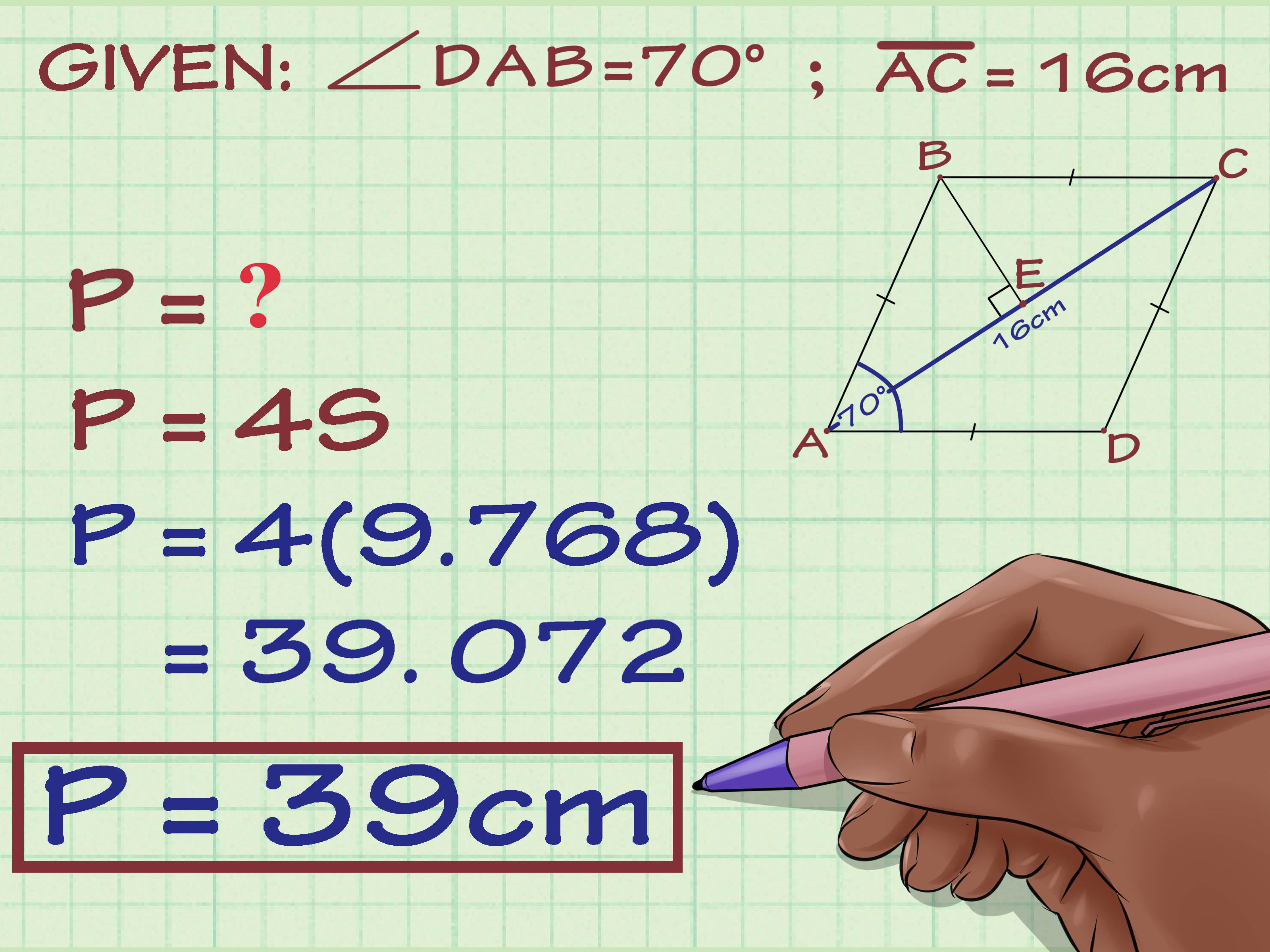
Finding the perimeter of a rhombus sounds like one of those math tasks that should require a wizard hat, a dusty chalkboard, and maybe a dramatic thunderclap. Fortunately, it is much friendlier than that. A rhombus is a four-sided shape where all sides are equal, which means its perimeter often comes down to one beautifully simple idea: find one side, then multiply by four.
Of course, math teachers rarely hand over the side length with a smile and a cookie. Sometimes you get diagonals. Sometimes you get coordinates. Sometimes you get a word problem that looks like it was written by someone who enjoys watching students squint. That is why knowing more than one method matters. In this guide, we will walk through three reliable ways to find the perimeter of a rhombus, complete with formulas, examples, common mistakes, and practical tips.
By the end, you will know how to calculate rhombus perimeter when you are given a side length, when you are given both diagonals, and when the rhombus appears on a coordinate plane. No panic. No guesswork. Just clean geometry with a little personality.
What Is a Rhombus?
A rhombus is a quadrilateral, meaning it has four sides. What makes it special is that all four sides are the same length. You can think of it as a “diamond-shaped” figure, although a rhombus does not have to be standing on one point like a playing-card diamond. It can be tilted, stretched, or even look like a square.
Yes, a square is technically a special type of rhombus because it has four equal sides. The difference is that a square also has four right angles, while a general rhombus may have two sharp angles and two wide angles. A rhombus is also a type of parallelogram, so its opposite sides are parallel and its opposite angles are equal.
Important Rhombus Properties
Before jumping into formulas, it helps to remember a few key properties:
- All four sides are equal in length.
- Opposite sides are parallel.
- Opposite angles are equal.
- Adjacent angles add up to 180 degrees.
- The diagonals bisect each other at right angles.
- The diagonals create four right triangles inside the rhombus.
That last point is especially useful. When diagonals are involved, the rhombus quietly turns into a Pythagorean theorem problem wearing a geometry costume.
What Does Perimeter Mean?
The perimeter of any polygon is the total distance around the outside of the shape. Imagine walking along the border of the rhombus. The distance you walk from one corner all the way around and back to the starting point is the perimeter.
Since a rhombus has four equal sides, its perimeter is easier than the perimeter of many other quadrilaterals. Instead of adding four different measurements, you can find one side and multiply it by four.
The basic formula is:
Perimeter of a rhombus = 4 × side length
In formula form:
P = 4s
Here, P means perimeter, and s means the length of one side.
Way 1: Find the Perimeter Using the Side Length
This is the fastest and most common method. If the problem gives you the length of one side of the rhombus, you are almost finished before you start. Since all four sides are equal, multiply the given side length by four.
Formula
P = 4s
Where:
- P = perimeter
- s = side length
Example 1: Simple Side Length
A rhombus has a side length of 9 inches. Find its perimeter.
Step 1: Write the formula.
P = 4s
Step 2: Substitute the side length.
P = 4 × 9
Step 3: Multiply.
P = 36
Answer: The perimeter is 36 inches.
Example 2: Decimal Side Length
A rhombus has a side length of 6.5 centimeters. Find the perimeter.
P = 4 × 6.5 = 26
Answer: The perimeter is 26 centimeters.
Why This Method Works
In a rectangle, you usually need length and width. In a random quadrilateral, you may need all four side lengths. But a rhombus gives you a shortcut because every side matches. Once you know one side, you know all four.
This method is perfect for basic homework problems, construction measurements, craft projects, tile layouts, and test questions where the side is clearly labeled.
Way 2: Find the Perimeter Using the Diagonals
Sometimes a problem gives you the two diagonals of a rhombus instead of the side length. This looks more complicated, but it is still manageable because the diagonals of a rhombus bisect each other at right angles.
That means each diagonal is split into two equal halves, and those halves form the legs of a right triangle. The side of the rhombus becomes the hypotenuse of that triangle.
Formula
If the diagonals are d1 and d2, the perimeter can be found with:
P = 2√(d1² + d2²)
This formula comes from the Pythagorean theorem. Another way to write the process is:
s = √((d1/2)² + (d2/2)²)
Then:
P = 4s
Both methods give the same result. The second version is easier to understand step by step, while the first version is faster once you are comfortable.
Example 1: Diagonals of 12 cm and 16 cm
A rhombus has diagonals of 12 centimeters and 16 centimeters. Find its perimeter.
Step 1: Cut each diagonal in half.
12 ÷ 2 = 6
16 ÷ 2 = 8
Step 2: Use the Pythagorean theorem to find the side.
s² = 6² + 8²
s² = 36 + 64
s² = 100
s = 10
Step 3: Multiply the side length by four.
P = 4 × 10 = 40
Answer: The perimeter is 40 centimeters.
Example 2: Diagonals of 10 ft and 24 ft
A rhombus has diagonals measuring 10 feet and 24 feet. Find the perimeter.
Step 1: Halve the diagonals.
10 ÷ 2 = 5
24 ÷ 2 = 12
Step 2: Find the side length.
s² = 5² + 12²
s² = 25 + 144
s² = 169
s = 13
Step 3: Find the perimeter.
P = 4 × 13 = 52
Answer: The perimeter is 52 feet.
Why the Diagonal Method Is Useful
This method is common in geometry because it connects rhombus properties with right triangles. It also helps students practice the Pythagorean theorem in a real shape instead of in a lonely triangle floating on a worksheet.
The biggest thing to remember is that you do not use the full diagonals as the legs of the triangle. You use half of each diagonal. Forgetting to divide by two is the classic rhombus mistake, right up there with writing “units squared” for perimeter. Perimeter uses regular linear units, such as inches, feet, meters, or centimeters.
Way 3: Find the Perimeter Using Coordinates
The third method appears when a rhombus is drawn on a coordinate plane. Instead of giving you a side length or diagonals directly, the problem gives you points such as A(1, 2), B(5, 5), C(9, 2), and D(5, -1).
Your mission is to find the length of one side using the distance formula. Once you find one side, multiply by four.
Distance Formula
To find the distance between two points, use:
d = √((x2 – x1)² + (y2 – y1)²)
For a rhombus, that distance becomes the side length.
Example: Coordinate Plane Rhombus
Suppose one side of a rhombus goes from A(2, 1) to B(8, 9). Find the perimeter.
Step 1: Identify the coordinates.
A(2, 1), B(8, 9)
Step 2: Use the distance formula.
s = √((8 – 2)² + (9 – 1)²)
s = √(6² + 8²)
s = √(36 + 64)
s = √100
s = 10
Step 3: Multiply by four.
P = 4 × 10 = 40
Answer: The perimeter is 40 units.
When to Use the Coordinate Method
Use this method when the rhombus is placed on a graph or when the problem gives ordered pairs. You do not need to calculate the length of every side if the figure is truly a rhombus. One side is enough. However, if a problem asks you to prove that a quadrilateral is a rhombus, then you may need to check all four side lengths or use diagonal properties.
Quick Comparison of the 3 Methods
| Method | Use It When You Know | Main Formula |
|---|---|---|
| Side Length | One side of the rhombus | P = 4s |
| Diagonals | Both diagonals | P = 2√(d1² + d2²) |
| Coordinates | Two adjacent vertices | P = 4√((x2 – x1)² + (y2 – y1)²) |
Common Mistakes When Finding Rhombus Perimeter
Mistake 1: Confusing Area and Perimeter
Area measures the space inside a shape. Perimeter measures the distance around it. If your answer is in square units, such as square inches or square meters, you are probably finding area, not perimeter.
Mistake 2: Using Both Diagonals as Full Triangle Legs
When using diagonals, remember that they bisect each other. The right triangle inside the rhombus uses half of each diagonal, not the full lengths.
Mistake 3: Treating a Rhombus Like a Rectangle
A rhombus is not usually solved with 2(length + width). That formula belongs to rectangles and some parallelograms with two pairs of equal opposite sides. A rhombus has four equal sides, so the perimeter is 4 times one side.
Mistake 4: Forgetting the Units
A correct number without a unit is like a sandwich without bread. Technically something is there, but it feels unfinished. If the side length is in centimeters, the perimeter is in centimeters. If the graph uses units, the perimeter is in units.
Practice Problems
Problem 1
A rhombus has a side length of 14 meters. What is the perimeter?
Solution: P = 4 × 14 = 56 meters.
Problem 2
A rhombus has diagonals of 18 inches and 24 inches. What is the perimeter?
Solution: Half of 18 is 9, and half of 24 is 12. The side is √(9² + 12²) = √225 = 15. The perimeter is 4 × 15 = 60 inches.
Problem 3
One side of a rhombus has endpoints (3, 4) and (9, 12). What is the perimeter?
Solution: The side length is √((9 – 3)² + (12 – 4)²) = √(6² + 8²) = 10. The perimeter is 4 × 10 = 40 units.
Real-Life Uses of Rhombus Perimeter
You may not wake up every morning whispering, “Today I shall calculate a rhombus perimeter.” Fair. But this concept appears more often than people expect. Rhombus-like shapes show up in tile designs, garden layouts, quilting patterns, jewelry design, architecture, logos, road signs, and decorative borders.
If you are planning a diamond-shaped garden bed and want to place edging around it, you need the perimeter. If you are designing a quilt block and need fabric trim around a rhombus pattern, you need the perimeter. If you are creating a geometric logo and want a border, outline, or frame, perimeter tells you the total length around the shape.
In short, perimeter is not just a classroom idea. It is a measurement tool. It tells you how much material is needed to go around something.
Experiences and Practical Tips for Learning the Perimeter of a Rhombus
One of the best ways to understand the perimeter of a rhombus is to stop treating it like a mysterious geometry object and start treating it like a shape you can actually touch. Draw one on paper. Use four equal pencils or craft sticks and tilt them into a diamond shape. The moment you see that all four sides stay equal, the formula P = 4s becomes much more obvious. You are not memorizing a rule out of nowhere; you are simply adding the same side four times.
A helpful classroom experience is to compare a rhombus with a square. Students often think a square and a rhombus are totally separate creatures, like a dog and a toaster. But a square is a special rhombus with right angles. Once that clicks, perimeter becomes easier. If a square with side 7 has a perimeter of 28, then a tilted rhombus with side 7 also has a perimeter of 28. The angles may change, but the side lengths control the perimeter.
Another useful learning trick is to create a “given information checklist.” Before solving, ask: Do I have a side? Do I have diagonals? Do I have coordinates? This quick check prevents formula confusion. If you have a side, use P = 4s. If you have diagonals, halve them and use the Pythagorean theorem. If you have points on a graph, use the distance formula first. Choosing the right method is half the battle; the other half is not dropping a negative sign like it is a hot potato.
When working with diagonals, many students improve by drawing the diagonals inside the rhombus and marking the halves. This simple visual step prevents the most common error: using the full diagonal lengths in the right triangle. The diagonals cross in the middle, and each one is split into two equal parts. Once those halves are marked, the side of the rhombus clearly becomes the hypotenuse.
For coordinate problems, graphing the points can save a lot of confusion. Even a rough sketch helps you see which vertices are adjacent. You need the distance between two neighboring corners, not opposite corners. Accidentally using opposite corners may give you a diagonal instead of a side, and then your perimeter will head off into the mathematical wilderness.
It also helps to estimate before calculating. If one side of a rhombus is about 10 units, the perimeter should be about 40 units. If your answer comes out as 400 or 4, pause and check your work. Estimation is like a built-in smoke alarm for math mistakes. It will not solve the problem for you, but it can warn you when something smells suspicious.
Finally, practice with mixed problems. Do not solve ten side-length problems in a row and assume you have mastered everything. Mix side lengths, diagonals, and coordinates. This builds flexibility. Real tests often ask the same concept in different disguises, and the student who recognizes the disguise wins the round.
Conclusion
Finding the perimeter of a rhombus is straightforward once you understand what information the problem gives you. If you know one side, multiply it by four. If you know the diagonals, use their halves to create a right triangle and apply the Pythagorean theorem. If you have coordinates, find one side with the distance formula and multiply by four.
The secret is not memorizing three random tricks. The secret is understanding that every method is trying to uncover the same thing: the length of one side. Once you have that side, the rhombus does the rest of the work for you. Four equal sides, one neat perimeter, and absolutely no wizard hat required.
Note: This article is written for web publication and is based on standard geometry concepts used by reputable educational references. It avoids unnecessary source-code elements and keeps the HTML limited to the body content for easy copying.














