English is a language that can place a knight at night, let someone sell a sail, and make a baker flower the counter with flour. It is wonderfully expressive, historically rich, and occasionally determined to make everyone look as though they skipped third-grade spelling.
That comic potential inspired illustrator Bruce Worden’s Homophones, Weakly, a project that transforms easily confused words into simple visual jokes. Worden, described as a scientific illustrator and comic creator, spent about five years building roughly 300 sets of homophone illustrations. The project became popular because each drawing turns an abstract spelling distinction into a tiny, memorable scene.
The following guide explores 40 “same-sounding” words through original visual concepts, plain-English definitions, examples, and memory tricks. No dusty grammar lecture is required. Bring only your imaginationand perhaps a healthy suspicion of silent letters.
Why Do These “Same” Words Cause So Much Confusion?
A homophone is a word pronounced like another word but carrying a different meaning, spelling, or origin. Sea and see, for example, sound alike but perform completely different jobs. A homograph has the same spelling as another word but a different meaning or pronunciation, while homonym is a broader term that may refer to words sharing a sound, spelling, or both.
Homophones are especially sneaky because spell-checking software may not flag them. “The knight rode through the night” contains two correctly spelled words, so the computer cheerfully approves while you quietly question who designed English.
Visual explanations can help because they connect a written distinction with a concrete picture. This combination of words and meaningful images resembles dual coding, a learning approach that uses verbal and visual representations together. The picture should support the idea rather than merely decorate it; otherwise, the learner remembers the joke but forgets which spelling paid for dinner.
40 Clever Homophone Illustrations You Can Picture Immediately
Everyday Homophones That Hide in Plain Sight
- Sale and Sail: A sale offers goods at reduced prices, while a sail catches wind on a boat. Imagine a sailboat displaying a giant “50% Off” banner and drifting toward the clearance aisle.
- Beat and Beet: To beat means to strike, mix vigorously, or defeat. A beet is a root vegetable. Picture a beet wearing boxing gloves and declaring itself the undefeated champion of the produce department.
- Brake and Break: A brake slows a vehicle; to break is to damage, separate, or interrupt something. The perfect illustration is a car brake snapping in halffunny on paper, less delightful on the highway.
- Flower and Flour: A flower blooms on a plant, while flour is used in baking. Imagine a bouquet made from bread rolls, with a baker carefully watering the baguettes.
- Which and Witch: Which asks someone to choose; a witch is a magical figure from folklore. Picture a witch holding two broomsticks and asking, “Which witchy ride has better mileage?”
- Wine and Whine: Wine is a fermented drink; to whine is to complain in an irritating manner. Imagine a wineglass grumbling that the cheese plate arrived three minutes late.
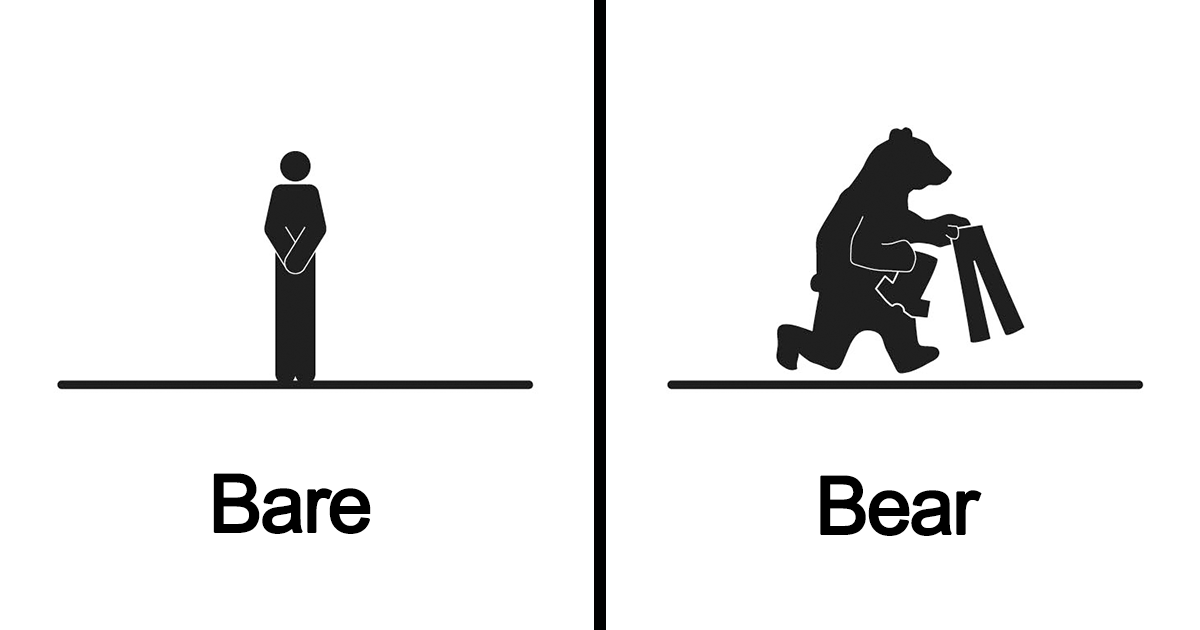
- Bear and Bare: A bear is a large mammal or the act of carrying something; bare means uncovered. A bare bear wearing nothing but a strategically positioned picnic basket makes the difference difficult to forget.
- Hole and Whole: A hole is an opening or empty space; whole means complete. Picture a doughnut proudly claiming to be whole while everyone stares at the obvious problem in its center.
- Stair and Stare: A stair is a step in a staircase; to stare means to look fixedly. Imagine a staircase with enormous eyes watching everyone climb. Suddenly taking the elevator seems reasonable.
- Weather and Whether: Weather describes atmospheric conditions; whether introduces alternatives. Picture a meteorologist asking whether the weather plans to rain, snow, or continue being dramatically undecided.
These pairs follow standard American English dictionary distinctions, although the funniest illustrations are naturally much less serious than the definitions.
Places, Objects, and People That Sound Suspiciously Alike
- Aisle, Isle, and I’ll: An aisle is a passage between rows, an isle is an island, and I’ll means “I will.” Imagine someone announcing, “I’ll walk down the aisle on an isle,” while a confused wedding planner checks the ferry schedule.
- Plain and Plane: A plain may be undecorated or a broad area of flat land. A plane is an aircraft or a flat surface. Picture a completely undecorated airplane flying over a grassy plain: no logo, no snacks, no personality.
- Stationary and Stationery: Stationary means not moving, whereas stationery refers to writing materials. Remember that stationery contains an e for envelope. An unmoving envelope makes the visual lesson complete.
- Principal and Principle: A principal may lead a school or represent the main person or amount. A principle is a rule or belief. The classic memory trick is that the school principal is your “pal,” at least until report cards appear.
- Council and Counsel: A council is a group that meets to discuss or govern. Counsel means advice or an adviser, especially a lawyer. Imagine a city council receiving legal counsel from an attorney whose briefcase is larger than the conference table.
- Role and Roll: A role is a function or character; a roll may turn over, describe a list, or name a small loaf. Picture an actor playing the role of a dinner roll. Critics call the performance surprisingly crusty.
- Palate, Palette, and Pallet: Your palate relates to the roof of your mouth or sense of taste. A palette holds an artist’s colors. A pallet supports goods. Imagine a chef tasting paint from a palette while standing on a warehouse pallet. Do not attempt this memory device literally.
- Pedal and Peddle: A pedal is operated with the foot; to peddle means to sell goods. Picture a traveling merchant pedaling a bicycle while peddling bicycle pedals. His business plan has excellent thematic consistency.
- Miner and Minor: A miner works underground extracting resources. A minor is someone below legal adulthood or something comparatively small. Imagine a very young miner being told that both definitions apply to him.
- Medal and Meddle: A medal is an award; to meddle means to interfere. Picture someone interrupting a championship ceremony to rearrange every medal. That person wins first place in unnecessary involvement.
Commonly confused-word references repeatedly emphasize that contextnot sound alonedetermines the correct spelling.
Words That Can Change an Entire Sentence
- Allowed and Aloud: Allowed means permitted; aloud means spoken audibly. “Reading aloud is allowed” is both a useful example and the beginning of a librarian’s least favorite rebellion.
- Cite, Site, and Sight: To cite is to quote or mention a source. A site is a location. Sight concerns seeing. Imagine a researcher citing a website about a beautiful construction site that is quite a sight.
- Peace and Piece: Peace means calm or the absence of conflict. A piece is a portion. Picture two siblings signing a peace treaty over the final piece of cake. The agreement lasts until someone notices the unequal frosting.
- Right, Write, and Rite: Right can mean correct, proper, or a direction. Write means to form words. A rite is a ceremonial act. Imagine a writer turning right while documenting a riteand still missing the exit.
- Rain, Reign, and Rein: Rain falls from clouds. A monarch may reign. A rein controls a horse. Picture a king riding through heavy rain and pulling the reins while announcing that his reign needs better weather.
- Coarse and Course: Coarse means rough or crude. A course may be a route, class, or part of a meal. Imagine a waiter serving a very coarse first course made entirely from sandpaper-shaped crackers.
- Complement and Compliment: A complement completes or enhances something. A compliment expresses praise. “That sauce complements your meal” discusses compatibility; “Your meal looks wonderful” is the compliment.
- Fair and Fare: Fair may mean just, moderately good, or a public event. Fare can mean a transportation charge or food. Picture a taxi driver taking passengers to a county fair and charging a completely fair fare.
- Serial and Cereal: Serial describes something occurring in a series. Cereal is a breakfast food. Imagine a detective investigating a serial cereal thief who leaves one suspicious oat flake at every scene.
- Scene and Seen: A scene is a location, event, or section of a performance. Seen is the past participle of see. “I have seen that scene” sounds repetitive but is perfectly correct.
English usage guides often group both exact homophones and closely resembling words under the practical label “commonly confused words.” The essential question remains the same: Which meaning fits the sentence?
Classic Homophones Worth Memorizing Forever
- Sea and See: The sea is a large body of salt water; to see means to perceive visually. Picture an enormous eye floating in the ocean and announcing, “Now I seasorry, seethe problem.”
- Son and Sun: A son is a male child; the sun is the star at the center of our solar system. Imagine a proud parent telling everyone that their son is the center of the universe. The illustration practically draws itself.
- Pair, Pear, and Pare: A pair contains two matching things. A pear is a fruit. To pare means to trim or peel. Picture someone paring a pear before placing it beside another pear to create a pair.
- Here and Hear: Here refers to a location; hear means to perceive sound. Imagine a giant ear shouting, “I’m here!” The spelling with an ear insidehearoffers an easy memory clue.
- Heel and Heal: A heel is the back of the foot; to heal means to recover. Picture a bandaged heel attending physical therapy and wearing a sticker that says, “Currently healing.”
- Hoard and Horde: A hoard is a hidden or accumulated supply. A horde is a large crowd. Imagine a horde of squirrels guarding a hoard of acorns with tiny clipboards and very serious expressions.
- Pore and Pour: To pore over something is to study it carefully; to pour is to make liquid flow. Picture a student poring over a book while someone pours coffee directly onto the chapter. Concentration has limits.
- Pray and Prey: To pray is to address a deity or express a strong hope. Prey is an animal hunted by another. Imagine a nervous rabbit praying not to become a fox’s prey.
- Knight and Night: A knight is a warrior or honorary title; night is the period of darkness. Picture a knight wearing pajamas over his armor and preparing for a well-defended night’s sleep.
- Waist and Waste: The waist is the middle part of the body. To waste something is to use it carelessly. Imagine someone tying discarded wrapping paper around their waist because they refuse to waste it.
Many of these pairs appear in major dictionaries and American grammar references precisely because correct spelling depends on meaning rather than pronunciation.
How to Stop Confusing Homophones
Turn Each Pair Into a Ridiculous Picture
The stranger the image, the more distinctive the memory cue can become. A normal beet sitting quietly in a bowl is forgettable. A beet defeating a drummer in a musical boxing match is harder to lose. Connect both spellings to one exaggerated scene and mentally label each object.
Test the Meaning, Not the Sound
When two words sound identical, listening harder will not solve the problem. Replace the questionable word with its definition. If “The driver stepped on the break” becomes “The driver stepped on the act of damaging something,” the sentence exposes the error immediately.
Use Built-In Spelling Clues
Look for smaller words hiding inside larger ones:
- Hear contains ear.
- There contains here, suggesting place.
- Stationery contains an e for envelope.
- A school principal can be your pal.
Proofread Without Trusting Autocorrect
Grammar tools can catch many errors, but a correctly spelled homophone may pass unnoticed. Read slowly, inspect words according to their meaning, and review sentences aloud. University writing guidance also recommends using dictionaries, editing checklists, and focused proofreading instead of assuming an automated spell-check has understood the writer’s intention.
Practice With Complete Sentences
Flash cards that show only “sale/sail” may teach the definitions, but sentences teach decisions. Compare “The store announced a sale” with “The storm tore the sail.” Context forces the brain to retrieve meaning, spelling, and grammar together.
A Relatable Experience: When Homophones Start Following You Everywhere
Learning commonly confused words often begins with embarrassment. Someone writes a perfectly confident message such as, “Your going to love this,” presses Send, and notices the mistake exactly one second later. Before sending, the sentence looked polished. After sending, the incorrect your appears to be forty feet tall, flashing under a spotlight while a tiny grammar judge bangs a gavel.
The next stage is overcorrection. Once a person learns that you’re means “you are,” every use of your suddenly becomes suspicious. The writer pauses over “your phone,” silently tests “you are phone,” and feels an unreasonable surge of triumph. It is a small victory, but language learning is built from many small victories wearing ordinary clothes.
Visual associations make the process more entertaining. After seeing or imagining a beet playing a musical beat, the pair stops looking like an arbitrary spelling test. It becomes a scene. The same transformation happens with a knight at night, a pear in a pair, or stationery that refuses to remain stationary. Soon the learner is not merely memorizing letters. The learner is attaching each spelling to a character, action, object, and joke.
Then something unexpected happens: homophones begin appearing everywhere. Store signs, menus, captions, advertisements, and group chats turn into an unofficial scavenger hunt. “Complimentary breakfast” prompts a quick check: Is the breakfast praising me, or is it free? A restaurant promises to “wet your appetite,” and the mind immediately supplies an image of someone spraying a sandwich with a garden hose. The intended phrase is whet your appetite, meaning to stimulate it, but the accidental version may be more visually memorable.
There is also a social challenge. Correcting every error can make a person seem less like a helpful language enthusiast and more like an emergency grammar siren. Context matters outside the sentence too. A typo in a friend’s casual text rarely requires intervention. A homophone error in a résumé, business proposal, school assignment, public sign, or published article deserves greater attention because it can affect clarity and credibility.
Over time, the goal changes. The learner stops trying to prove that English is logical because that mission has poor survival prospects. Instead, the goal becomes recognizing patterns, checking uncertain words, and enjoying the language’s eccentricities. English inherited vocabulary from many sources, changed pronunciation across centuries, and kept spellings that sometimes resemble historical souvenirs. Complaining will not make knight surrender its silent letters.
The most useful experience is discovering that mistakes become easier to fix when they are treated as puzzles rather than personal failures. Confusing principal and principle does not mean someone is unintelligent. It means two similar-looking words are competing for attention. Give each one a memorable picture, test it inside a sentence, and retrieve it several times. Eventually the correct choice starts arriving automaticallyand the tiny grammar judge can finally take a lunch break.
Conclusion
Homophones reveal one of English’s favorite tricks: making completely different ideas wear the same sound. Yet the confusion becomes manageable when each word is connected to meaning, context, and a vivid visual cue. A sail at a sale, a beet keeping the beat, or a knight working the night shift may be ridiculous, but ridiculous images are often excellent memory hooks.
The next time two spellings compete for control of a sentence, do not simply ask which one looks familiar. Ask what the sentence actually means. Then picture the difference. Correct spelling becomes much easier when every word has a joband perhaps a tiny illustrated costume.
Note: Pronunciation differs across regions and dialects, so two words that are exact homophones for one American English speaker may sound slightly different to another.