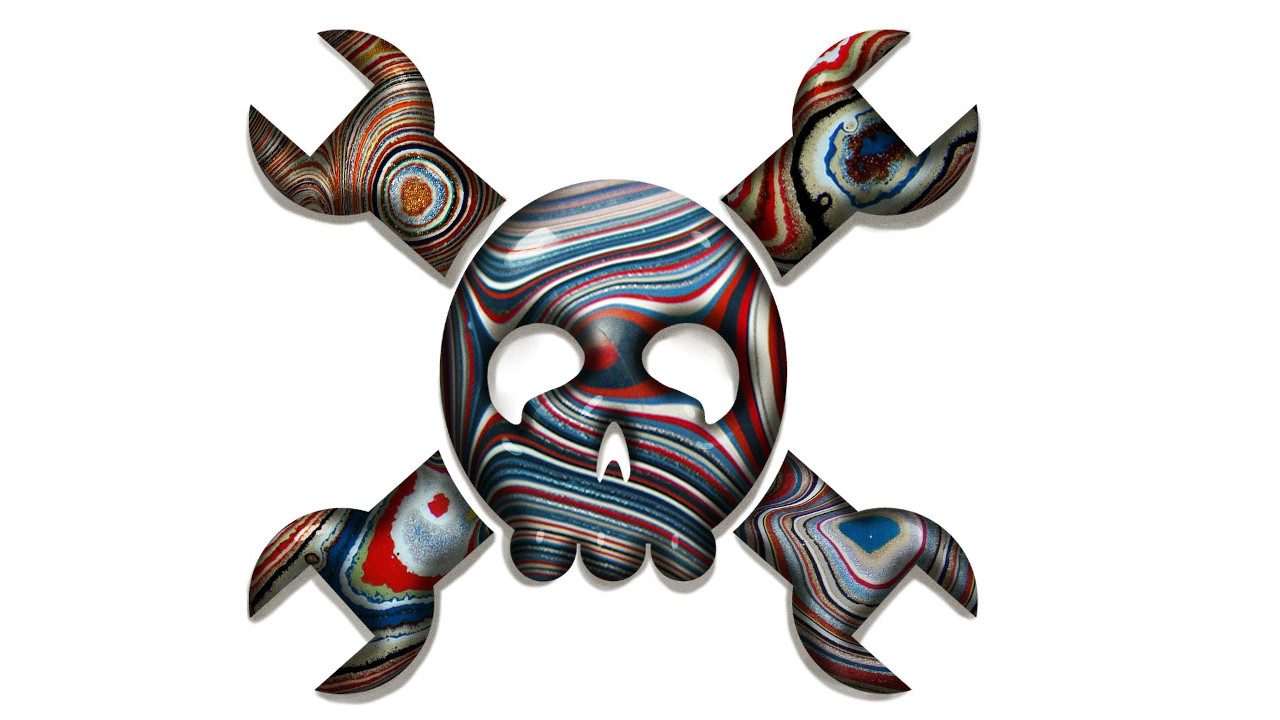
Some pieces of American history sit behind museum glass. Others rumble through classic-car shows with polished chrome and an engine loud enough to rearrange your internal organs. Fordite takes a stranger route: it began as unwanted paint buildup inside automobile factories and eventually became jewelry, sculpture, and a highly collectible record of industrial design.
Also called Detroit agate, Motor City agate, automotive agate, or paint slag, Fordite looks surprisingly geological. Cut through a chunk and you may find stripes, waves, concentric circles, metallic flecks, and psychedelic swirls. Yet no volcano, ocean, or mineral-rich cave created it. Fordite was made accidentally by workers, spray guns, assembly-line equipment, paint ovens, and years of vehicle production.
Calling Fordite a “boss byproduct” feels appropriate. This former factory nuisance has personality, historical value, and colors that could make an ordinary stone reconsider its career choices.
What Is Fordite?
Fordite is a hardened mass of automotive paint layers that can be cut, shaped, sanded, and polished. Although it is frequently called Detroit agate, it is not a natural agate, mineral, crystal, or conventional gemstone. The name is an affectionate comparison inspired by the material’s colorful banding.
Traditional agate forms when silica-rich material gradually fills spaces in rock. Fordite formed when automotive paint missed the car body and landed on assembly-line skids, tracks, racks, fixtures, and paint-shop surfaces. Layer after layer accumulated until the material became thick enough to remove in slabs or chunks.
Once polished, the humble buildup reveals a cross-section of manufacturing history. A gray stripe may represent primer. A bright red band may have come from a sports car production run. Metallic blue, cream, orange, black, green, and gold might appear together in a pattern that no jewelry designer could reproduce exactly.
One factory-based estimate reported by the Gemological Institute of America suggested that approximately 997 paint layers could be required to produce a one-inch-thick specimen. That number should not be treated as a universal formula, but it illustrates how slowly substantial Fordite deposits developed. Industrial patience was involved, even if nobody in the factory knew they were making tomorrow’s pendants.
How Automotive Paint Became Accidental Art
Overspray Started the Process
Older automobile-painting systems were less efficient at transferring every paint droplet to the vehicle. Workers sprayed bodies as they traveled through production areas, and some of the airborne coating landed on the equipment carrying the cars.
The first layer was merely overspray. The next vehicle added another. Each change in model, primer, finish, or body color could create a new stripe. Over months and years, the deposits became miniature timelines of factory activity.
Paint Ovens Hardened the Layers
The carrier equipment often moved through curing ovens with the painted automobile bodies. Consequently, existing overspray deposits were heated again and again. Fordite specialists report that deeper sections could undergo dozens of baking cycles, gradually becoming dense and hard enough for lapidary work.
The material did not emerge from the oven looking like a finished gemstone. Raw Fordite can resemble an unattractive lump of industrial debris. Its remarkable patterns remain hidden until a cutter selects an angle and removes the outer surface. This is the automotive equivalent of opening a very colorful sandwich assembled by robots and decades.
Factory Cleaning Revealed the Raw Material
Paint buildup eventually interfered with equipment and had to be removed. Workers chipped or cut deposits from skids and fixtures during maintenance. Much of it was discarded, but some employees recognized its unusual banding and saved pieces as souvenirs.
Fordite is therefore not simply recycled paint. Authentic vintage material is paint that accumulated through a specific manufacturing process, was repeatedly cured, and survived long enough to be rescued from the waste stream.
Why Fordite Records American Automotive History
Fordite preserves color rather than engine specifications, sales numbers, or assembly diagrams. That makes it an unusual historical document, but not a meaningless one. Automotive color has always reflected manufacturing technology, consumer taste, economic conditions, and broader cultural moods.
From Practical Black to a Nation in Color
Early mass-produced vehicles offered limited color choices because paint was slow to apply and cure. Ford’s famous black-only Model T period lasted from 1914 through 1925, although Model Ts were offered in other colors before and after those years. Black was durable, economical, and easier to integrate into a standardized manufacturing process.
Automotive coatings soon became faster and more flexible. Nitrocellulose lacquer dramatically reduced drying time during the 1920s and allowed manufacturers to offer a wider variety of pigments. Alkyd enamels, acrylic lacquers, improved primers, metallic effects, and other coating technologies followed.
By the 1950s, cars had become personal style statements as much as transportation. Pastels, saturated blues, vivid reds, and two-tone bodies appeared on American roads. The 1960s expanded the appetite for deep colors and metallic finishes. The 1970s shifted toward rust, brown, gold, avocado-like green, and other earthy shades that coordinated nicely with shag carpeting and questionable kitchen appliances.
When those colors appear inside Fordite, they offer clues about the production era. Older material is often associated with darker or more restrained bands. Deposits from the 1960s and 1970s can feature especially bold pigments and metallic flakes. A polished slice may therefore resemble a compressed history of changing automotive fashion.
Fordite Did Not Come Only From Ford Factories
The name suggests that every authentic piece came from a Ford Motor Company plant in Detroit. The earliest recognized material is closely associated with Ford facilities in Michigan, but “Fordite” has become a broad marketplace term for layered automotive paint recovered from many manufacturers and locations.
Well-documented examples have come from the Corvette assembly plant in Bowling Green, Kentucky. Collectors sometimes call that material “Corvetteite.” Similar deposits have been associated with Lincoln-Mercury operations, Jeep production, motorcycle factories, truck plants, and other industrial coating lines.
This broader use of the name creates both opportunities and confusion. A seller may offer “Detroit Fordite” even when the piece has no documented connection to Detroit. Another may use a manufacturer-specific nickname that sounds official but is primarily a collector’s term.
Provenance matters. A beautiful piece remains beautiful without paperwork, but a credible connection to a particular plant, employee, production period, or vehicle line can strengthen its historical appeal. Serious buyers should ask where the material came from, who recovered it, and whether the seller can explain its chain of ownership without suddenly developing the conversational agility of a smoke bomb.
Why Traditional Fordite Is No Longer Forming in the Same Way
Vintage Fordite is connected to older painting methods that generated substantial overspray. Modern automotive factories use more controlled equipment, automated applicators, improved spray booths, electrostatic systems, and highly managed coating processes.
Electrostatic application gives paint particles an electrical charge that attracts them to the vehicle surface. The process improves transfer efficiency, reducing the amount of material that drifts onto surrounding equipment. Modern plants still generate coating waste, but they generally do not create thick, multicolored deposits in precisely the same way as older production lines.
This technological change is one reason authentic vintage Fordite is treated as a finite material. Existing collections may be substantial, and previously stored factory deposits can still reach the market, but the classic source process has largely disappeared. Fordite is rare not because the planet refuses to manufacture more rocks, but because factories became better at putting paint where it was supposed to go. Efficiency ruined everythingexcept air quality, material use, workplace control, and several other fairly important matters.
Patterns and Types of Fordite
No two Fordite cuts are exactly alike. Even pieces from the same raw deposit can look dramatically different depending on the direction and depth of the cut.
Layered or Striped Fordite
This familiar variety displays relatively straight bands. Gray, red, or beige primer lines may separate brighter topcoat colors. When cut across the layers, the result resembles tightly stacked ribbons.
Drip and Swirl Patterns
Paint that flowed around irregular equipment surfaces can create waves, folds, loops, and orbital shapes. These pieces often resemble natural agate more closely because their bands curve and change direction.
Metallic Fordite
Metallic automotive finishes contain reflective flakes that sparkle after polishing. Material associated with performance cars or colorful mid-century production can be particularly dramatic. GIA documented a rare 1972 Corvette-related cabochon with unusually large metallic flakes that sold for several hundred dollars.
Primer-Heavy Material
Not every piece resembles a melted rainbow. Some specimens contain long stretches of gray, black, cream, or oxide-red primer. Collectors may prefer vivid color, but muted Fordite can offer a more obvious view of the vehicle-coating process.
Stalactite and Concentric Forms
When overspray accumulated around narrow fixtures, it could form rounded deposits. Slicing across these shapes reveals rings and concentric circles. The result can look like a tiny psychedelic tree trunk, assuming the tree spent its formative years beside an automotive paint booth.
How Fordite Becomes Jewelry and Collectible Art
Lapidary artists generally begin by inspecting the rough material for cracks, bubbles, weak layers, and promising color transitions. The direction of the first cut is critical. Cutting parallel to the paint layers may reveal broad fields of color, while cutting across them exposes stripes. Angled cuts can produce waves or elongated ovals.
The piece is then shaped into a cabochon, freeform insert, bead, or decorative component. Progressive sanding removes scratches, and polishing creates the glossy surface that makes the colors appear deeper and more saturated.
Fordite is lighter than most natural stones, which makes it useful for large earrings, pendants, cuffs, brooches, rings, and statement pieces. It has also appeared in knife handles, pens, gearshift knobs, guitar accessories, keychains, and automotive interior details. Corvette enthusiasts have even used model-specific material to replace decorative inserts in vintage controls.
Despite its hardened appearance, Fordite should not be treated like sapphire or quartz. Its durability varies according to the original coating chemistry, layer adhesion, internal bubbles, and cutting orientation. Finished pieces should be protected from harsh chemicals, prolonged soaking, excessive heat, deep scratches, and hard impacts.
Cutting raw material also creates fine paint dust. Professional lapidary artists use appropriate ventilation, dust collection, eye protection, respiratory protection, and wet-working techniques where suitable. Vintage coatings should be handled with care rather than attacked with an unprotected rotary tool on the kitchen table beside tonight’s casserole.
How to Identify Authentic Fordite
Authentication can be difficult because modern artists can deliberately pour and cure layers of paint. Such material may still be attractive, but it is not the same historical byproduct as vintage automotive Fordite.
Genuine material commonly shows variations in layer thickness, repeated primer bands, metallic particles, tiny bubbles, drips, surface channels, and irregular curing patterns. Perfectly uniform stripes may deserve additional scrutiny, especially when the seller claims they accumulated naturally over decades.
Documentation is more reliable than appearance alone. Useful provenance can include information about the factory, vehicle line, worker who recovered the deposit, approximate production period, and history of the collection.
Buyers should also be cautious of dramatic claims such as “the rarest Fordite on Earth” or “paint from one exact 1967 muscle car.” Fordite normally represents overspray from many vehicles and production cycles. Connecting an individual stripe to one particular automobile would usually require evidence that is more impressive than enthusiastic punctuation.
Why Collectors Value Fordite
Fordite combines several collecting categories in one object. It appeals to jewelry buyers, lapidary artists, classic-car enthusiasts, industrial historians, design lovers, and people who simply enjoy owning items with excellent stories.
Its greatest strength is not conventional rarity or gemological perfection. Fordite is valuable because its imperfections are meaningful. A distorted stripe records how paint flowed. A primer layer shows a production step. Metallic particles reflect a period when automakers competed for attention through increasingly dramatic finishes.
The material also represents creative reuse. Something once removed from a factory as inconvenient waste is now displayed in museums, worn as jewelry, and collected as automotive folk art. That transformation does not erase the industrial origin; it makes the origin visible.
Fordite allows people to carry a small physical connection to American manufacturing without parking a 19-foot classic car in the living room. Your family may still object to the pendant collection, but the structural engineer probably will not.
Fordite as an American Cultural Artifact
The United States is filled with objects that began as practical products and later acquired cultural meaning: advertising signs, gas pumps, diner furniture, factory tools, license plates, and automobile badges. Fordite belongs in this tradition, but it is especially compelling because no company originally intended to manufacture it.
It records labor, machinery, chemistry, consumer desire, and changing taste simultaneously. Its layers represent both cars and the people who built them. A polished cabochon may contain colors applied by multiple shifts of workers over a long period, all compressed into an object small enough to rest in a hand.
There is also a subtle lesson in its survival. Industrial history is not preserved only through executive decisions, famous models, and corporate archives. Sometimes it survives in material scraped from machinery during routine maintenance. What one generation labels waste, another may recognize as evidence.
Experiencing Fordite: From First Glance to Personal Artifact
A typical first encounter with Fordite begins with disbelief. The polished surface looks too organized to be industrial waste and too flamboyant to have spent its youth attached to factory equipment. A seller explains that the “stone” is hundreds of layers of automotive paint, and the immediate response is usually some variation of, “Wait, actual car paint?”
Holding a piece adds another surprise. Fordite is remarkably light compared with natural stone. A large cabochon may look dense and substantial but feel closer to a piece of hardened resin. That contrast makes the object seem even stranger: visually geological, physically industrial, and historically automotive.
The most enjoyable way to examine Fordite is to rotate it under direct light. Metallic flakes flash briefly, then disappear. Thin primer bands become visible between brighter colors. A red stripe may widen into a pool before narrowing again, while blue and cream layers bend around a small bubble. The pattern changes with every few degrees of movement.
Choosing a piece can become unexpectedly personal. A Corvette owner may search for documented Bowling Green material. Someone whose parent worked in a Detroit-area plant may prefer a piece associated with that facility. A collector restoring a 1970s vehicle might look for earth tones that match the car’s original paint palette. Others simply choose the loudest specimen available, proving that subtlety remains optional.
At a lapidary show, the experience becomes more technical. Rough Fordite rarely advertises its best interior pattern. A cutter studies the outside curves, visible stripes, fractures, and paint flow before deciding where to open it. The first cut is a calculated gamble. A plain-looking chunk may reveal concentric rings, while a colorful exterior may conceal dull primer below.
Watching the polishing process changes how the finished jewelry is perceived. The artisan is not merely smoothing a surface. Each stage reveals additional depth and sharpens the boundaries between layers. Fine scratches disappear, metallic particles brighten, and previously muddy colors become distinct. The final polish is the moment factory residue officially puts on formalwear.
Wearing Fordite also creates an unusual social experience. A diamond may receive a compliment, but Fordite usually receives a question. The owner gets to explain old paint booths, overspray, curing ovens, Detroit manufacturing, and the transformation of discarded material into jewelry. One pendant can turn a short elevator ride into an industrial-history seminar.
There is emotional weight in that explanation. Fordite can remind people of relatives who worked on assembly lines, neighborhoods shaped by automobile plants, or vehicles connected to family memories. Its value may come less from market price than from the connection between a physical object and a personal story.
Living with Fordite encourages careful handling. A pendant is normally easy to wear, but it should be stored separately from harder gemstones and metal edges that could scratch it. A soft cloth is preferable to aggressive chemical cleaners. Rings need additional caution because hands regularly encounter counters, doors, tools, and other objects with no respect for automotive heritage.
Collectors often discover that one piece leads to another. A striped pendant introduces the material; a metallic cabochon demonstrates a different period; a concentric specimen reveals another method of accumulation. Before long, the collector is discussing primer bands at dinner and evaluating gray paint layers with the seriousness of a museum curator.
The most memorable Fordite experience, however, is realizing what the object represents. It is not simply recycled material with pretty colors. It is a cross-section of repeated work: cars moving, sprayers operating, ovens heating, employees maintaining equipment, and manufacturing methods gradually changing. The polished piece makes an invisible part of factory life visible.
That is why Fordite feels more significant than its ingredients suggest. Chemically, it is cured automotive coating. Historically, it is a layered record of American production. Artistically, it is accidental abstraction. Personally, it can become a souvenir of an industry, city, company, vehicle, worker, or era. Few byproducts manage that much character after being scraped off a machine.
Conclusion: American History, One Paint Layer at a Time
Fordite proves that valuable historical objects do not always begin with grand intentions. It was created accidentally as automotive overspray collected, hardened, and passed repeatedly through paint-curing ovens. Workers removed it as buildup; artists later discovered that its interior contained remarkable bands of color.
Today, Detroit agate connects jewelry design with automobile manufacturing, industrial chemistry, cultural fashion, and American labor. Every authentic piece is different because every factory deposit followed a different sequence of colors, coatings, drips, heat cycles, and production runs.
Natural gemstones tell stories about geological time. Fordite tells a faster, noisier story filled with assembly lines, spray booths, classic cars, and people making things. It may not be a true stone, but it is unquestionably a piece of historyand a boss-looking one at that.