
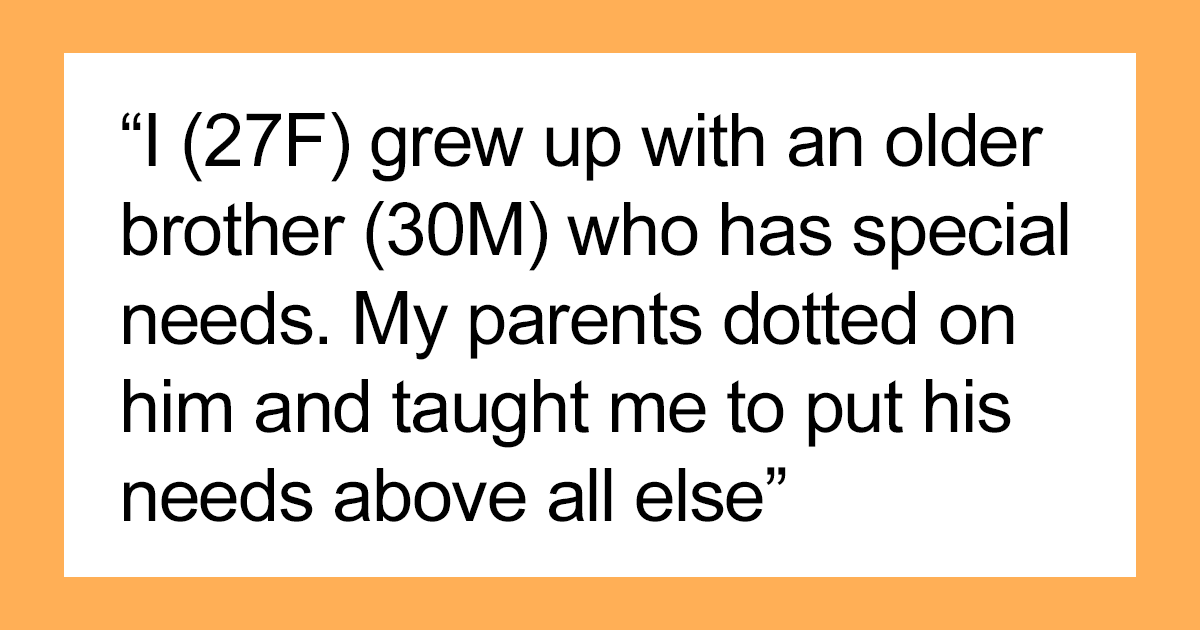
Some family stories do not explode in one dramatic moment. They simmer. They marinate. They age like milk in a hot car.
That is what makes a headline like this land so hard. On the surface, it sounds like a fight about damaged belongings. Underneath, it is usually about something much older: sibling favoritism, unequal treatment, broken boundaries, and a family script that has been running for years with the enthusiasm of a bad sitcom nobody knows how to cancel. The brother gets excused. The sister gets told to be mature. He makes a mess. She is expected to mop it up and smile politely while doing it.
When that pattern stretches from childhood into adulthood, even one destructive act can feel less like an isolated mistake and more like proof. Proof that the rules never changed. Proof that her space is not respected. Proof that his comfort still matters more than her pain. And once a person has spent years swallowing resentment for the sake of “keeping the peace,” the moment they finally push back can look sudden to everyone else. To them, though, it feels overdue by about a decade and a half.
The Real Story Is Not the Broken Item, It Is the Broken Pattern
In families shaped by parental favoritism, the favored sibling often receives more grace, more excuses, and more emotional cushioning. The less favored sibling gets a very different package: higher expectations, less benefit of the doubt, and the delightful lifelong assignment of being “the reasonable one.” In plain English, that usually means, “Please absorb the damage quietly so nobody has to confront your brother.”
That kind of uneven treatment leaves a mark. It can distort how siblings see each other and how they see themselves. The sister in this kind of story is often not just angry at the adult brother who wrecked her things. She is angry at the years behind the moment: the birthday attention that tilted one direction, the excuses that only applied to him, the consequences that somehow missed him like a bad Wi-Fi signal.
And that is why the family often misreads the final blowup. They say, “Why are you overreacting over a few possessions?” She hears, “We are still pretending this started yesterday.” That mismatch is the whole tragedy.
Favoritism Does Not Stay in Childhood
People love to act as if sibling rivalry is a cute childhood phase, like gap teeth or wearing a superhero cape to the grocery store. Real life is not always so adorable. When favoritism goes unchecked, it follows siblings into adulthood. It shows up in holidays, inheritances, caretaking expectations, side-taking during arguments, and the strange family tradition of pretending one sibling is a misunderstood genius while the other is just “too sensitive.”
Adult sibling conflict is often fueled by old roles that never got updated. The brother stays the protected one. The sister stays the one expected to accommodate. Even when everyone has jobs, rent, back pain, and opinions about air fryers, the emotional hierarchy from childhood can remain weirdly intact.
Why Prized Possessions Matter More Than Outsiders Think
When a brother destroys his sister’s prized possessions as adults, the damage is not just financial. It is symbolic. Possessions can hold memory, identity, safety, and continuity. They are sometimes the physical record of a person’s inner life: journals, collectibles, art supplies, photos, clothes saved from important years, gifts from people who mattered, or items bought after working hard and going without.
So when someone smashes, steals, ruins, or casually disrespects those things, the message is bigger than “Oops.” The message is, “What matters to you is disposable to me.” That is why this kind of act cuts especially deep in a family already shaped by unequal treatment. The destroyed object becomes a stand-in for the sister herself. Her taste, memories, time, effort, and emotional world all get treated as collateral damage.
And if the family response is something like, “He didn’t mean it,” or “You know how he is,” that only adds a second injury. First the belongings are destroyed. Then the pain gets minimized. It is a one-two punch of disrespect with a side of emotional gaslighting.
When Property Damage Feels Like a Boundary Violation
Healthy families recognize that personal space and personal belongings matter. Unhealthy families often treat boundaries like optional decorations. Nice idea, rarely used.
That is what makes this scenario so loaded. Destroying prized possessions is not just careless behavior. It is often a boundary violation. It says the sister’s room, storage, keepsakes, or personal history are available for invasion. It reinforces the idea that her limits can be crossed and she is still expected to stay calm, forgiving, and family-friendly for the group photo later.
Over time, repeated boundary violations can create exhaustion, resentment, and emotional detachment. A person may begin pulling away not because they are cold, but because closeness has become expensive. Every family visit costs them peace. Every interaction comes with cleanup.
Why She “Snaps” as an Adult
The word snaps can be misleading. It makes a long process sound like a lightning strike. In reality, adults usually reach that point after years of accumulated unfairness. The sister may have spent childhood trying to earn equal treatment. She may have tried being agreeable, high-achieving, forgiving, quiet, funny, useful, or endlessly patient. None of it fixed the core problem.
Then adulthood arrives with an uncomfortable revelation: the family dynamic did not magically mature just because everyone got older. If anything, adulthood can intensify the resentment because now there is no developmental excuse left. A grown man wrecking his sister’s things is not “kids being kids.” That ship sailed long ago and, frankly, should have been fined.
At that stage, her anger is often less about losing control and more about finally refusing the role she has been assigned. She is no longer willing to be the emotional shock absorber for the entire family system. She is done being the one who keeps her voice soft while everyone else keeps their standards low.
The Family Often Punishes the Reaction More Than the Cause
This is another common twist. Families built around favoritism frequently focus more on the less favored child’s reaction than on the favored child’s behavior. In other words, the brother destroys something meaningful, but the sister becomes the problem because she yelled, cried, confronted him, or left. The original offense somehow slips out the back door while her response gets put on trial under bright courtroom lights.
That reversal is powerful because it keeps the whole system intact. Nobody has to admit the pattern is unfair if they can frame the sister as dramatic. It is a neat trick, emotionally speaking, and an infuriating one if you are the person living through it.
What This Kind of Story Says About Toxic Family Dynamics
A headline like this resonates because many people recognize the structure immediately. Maybe the details differ, but the emotional architecture is familiar. One sibling gets protected. One gets blamed. One receives second chances. The other gets lectures about grace, patience, and family loyalty. Somehow “family loyalty” rarely means protecting the person who was hurt. Funny how that works.
These toxic family dynamics usually thrive on a few ingredients:
Selective accountability. The brother’s bad behavior is excused as stress, immaturity, or personality. The sister’s anger is treated as a character flaw.
Emotional minimization. Her pain gets downgraded. The damage is called “not that serious,” even when it clearly is.
Role freezing. The family refuses to update who each person is. He remains the golden child, screwup, baby, or special case. She remains the fixer, peacekeeper, or overreactor.
Boundary resistance. The moment she says “No more,” the family acts shocked, as if endless access to her time, space, and forgiveness was a constitutional right.
None of that creates healthy adult sibling relationships. It creates resentment with matching holiday seating charts.
What Healthier Families Would Do Differently
In a healthier family, the adult brother would be expected to take responsibility immediately. That means acknowledging the harm, replacing what can be replaced, apologizing without excuses, and understanding that trust does not regrow overnight just because he finally discovered the word “sorry.”
In a healthier family, the parents would not rush to smooth things over for appearances. They would validate the sister’s anger, recognize the larger history, and stop asking the injured person to perform emotional labor for everyone else’s comfort. They would care less about the family looking united and more about the family becoming accountable.
And in a healthier family, boundaries would not be framed as cruelty. If the sister decides her brother is no longer welcome in her home, no longer gets access to her belongings, or no longer gets automatic forgiveness, that is not revenge. That is a consequence. Adults are allowed to protect their peace, especially after someone has treated it like a clearance item.
When Distance Is Not Pettiness, but Self-Respect
There is a certain kind of family culture that treats any distance as betrayal. If the sister limits contact, declines invitations, locks doors, keeps conversations brief, or stops sharing personal information, she may be accused of holding grudges. But sometimes distance is not emotional immaturity. Sometimes it is the first sane response after years of chaos.
Not every relationship can be repaired by one conversation and a casserole. Some family systems only understand change when access changes. That does not mean the sister is cruel. It may simply mean she has realized that proximity without respect is not love. It is exposure.
Setting boundaries can look boring from the outside. Fewer calls. Shorter visits. Separate holidays. No unsupervised access to personal spaces. No lending money. No pretending. Yet boring boundaries often do more for a person’s mental well-being than ten dramatic confrontations ever could.
Experiences Related to This Story That Many People Quietly Recognize
One reason this kind of story spreads so fast online is that people see themselves in it almost immediately. Not always in the exact details, but in the emotional pattern. A lot of sisters know what it feels like to grow up in a house where the brother’s mistakes were treated like weather while their mistakes were treated like moral collapse. If he forgot something, it was brushed off. If she forgot something, it became a lecture, a label, and somehow a prophecy about her entire character.
Some people remember the little things most vividly because the little things never felt little at the time. He got the bigger room because “he needs space.” She got told to share. He broke her stuff and was called careless. She touched his stuff and was called disrespectful. He was defended as complicated. She was criticized for not being understanding enough. Family life can teach strange math: his feelings count twice, her boundaries count half.
Others talk about what happens later, once both siblings are adults and the old hierarchy still has a pulse. The brother still borrows things and returns them damaged, if at all. He still arrives late, leaves a mess, speaks over people, and somehow remains the one everyone has to “be patient with.” Meanwhile, the sister is praised for being responsible right up until she asks for the bare minimum. Then suddenly she is difficult. Amazing how quickly competence gets repackaged as attitude when it stops serving everyone else.
There are also people who describe a deeper grief underneath the anger. They are not only upset about a ruined item or one awful visit. They are mourning the sibling relationship they never really got to have. They wanted a brother, not a recurring family exemption. They wanted parents who noticed the imbalance, not referees who somehow always misplaced the whistle. What hurts is not just the unfairness. It is the loneliness of being expected to endure it while the family keeps calling itself close.
And then there is the strange guilt that can follow the breaking point. Many people say that once they finally stand up for themselves, they do not feel immediate relief. They feel shaky. Sad. Questioning. They wonder if they were too harsh, even when the situation clearly demanded a line in the sand. That self-doubt often comes from years of conditioning. If you were taught that peace means your silence, then using your voice can feel wrong even when it is absolutely necessary.
But over time, many also describe something else: clarity. They realize they were never angry only because of one smashed possession, one cruel comment, or one family dinner gone sideways. They were angry because those moments confirmed a lifelong pattern. Once they name the pattern, they can finally stop negotiating with it. That is when real change begins. Sometimes the family improves. Sometimes it doesn’t. But the person at the center of the storm finally stops calling the storm normal.
Final Takeaway
“Brother gets prioritized over sister for the entirety of her life, she snaps after he destroys her prized possessions as an adult” is not really a story about a sudden meltdown. It is a story about the emotional cost of family favoritism. It is about what happens when one sibling is consistently protected and another is consistently asked to tolerate the fallout. It is about how broken boundaries, minimized pain, and selective accountability can push a person from quiet resentment to open refusal.
The sister’s breaking point is not the beginning of the problem. It is the first moment the problem becomes impossible to ignore.
And honestly, that is why stories like this hit such a nerve. They remind people that fairness in families is not a luxury. It is the foundation. Without it, even love starts to feel lopsided, and every “small” act of disrespect carries the full weight of history.














