
Note: This original SEO article is based on publicly available information about Jen Woodhouse, The House of Wood, her DIY projects, workshop-centered home life, and related home-improvement resources.
A Home That Doubles as a Workshop, Classroom, and Creative Playground
Some people see a house as a place to store throw pillows, hide laundry, and pretend the junk drawer is “organized enough.” Jen Woodhouse sees a house as a blueprint waiting to happen. For the self-taught carpenter, designer, blogger, and founder of The House of Wood, home is not just where life happens. It is where ideas get measured, cut, sanded, installed, photographed, and occasionally re-measured because wood, like toddlers and tape measures, can be unpredictable.
Jen Woodhouse has carved out a distinctive space in the DIY home improvement world by making woodworking feel less like a secret club guarded by people in dusty aprons and more like a skill any determined homeowner can learn. Her style blends beauty with function, but not in the stiff, museum-home way where everyone is afraid to sit down. Her projects are designed for real families, real messes, real storage problems, and real “why is this closet eating our shoes?” moments.
The phrase “DIY dream home” fits Jen’s world because her home operates as more than a finished space. It is a living design lab. A kitchen can become a renovation classroom. A mudroom can become a study in traffic flow and storage. A workshop can become the engine room of the whole house. Instead of chasing perfection, Jen shows the process: the plan, the pivot, the dust, the mistakes, the fixes, and finally, the reveal that makes everyone say, “Wait, you built that?”
Who Is Jen Woodhouse?
Jen Woodhouse is best known as the creative force behind The House of Wood, a DIY and design blog where she shares furniture builds, home renovation projects, woodworking plans, organization ideas, tool guidance, and decorating inspiration. Her public profile describes her as a self-taught carpenter with a fearless DIY spirit and a talent for problem-solving. That description matters because it explains the heart of her brand: she is not teaching from an ivory tower; she is teaching from the sawdust pile.
Her background as a military wife and mother has also shaped her approach to home. Military-family life often means moving, adapting, unpacking, rebuilding routines, and learning to make temporary spaces feel personal. That practical experience shows up in her work. Jen’s projects are not only about making something pretty for a camera. They are about making spaces more useful, flexible, and meaningful for the people who live in them.
Over time, her work has expanded beyond a blog into a recognizable DIY brand. She has been associated with furniture plans, brand partnerships, workshops, video tutorials, and features in major home and lifestyle publications. But her lasting appeal comes from something more grounded: she makes building feel possible. Her content has the rare ability to say, “Yes, this may involve a table saw,” and also, “No, you do not need to panic into a throw pillow.”
The House of Wood: A Brand Built Board by Board
The House of Wood is Jen’s creative hub, and the name could not be more on-brand if it arrived wearing safety glasses. The site covers DIY furniture, home renovations, outdoor projects, organization systems, room makeovers, design plans, and tool-related content. It is the kind of place where a reader may arrive looking for a nightstand plan and leave three hours later convinced they can build a pergola, reorganize the garage, and become “a cabinet person.”
What makes Jen’s content SEO-friendly by nature is its usefulness. Search engines reward content that answers real questions, and Jen’s tutorials are built around real homeowner problems: how to build storage, how to create a more functional kitchen, how to design built-ins, how to make a workspace work harder, and how to turn a blank or awkward area into something intentional.
Her project library also demonstrates one of the strongest lessons in DIY content: specificity builds trust. Instead of vague advice like “add storage,” she shows storage with measurements, material choices, construction logic, and finish details. Instead of simply saying “make it beautiful,” she explains how design decisions connect to the character of the house. That is why her work resonates with both beginners and experienced DIYers. She respects the dream, but she also respects the cut list.
Inside the DIY Dream Home: Function Comes First
The most interesting thing about Jen Woodhouse’s home is not that it looks polished. Many homes look polished after enough editing, staging, and carefully placed lemons in a bowl. What makes her home compelling is that it functions as a working family home and a creative studio. It is a place where design decisions are tested against daily life.
Her renovation approach often starts with a simple but powerful question: how does this space need to work? In her mudroom locker project, for example, the goal was not just to create a pretty built-in. The plan was to transform a pantry-closet-turned-catch-all into a hardworking transition space between the garage, laundry room, and kitchen. That is a classic real-life problem. Backpacks land somewhere. Shoes multiply like tiny rubber-soled rabbits. Coats need a home. If a space does not have a system, clutter writes its own floor plan.
Jen’s solution-minded process is part of what makes her dream home feel attainable. The dream is not about luxury for luxury’s sake. It is about a house that supports the family living inside it. That means cabinets above, drawers below, lockers for daily gear, and design choices that feel original to the home rather than awkwardly added on later. In other words, her DIY dream home is not a showroom. It is a beautifully organized answer to the question, “Where does all this stuff go?”
A French Colonial Influence with Warm, Custom Details
Jen has described her home as French Colonial, and that architectural identity influences how she approaches updates. Instead of forcing trendy features into every room, she often studies the home’s character and looks for materials, finishes, and proportions that belong. This is where her design work gets especially interesting. She is not just building storage; she is building continuity.
In the mudroom project, for instance, the design plan included walnut, brass mesh panels, floral wallpaper, and contrast trim. Those choices are not random. Walnut brings warmth and depth. Brass mesh adds texture and airflow. Wallpaper introduces charm. Contrast trim ties the space into the rest of the house. The result is a project that feels custom without feeling like it wandered in from a different decade carrying a suspiciously trendy handbag.
This is one of Jen’s strongest design lessons: a successful DIY home is not a collection of isolated projects. It is a conversation between rooms. A kitchen remodel, a laundry room renovation, a built-in locker system, a workshop, and a home office can all feel connected when the homeowner uses consistent design thinking. Jen’s niche is not simply “I build furniture.” It is “I build spaces that make sense.”
The Workshop at the Heart of It All
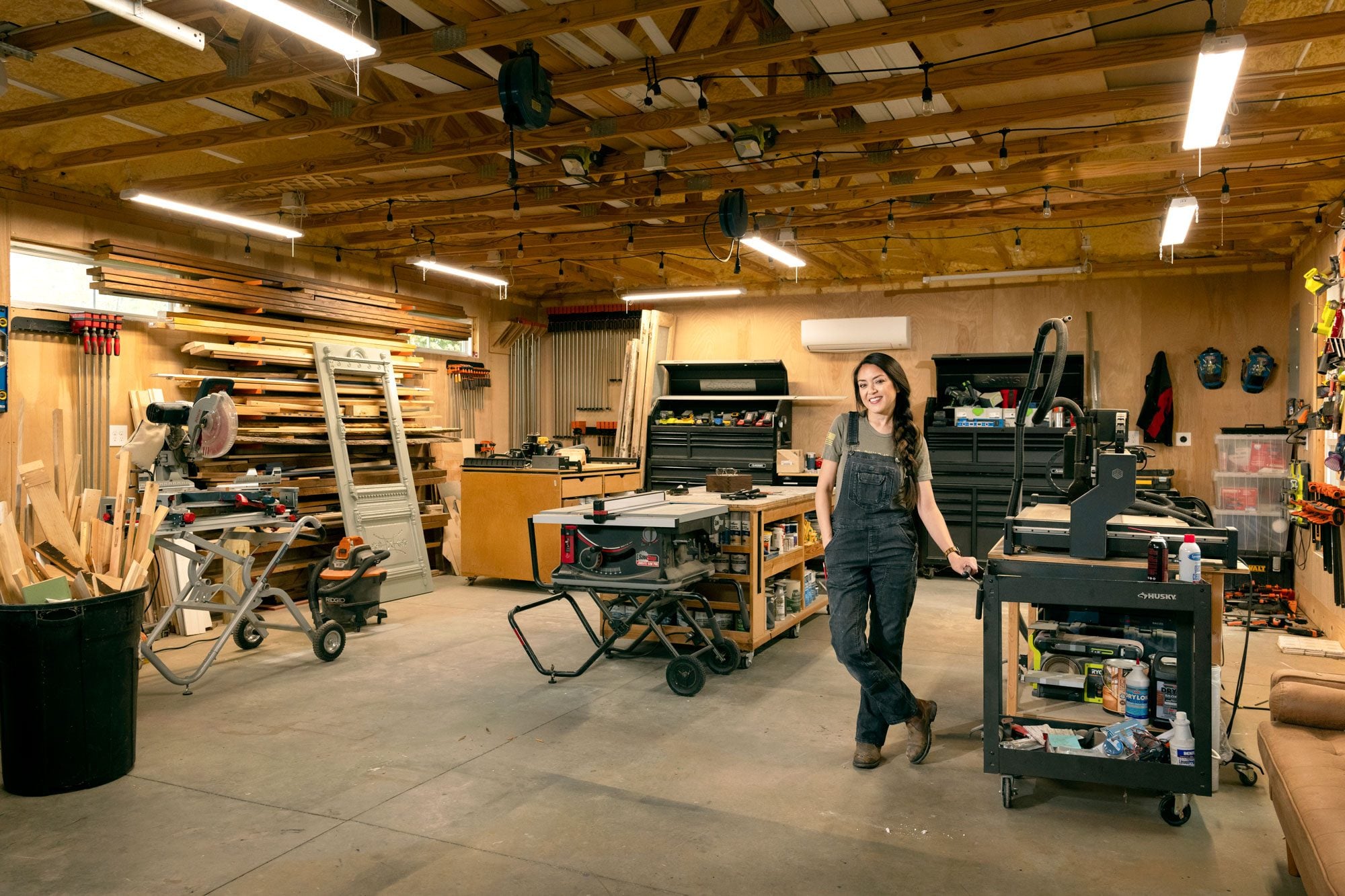
Every serious DIY home needs a command center. For some people, that is a garage corner with a folding table and heroic optimism. For Jen Woodhouse, the workshop is central to the dream. Family Handyman’s feature framed her home as one big drawing board with a full workshop at its heart, and that idea captures her brand perfectly.
A workshop is more than a place to store tools. It shapes what is possible. Jen’s workbench projects show how deeply she understands that. An extra-large DIY workbench can act as a sturdy build surface, storage zone, and outfeed support for a table saw. A mobile workbench with drawers can create a dedicated station for a carving machine or other specialized tool. Casters, shelves, drawers, magnetic strips, and thoughtful dimensions are not glamorous details, but they are the reason a workshop becomes efficient instead of chaotic.
The workshop also represents a larger idea: creativity needs infrastructure. A dream home does not happen only because someone has good taste. It happens because there is a place to cut plywood, test finishes, store screws, clamp parts, and fix the drawer slide that suddenly has the personality of a stubborn mule. Jen’s workshop-centered approach reminds DIYers that behind every beautiful reveal is a well-used workspace.
The Kitchen Renovation: Big Dreams, Practical Decisions
One of Jen’s major home projects has been her kitchen renovation, a project she described as one of her biggest renovation challenges. Kitchens are the Olympic finals of home improvement. They involve layout, plumbing, electrical work, cabinetry, appliances, lighting, flooring, countertops, storage, and at least one moment where someone asks, “Can we just eat cereal forever?”
Jen’s kitchen plans focused on making the existing layout more functional for her family. That included updating cabinets, addressing wasted corner space, creating a dedicated pantry, relocating the microwave, making room for a range hood, replacing countertops, and continuing flooring in a cohesive way. These decisions are practical, but they also show an important design philosophy: do not renovate only for the “after” photo. Renovate for the Tuesday morning when everyone needs breakfast, backpacks, coffee, and a clear countertop.
The kitchen is also where Jen’s balance of aspiration and honesty shines. She has openly acknowledged the intimidation that comes with a major remodel. That transparency is valuable. Many DIY creators show the beautiful final image; Jen also shows the learning curve. For readers, that makes the project more trustworthy. It tells them that being nervous does not disqualify them from doing hard things. It simply means they should plan carefully, ask better questions, and maybe keep snacks nearby.
Built-Ins, Storage, and the Art of Making Clutter Behave
Storage is one of the unsung heroes of Jen Woodhouse’s DIY dream home. Built-ins, lockers, closet systems, linen organization, spice storage, and drawer solutions may not sound as dramatic as a full kitchen remodel, but they are often the projects that change daily life the most. A beautiful room can still feel stressful if every surface is buried under “temporary” piles that have somehow become permanent residents.
Jen’s built-in projects show how custom carpentry can solve problems that store-bought furniture cannot. A built-in bookcase can use wall space efficiently. Mudroom lockers can give every family member a defined landing zone. Drawers can hide shoes, cords, or supplies. Upper cabinets can store seasonal or less-used items. A custom desk can hide a printer behind a faux drawer front, which is an act of design mercy because printers, as everyone knows, are emotionally complicated appliances.
The larger lesson is that good DIY design starts with behavior. Where do people drop things? What gets used every day? What needs to stay visible? What should be hidden? What makes a room feel calm? Jen’s projects work because they respect these questions before choosing finishes. The pretty part matters, but the function is the skeleton. Without it, the design collapses into decorative wishful thinking.
Outdoor Living, Furniture Builds, and Family-Friendly Projects
Jen’s project world extends beyond interior renovations. Her outdoor builds, furniture plans, kids’ projects, and entertaining pieces show the range of her DIY niche. She has shared plans and tutorials for projects such as pergolas, floating decks, outdoor tables, playhouses, craft tables, workbenches, storage pieces, and furniture inspired by high-end looks.
Outdoor projects are especially revealing because they require durability as well as design. A pergola or floating deck must handle weather, structure, hardware, safety, and long-term use. A playhouse must be sturdy enough for actual children, who treat small structures like castles, restaurants, rocket ships, and occasionally wrestling arenas. A party station or outdoor cart has to move, store, serve, and survive being near grilled food. That combination of beauty and toughness is where woodworking becomes practical magic.
Jen’s furniture projects also reflect her “build your way to a more beautiful home” mindset. A DIY furniture plan can be empowering because it gives homeowners more control over size, finish, function, and budget. Instead of settling for a piece that almost fits, a DIYer can create something made for the room. That is the heart of Jen’s niche: she gives people permission to stop waiting for the perfect item to appear and start building a version that works.
Why Jen Woodhouse Stands Out in the DIY World
The DIY internet is crowded. There are endless room reveals, furniture hacks, tool reviews, and videos promising that anyone can transform a space in a weekend. Jen Woodhouse stands out because her work combines credibility, warmth, technical detail, and a strong point of view. She is not just decorating around problems. She is solving them with design, woodworking, and a calm confidence that says, “We can figure this out.”
Her content also feels approachable because she does not present DIY as a flawless performance. She shows process. She talks through problems. She shares plans. She explains materials. She makes space for learning. That matters because many beginners are not afraid of style; they are afraid of tools, measurements, and making expensive mistakes. Jen’s tutorials help reduce that fear by breaking projects into steps.
Her humor and honesty also make the work feel human. A DIY home without humor is just a construction site with better lighting. Jen’s personality helps readers feel like they are building alongside a knowledgeable friend rather than being judged by a professional who alphabetizes clamps for fun. She proves that expertise can be generous, detailed, and still enjoyable.
SEO Analysis: Why This Story Works for Home Improvement Readers
From an SEO perspective, Jen Woodhouse’s DIY dream home story is powerful because it connects multiple search intents. Readers may search for “Jen Woodhouse,” “The House of Wood,” “DIY dream home,” “woodworking plans,” “DIY mudroom lockers,” “home workshop ideas,” “kitchen renovation inspiration,” or “custom built-ins.” A strong article can naturally cover all of those related topics without keyword stuffing.
The key is to structure the content around useful themes: who Jen is, what her home represents, how her workshop supports the projects, which renovations show her process, and what readers can learn from her approach. That creates a better user experience because readers are not just getting a biography. They are getting practical insight into DIY planning, storage design, workshop organization, and home improvement strategy.
Search engines increasingly favor content that demonstrates experience, expertise, authority, and trust. Jen’s story fits that framework because her work is rooted in documented projects, public tutorials, hands-on building, and recognizable home-improvement expertise. For publishers, the article also has evergreen value. DIY storage, workshop setup, family-friendly renovation, and custom furniture are topics people search year after year, usually right after opening a closet and regretting every life choice that led to that moment.
What Homeowners Can Learn from Jen Woodhouse’s DIY Dream Home
1. Start with the Problem, Not the Paint Color
Paint is fun. Wallpaper is fun. Hardware is fun. But Jen’s projects show that the best DIY improvements begin with the problem. Is the kitchen wasting storage? Is the mudroom failing during the morning rush? Is the workshop slowing down every project? Once the problem is clear, the design choices become smarter.
2. Build for the Life You Actually Live
A dream home should support your real routine, not the imaginary routine where everyone folds laundry immediately and no one owns 17 water bottles. Jen’s work embraces family life, clutter control, and everyday function. That makes the results more useful and more sustainable.
3. Make the Workshop Work First
Whether your workshop is a garage bay, basement corner, shed, or full building, it needs systems. A solid workbench, tool storage, mobile stations, lighting, dust control, and safe workflow can make every future project easier. The workshop is not separate from the dream home; it is how the dream home gets built.
4. Respect the House’s Character
Jen’s French Colonial-inspired design choices show the value of working with a home’s architecture. Trendy details can be beautiful, but the best renovations feel like they belong. Materials, trim, proportions, and finishes should create continuity.
5. Share the Process, Not Just the Reveal
For content creators and DIYers alike, Jen’s success proves that process is powerful. People want to see how a project comes together. They want the planning, the mistakes, the fixes, and the final result. A perfect reveal is inspiring; an honest process is useful.
Conclusion: The Beauty of Building Your Own Niche
Jen Woodhouse’s DIY dream home is not impressive simply because it includes beautiful spaces, clever built-ins, or a serious workshop. It is impressive because it reflects a clear philosophy: home should be personal, functional, creative, and within reach. Her work turns the intimidating world of woodworking and renovation into something more approachable, one plan, one tutorial, and one brave first cut at a time.
Through The House of Wood, Jen has built more than furniture. She has built a community around the idea that homeowners can shape their spaces with their own hands. Her projects remind readers that a dream home does not have to arrive fully finished. Sometimes it comes together slowly, through careful measurements, practical storage, thoughtful design, and a willingness to learn as you go.
That may be the most inspiring part of Jen’s niche. She shows that DIY is not about pretending to know everything. It is about practicing, problem-solving, and building confidence along with the project. And if there is sawdust on the floor? Congratulations. That is not a mess. That is progress wearing work boots.
Experience Notes: Living the Jen Woodhouse Approach in a Real DIY Home
Anyone who has tried to improve a home by hand knows that DIY is not always the tidy, music-overlaid montage we see online. It is part planning, part patience, part “where did I put the drill bit,” and part standing in the aisle of a hardware store pretending to understand every fastener. That is exactly why Jen Woodhouse’s approach feels so useful. Her work reflects the real experience of turning a house into something more personal, one decision at a time.
The first experience many DIYers can relate to is the discovery that a beautiful room begins with an annoying problem. Maybe the entryway is always cluttered. Maybe the laundry room has no folding surface. Maybe the kitchen cabinet corner is a black hole where small appliances go to retire. The Jen Woodhouse mindset says: do not just complain about the space; study it. Watch how your family uses it. Notice what lands on the floor. Measure the awkward wall. Then design a solution that meets the actual need.
The second experience is learning that tools become less scary when they have a purpose. A saw, sander, drill, or pocket-hole jig can feel intimidating when it is sitting on a shelf like a metal riddle. But once the tool is connected to a real project, the fear starts to shrink. Building a workbench, shelf, drawer, or cabinet teaches more than any abstract lesson. Each cut builds confidence. Each mistake builds judgment. Each finished piece whispers, “See? You are handier than you thought.”
The third experience is understanding that custom does not always mean complicated. A simple built-in bench, a drawer divider, a printer cabinet, or a wall-mounted storage system can feel custom because it fits the way you live. Jen’s projects show that DIY success is not measured only by size. A small project that solves a daily irritation may improve your home more than a dramatic renovation that looks great but changes nothing about your routine.
The fourth experience is accepting that design evolves. You may start with one plan and adjust because the wall is not square, the material is out of stock, the budget changes, or the family dog has strong opinions about drop cloths. That flexibility is not failure. It is part of the craft. Jen’s content often highlights the planning stage, but it also leaves room for pivots. Real DIY requires that balance: prepare carefully, then adapt without melting into a puddle of sawdust and regret.
Finally, the most valuable experience is pride. There is a unique satisfaction in using something you built. A store-bought table can be lovely, but a table you made carries a story. A mudroom locker you built can hold backpacks, but it also holds proof that you solved a problem. A workshop you organized can store tools, but it also stores momentum. That is the heart of the DIY dream home. It is not just a home filled with projects. It is a home filled with evidence that you tried, learned, and made the space your own.














