
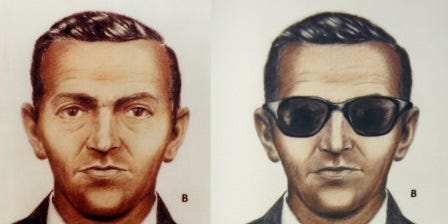
On November 24, 1971, a neatly dressed passenger bought a one-way airline ticket, ordered a bourbon and soda, claimed to have a bomb, collected $200,000 and four parachutes, and then stepped into the rainy darkness somewhere above the Pacific Northwest. He was never conclusively seen again.
More than half a century later, the man remembered as D.B. Cooper remains responsible for America’s most famous unsolved skyjacking. Now, a parachute reportedly discovered among the belongings of convicted hijacker Richard Floyd McCoy Jr. has revived an old theory: Cooper did not vanish without a name. He may have been McCoy all along.
The discovery sounds like the final scene of a documentarythe mysterious parachute, the children breaking their silence, and the FBI showing renewed interest. Unfortunately, cold cases rarely wrap themselves in a tidy bow. The new evidence is potentially important, but no verified forensic result has publicly identified McCoy as Cooper. The mystery has received a fresh lead, not yet a solved-case stamp.
Fact-check:
What Happened During the D.B. Cooper Hijacking?
The story began at Portland International Airport on the afternoon before Thanksgiving. A man using the name Dan Cooper paid cash for a ticket aboard Northwest Orient Airlines Flight 305, a short trip from Portland, Oregon, to Seattle, Washington.
Witnesses described him as a calm, quiet man who appeared to be in his mid-40s. He wore a dark business suit, a white shirt and a black clip-on tie. Shortly after takeoff, he handed flight attendant Florence Schaffner a note. She initially assumed the passenger was attempting to give her his phone number and placed it in her purse. Cooper politely informed her that she should read it because he had a bomb.
Inside his briefcase, Schaffner saw wires and red-colored cylinders. Whether it was a working explosive device has never been established, but nobody on that airplane was volunteering to conduct an electrical inspection.
Cooper demanded $200,000 in $20 bills, four parachutes and a fuel truck waiting in Seattle. After the aircraft landed, he exchanged the 36 passengers for the ransom and parachutes. He retained several crew members and ordered the Boeing 727 back into the air, heading south toward Mexico City with a planned refueling stop in Reno.
A little after 8 p.m., Cooper opened the aircraft’s rear stairs and jumped with the money. The pilots landed safely in Reno. Cooper, his parachute and most of the ransom disappeared.
Fact-check:
Why the D.B. Cooper Mystery Refuses to Die
The FBI named its investigation NORJAK, short for Northwest Hijacking. Agents interviewed hundreds of people, examined the aircraft and followed leads across the United States. By the fifth anniversary, investigators had considered more than 800 suspects.
Yet the physical evidence remained frustratingly thin. Cooper left behind his clip-on tie, a tie clip, cigarette-related evidence that was later lost, and pieces of parachute material he had cut while improvising a container for the ransom. No body, confirmed parachute, complete money bundle or getaway vehicle was recovered.
In 1980, eight-year-old Brian Ingram found three deteriorating bundles of $20 bills along the Columbia River near Vancouver, Washington. The serial numbers matched the Cooper ransom. The discovery proved that at least $5,800 had reached the riverbank, but it did not explain how. The money could have been carried by Cooper, transported by water, buried deliberately or moved during dredging and natural river activity.
The FBI also questioned whether Cooper survived. He jumped at night into rain, wind and heavily wooded terrain while wearing loafers and a business suit. His parachute could not be steered, and investigators concluded that his equipment choices did not suggest an elite skydiver. Cooper may have been a master criminalor a confident amateur whose luck expired somewhere below 10,000 feet.
In 2016, the FBI redirected resources away from the active investigation. The agency did not declare the mystery solved. It said it would still consider specific physical evidence connected to the parachutes or ransom money.
Fact-check:
The New Parachute Evidence and the McCoy Family Claim
The latest surge of interest centers on Richard Floyd McCoy Jr., a former military helicopter pilot, Vietnam veteran and experienced skydiver. McCoy had already occupied a prominent place in D.B. Cooper theories because he committed a remarkably similar crime less than five months later.
On April 7, 1972, a hijacker commandeered United Airlines Flight 855, demanded four parachutes and $500,000, and escaped from the Boeing 727 by parachute over Utah. Investigators connected the crime to McCoy through handwriting, fingerprints, witnesses, equipment and nearly all the ransom money found at his home. He was convicted of aircraft piracy.
McCoy later escaped from federal prison and was killed during a confrontation with FBI agents in 1974. The similarities between the two hijackings were so obvious that McCoy became a perennial Cooper suspect. Same aircraft model, same general escape method, similar parachute demands and only a few months between crimesit is hardly surprising that the theory keeps returning like a suitcase the airline cannot permanently lose.
Fact-check:
A Parachute Found on McCoy Family Property
According to aviation investigator and YouTube creator Dan Gryder, McCoy’s adult children contacted him after their mother, Karen McCoy, died in 2020. Rick and Chanté McCoy said they had long suspected that their father was D.B. Cooper and that their mother knew more than she publicly admitted.
In 2022, Gryder reportedly discovered a modified military-style parachute among items on property associated with the McCoy family in North Carolina. He argued that unusual features of the rig were consistent with equipment connected to the Cooper hijacking.
Gryder and Rick McCoy said they later met FBI agents in Richmond, Virginia, in September 2023. According to their account, agents took possession of the parachute, a harness and McCoy’s skydiving logbook. Media reports also stated that investigators obtained family DNA and examined the former McCoy property.
That sounds dramatic, but an essential distinction must be made: these details have largely come from Gryder and the McCoy family. When journalists requested confirmation, the FBI generally referred them to its 2016 statement and did not publicly authenticate the parachute as Cooper’s equipment.
Fact-check:
What the Parachute Could Prove
If the parachute can be reliably traced to the 1971 hijacking, its discovery among McCoy family possessions would be extraordinary. Investigators could examine manufacturing information, modifications, stitching, hardware, fibers, storage history and biological material.
A meaningful DNA profile might then be compared with McCoy’s relatives. However, simply finding McCoy-family DNA on an object stored by that family would prove very little. Investigators would need to establish that the object was connected to Flight 305 before its storage history contaminated the evidentiary trail.
That is the chain-of-custody problem. The parachute apparently spent decades outside official control, potentially exposed to multiple people and environmental conditions. Its age does not automatically make it authentic. Plenty of old parachutes exist, and “vintage” is not the same thing as “worn by America’s most famous disappearing bourbon drinker.”
Why Richard McCoy Still Does Not Perfectly Fit
The case for McCoy begins with capability. He knew how to fly, understood parachuting and demonstrated that he could hijack a Boeing 727 and escape with ransom money. His 1972 crime looked less like random imitation than a refined version of Cooper’s operation.
The case against him begins with the eyewitnesses. Cooper was consistently described by flight attendants as a man in his mid-40s. McCoy was 29 in November 1971. Witnesses who spent considerable time near Cooper did not identify McCoy as the hijacker, and the FBI has stated that physical-description differences helped rule him out.
Investigators also cited evidence placing McCoy elsewhere around Thanksgiving 1971. Later summaries of the FBI’s work noted an alibi in Utah and differences between McCoy’s appearance and the composite description. Furthermore, McCoy was a skilled parachutist, while some of Cooper’s equipment decisions suggested less expertise.
Supporters answer that witnesses can misjudge age, especially under stress, artificial lighting and an unfolding bomb threat. They also argue that Cooper may have intentionally chosen inferior or older equipment to avoid a sabotaged parachute. Those explanations are possible, but possibility is not proof. A good theory must explain inconvenient evidence rather than placing it in the overhead compartment and hoping nobody notices.
Fact-check:
Other New D.B. Cooper Evidence: The Tie and FBI Files
The McCoy parachute is not the only modern lead. Cooper’s inexpensive black JCPenney tie has become one of the case’s most valuable surviving objects. The FBI has said the tie produced a DNA sample, although questions remain about whether the material came from Cooper, another wearer, a manufacturer or later handlers.
Microscopic analysis reportedly identified more than 100,000 particles on the tie, including unusual metals and compounds such as unalloyed titanium, bismuth and strontium sulfide. Researchers have suggested that this debris may connect Cooper to aerospace, electronics or specialized metal manufacturing.
Private investigator Eric Ulis has pursued a theory involving Crucible Steel, a Pennsylvania company that supplied titanium and stainless-steel products used in aerospace manufacturing. He has identified engineers and employees as possible persons of interest, but no public DNA match has connected those individuals to the hijacking.
The tie evidence is fascinating because it could reveal Cooper’s workplace rather than his name. Microscopic particles may indicate where the tie was worn repeatedly, narrowing the suspect pool to an industry or facility. Still, a titanium speck is not a confession. Industrial material can travel through suppliers, aircraft cabins, workshops and secondhand clothing.
Meanwhile, the FBI continues releasing historical Cooper records through its online Vault. A new installment, Part 119, was listed on July 6, 2026. Recent batches have revealed the enormous range of tips, false confessions, suspect profiles and forensic questions investigators confronted. They have made the public record richer, but they have not announced Cooper’s identity.
Fact-check:
Has the D.B. Cooper Mystery Finally Been Solved?
Nonot according to the publicly available evidence.
The McCoy theory deserves serious examination because it combines a plausible suspect, a nearly identical later crime, family testimony and a newly surfaced physical object. That is more substantial than many Cooper theories, which often begin with “My uncle looked vaguely like the sketch” and end with a streaming-series proposal.
However, several missing steps prevent a responsible declaration that Richard McCoy was D.B. Cooper:
- The parachute has not been publicly authenticated as equipment used during the 1971 hijacking.
- No verified DNA result has publicly connected McCoy to evidence from Flight 305.
- The FBI has not publicly reversed its earlier conclusion that McCoy was ruled out.
- Eyewitness descriptions and McCoy’s reported whereabouts continue to create significant problems.
- Family memories and alleged confessions require independent corroboration.
A genuine solution would ideally unite several forms of evidence: an authenticated parachute, a reliable DNA comparison, documentation placing the suspect in Portland, a convincing explanation of the ransom money, and consistency with eyewitness accounts. Anything less may produce a persuasive suspect without producing a solved case.
Conclusion: A Better Lead, but Not Yet a Final Answer
The latest D.B. Cooper evidence has strengthened public interest in Richard Floyd McCoy Jr., but it has not conclusively revealed Cooper’s identity. The newly surfaced parachute may become enormously important if experts can authenticate it and recover meaningful forensic evidence. It may also prove to be unrelated military surplus that spent decades quietly minding its own business before being promoted to celebrity evidence.
For now, the most accurate verdict is that the mystery remains open. McCoy is a compelling candidate, the parachute is a legitimate object of interest, and modern DNA methods offer possibilities investigators could barely imagine in 1971. Yet without a public forensic match or official identification, “D.B. Cooper mystery solved” remains a questionnot a headline written in permanent ink.
What It Is Like to Retrace the D.B. Cooper Mystery
Exploring the Cooper case is less like following a conventional criminal investigation and more like assembling a jigsaw puzzle after someone has thrown half the pieces into the Columbia River. Every clue appears promising until it collides with another clue pointing in the opposite direction.
A useful way to experience the case is to begin with the original flight rather than a favorite suspect. Study the short Portland-to-Seattle route and imagine boarding in 1971, when passengers could buy tickets with cash and walk onto an aircraft without modern identification checks or security screening. Cooper did not need computer hacking, forged biometric documents or an elaborate airport disguise. He needed a ticket, a briefcase and extraordinary nerve.
Next, read the crew accounts and early investigative records. Cooper’s behavior is one reason the case remains captivating. He was threatening but reportedly controlled, occasionally courteous and careful about certain operational details. Those characteristics tempt readers to transform him into an antihero. The original context provides a correction: passengers and crew members were trapped aboard an aircraft with a man who claimed to possess a bomb. Whatever Cooper’s charm, this was not a victimless adventure.
The physical geography adds another layer. Southwestern Washington is not an empty green square on a map. It includes forests, rivers, uneven terrain, farms, changing weather and communities that have been searched, discussed and occasionally disturbed by generations of amateur investigators. Standing near the Columbia River or examining maps of the estimated flight path makes Cooper’s nighttime jump feel less cinematic and more brutally uncertain.
Tena Bar, where the ransom bills were found in 1980, is especially instructive. The discovery appears simple until researchers confront changing river levels, sediment movement, dredging records and competing theories about when the money arrived. A few decaying bundles created more questions than answersa recurring D.B. Cooper tradition.
For anyone researching the case, the best experience comes from building an evidence table. Place each suspect in one column and list age, appearance, aviation knowledge, parachuting experience, location on November 24, 1971, fingerprints, handwriting, DNA and personal history. This method quickly separates documented facts from entertaining claims. It also reveals why no candidate has achieved universal acceptance.
The final lesson is patience with uncertainty. Cold-case communities can become emotionally attached to suspects, treating contradictory evidence as a personal insult. A better approach is to ask what new information would disprove a theory. For McCoy, authentication and forensic testing of the parachute could move the case forward. A reliable exclusion could move it forward too.
Retracing the D.B. Cooper mystery does not guarantee a dramatic answer. It offers something more valuable: an experience in evidence, memory, probability and the uncomfortable distance between an attractive story and a proven fact. Cooper may eventually be identified. Until then, the wisest investigators keep one hand on the clues and the other firmly on the emergency brake.
Research verification:














