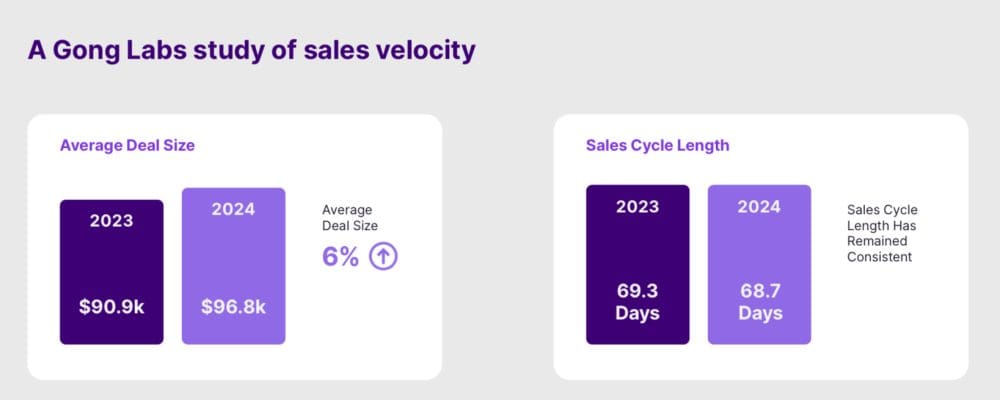
In B2B sales, few numbers make revenue leaders lean forward faster than this one: $100k deals take about 70 days to close. That benchmark, highlighted from Gong’s revenue data, is the kind of stat that sounds simple until you start using it to inspect your pipeline. Then it becomes less like trivia and more like a flashlight in a messy garage.
For sales teams selling software, services, platforms, or enterprise solutions, a 70-day sales cycle for a six-figure deal is not exactly “blink and you missed it.” But it is also not glacial. In fact, for a deal worth around $100,000, 70 days can be a surprisingly efficient timelineassuming the buyer is qualified, the problem is urgent, the business case is clear, and legal does not decide to take a spiritual retreat inside the redlines.
The real lesson is not that every sales team should force $100k deals into a 70-day box. The lesson is that sales cycle length, average deal size, win rate, and pipeline quality must be studied together. A fast sales cycle with poor-fit customers is not a victory; it is a refund request wearing a party hat. A long sales cycle with strong expansion potential may be worth the wait. The smartest revenue teams use benchmarks like Gong’s to ask better questions, not to panic every time a deal hits day 71.
Why the 70-Day Benchmark Matters
Gong’s benchmark gives sales leaders a practical reference point for six-figure opportunities. A $100k deal usually requires more than one discovery call, a friendly demo, and a “just circling back” email with suspiciously cheerful punctuation. It often involves multiple stakeholders, budget approval, technical review, security questions, procurement, legal, and an internal champion who has to convince colleagues that doing nothing is more expensive than buying.
That is why the 70-day figure is useful. It suggests that a disciplined team can move a serious B2B opportunity from qualified pipeline to closed-won in roughly two and a half months. Not overnight. Not “we met at a webinar and now we are best friends.” But not forever either.
It Sets a Realistic Expectation
Sales managers often suffer from two dangerous pipeline illusions. The first is optimism: “This deal is totally closing this month.” The second is spreadsheet theater: “The CRM says it is 80% likely, so everyone please clap.” A benchmark helps bring the conversation back to reality. If similar $100k opportunities usually take around 70 days, a deal that is only 20 days old may need nurturing, not pressure. A deal that is 140 days old may need a hard truth, not another “checking in” email.
It Connects Deal Size to Deal Complexity
A $10k deal and a $100k deal do not behave the same way. Smaller purchases may be approved by one manager with a credit card and a caffeine problem. Larger deals tend to attract committees, risk reviews, and finance teams with the enthusiasm of airport security. The higher the contract value, the more the buyer needs confidence, consensus, and a credible path to return on investment.
What Actually Happens During a 70-Day B2B Sales Cycle?
A healthy 70-day sales cycle is not just a countdown. It is a sequence of buyer commitments. The best sales teams do not merely ask, “When will they sign?” They ask, “What decision does the buyer need to make next?”
Days 1–14: Qualification and Problem Discovery
The first two weeks are about separating real opportunities from expensive distractions. A qualified $100k deal usually has a clear pain point, a business impact, a potential budget source, and someone inside the account who cares enough to do work between meetings.
Strong discovery goes beyond surface-level questions like, “What keeps you up at night?” Many buyers will politely answer, but privately think, “Mostly my toddler and inbox.” Better questions identify the cost of inaction, the current process, the buyer’s success metrics, the decision criteria, and the internal approval path.
Days 15–35: Business Case and Stakeholder Mapping
Once the problem is real, the seller must help the buyer translate pain into a business case. For a $100k deal, “our team likes the product” is rarely enough. Finance wants impact. Operations wants feasibility. IT wants security. Legal wants clauses. Leadership wants confidence that this purchase will not become another dashboard nobody opens after Q2.
This stage is where multi-threading becomes essential. A seller who relies on one champion is building a bridge out of popsicle sticks. One job change, one budget freeze, or one skeptical executive can stall the opportunity. In modern B2B buying, successful teams map the buying committee early and help each stakeholder understand value in their own language.
Days 36–55: Validation, Demo, ROI, and Risk Reduction
Mid-cycle momentum depends on proof. Buyers want to know whether the product works, whether the implementation is realistic, whether users will adopt it, and whether the promised ROI can survive contact with Monday morning.
This is where revenue intelligence tools like Gong become valuable. Conversation data, call summaries, deal warnings, competitor mentions, and stakeholder engagement patterns help managers see what is really happening. The CRM may say “proposal sent,” but call recordings may reveal that the CFO has not been involved, the champion is unsure how to justify budget, and the buyer has a competing project with executive support. In other words, the deal is not “in procurement.” It is in trouble wearing a procurement costume.
Days 56–70: Negotiation, Procurement, and Close
The final two weeks are often less about persuasion and more about coordination. Pricing, contract terms, start date, onboarding plan, security documents, and executive sign-off must move together. A deal can be emotionally sold and still operationally stuck.
Top sellers make this stage boring on purpose. They confirm the paper process, identify who signs, clarify what legal needs, schedule mutual action plan checkpoints, and keep the buyer focused on the original business problem. The goal is not to “push harder.” The goal is to remove friction so the buyer can complete the decision they already want to make.
The Sales Velocity Formula Behind the Benchmark
The 70-day benchmark becomes more powerful when connected to sales velocity. Sales velocity measures how quickly pipeline turns into revenue. A common formula is:
Sales Velocity = Number of Opportunities × Average Deal Size × Win Rate ÷ Sales Cycle Length
For example, imagine an enterprise rep carrying 50 qualified opportunities, with an average deal size of $100,000, a 25% win rate, and a 70-day sales cycle. That pipeline has serious revenue potential. But change just one variable and the picture shifts quickly.
- If the win rate drops, revenue slows.
- If the sales cycle stretches from 70 days to 120 days, cash arrives later.
- If average deal size rises but quality falls, forecasting becomes fantasy football for executives.
- If opportunity count grows without qualification discipline, reps get busy but not productive.
This is why revenue leaders should not obsess over sales cycle length alone. A shorter cycle is usually good, but only when paired with strong fit, clean qualification, and profitable customers. Speed without quality is just a very efficient way to create churn.
Why $100k Deals Stall
If a $100k opportunity is taking far longer than 70 days, the delay usually has a cause. Sometimes the buyer is slow. Sometimes the seller skipped steps. Sometimes the deal was never real, and everyone has been politely cosplaying as pipeline.
1. The Economic Buyer Is Missing
Many six-figure deals begin with an enthusiastic user or manager. That is helpful, but enthusiasm does not sign contracts. If the economic buyer is absent, the seller may be educating someone who cannot approve the purchase. The deal can feel active because meetings are happening, but no real decision is moving forward.
2. The Problem Is Interesting, Not Urgent
Buyers explore many solutions they do not buy. A problem may be annoying, but not painful enough to fund. A seller must identify whether the issue affects revenue, cost, risk, productivity, retention, compliance, or strategic goals. If the buyer cannot explain why the problem must be solved now, the close date is probably decorative.
3. The Business Case Is Too Fuzzy
For $100k deals, vague value propositions are dangerous. “Improve visibility” may sound nice, but CFOs prefer numbers. How many hours will be saved? How much pipeline risk will be reduced? How many deals could be recovered? What happens if the buyer waits another six months?
A strong business case turns a product conversation into an executive decision. It also gives the champion internal ammunition, which is important because most selling happens when the seller is not in the room.
4. Procurement Appears Too Late
Procurement is not a villain. Procurement is a process. The mistake is pretending it does not exist until the last minute. Smart sellers ask early about vendor approval, security requirements, contract review, payment terms, and purchasing steps. Surprises are fun at birthday parties, not in enterprise sales.
5. The Buying Committee Cannot Agree
Modern B2B purchases often involve many stakeholders across departments. A sales leader may care about productivity, finance may care about cost control, IT may care about integration, and legal may care about data protection. If the seller only speaks to one perspective, the deal can stall while the buyer’s internal team debates the decision without a shared framework.
How Revenue Teams Can Close $100k Deals Faster
Closing six-figure deals faster does not mean rushing the buyer. It means reducing uncertainty, improving qualification, and helping the buying group make a confident decision.
Use a Mutual Action Plan
A mutual action plan outlines the steps required to reach a decision. It may include discovery, technical validation, executive alignment, security review, legal review, procurement, signature, onboarding, and launch. The best version is not a seller’s wish list. It is a shared plan that the buyer agrees reflects their internal process.
Multi-Thread Before You Need To
Do not wait until the champion goes silent to ask, “Who else should be involved?” By then, the answer may be “our competitor.” Multi-threading should happen early and naturally. Each stakeholder should receive relevant value: ROI for finance, ease of adoption for operations, risk controls for IT, and strategic impact for leadership.
Build the ROI Case With the Buyer
A seller-created ROI calculator can help, but a buyer-owned business case is stronger. Invite the prospect to validate assumptions. Use their numbers when possible. Ask what finance will challenge. Identify the metric that matters most. A $100k deal moves faster when the buyer can defend the purchase without sounding like they copied a vendor brochure.
Coach the Champion
Your champion may like you, but that does not mean they know how to sell internally. Give them a concise business case, stakeholder-specific talking points, implementation expectations, and answers to likely objections. A champion without enablement is just a friendly person with calendar access.
Use AI and Revenue Intelligence Wisely
AI can help summarize calls, identify risks, draft follow-ups, surface next steps, analyze deal engagement, and spot missing stakeholders. But AI does not replace judgment. The best teams use AI to remove administrative drag so sellers can spend more time on strategic conversations. Think of AI as a very fast assistant, not a magical quota fairy.
What Sales Managers Should Inspect in a $100k Pipeline
Managers should use the 70-day benchmark as a coaching lens. A deal at day 20 should not be judged the same way as a deal at day 95. Instead of asking only, “Will it close?” managers should inspect evidence.
Pipeline Questions That Actually Help
- Who is the economic buyer, and have we spoken with them?
- What business pain is tied to money, risk, or strategic priority?
- What happens if the buyer does nothing?
- Which stakeholders support the deal, and which are neutral or opposed?
- What is the buyer’s approval process?
- What is the agreed next step, and is it on the buyer’s calendar?
- What evidence proves this close date is real?
These questions are not meant to interrogate reps like a courtroom drama. They help separate real deals from hopeful forecasts. A pipeline review should improve deal strategy, not become a weekly ceremony where everyone pretends the commit number is emotionally stable.
What the Gong Benchmark Means for Founders and CROs
For founders and revenue executives, the message is clear: benchmark your sales motion by deal size. If your average contract value is near $100k and your sales cycle is much longer than 70 days, investigate why. You may be targeting the wrong accounts, entering too low in the organization, failing to quantify value, or letting procurement surprise you.
If your sales cycle is much shorter than 70 days, congratulationsbut inspect quality. Are customers adopting? Are they renewing? Are discounts too aggressive? Are you selling to departments with limited expansion potential? A fast close is excellent only when it leads to durable revenue.
For early-stage companies, a 70-day benchmark can also help with cash planning and hiring. If a new account executive needs 70 days to close a qualified six-figure opportunity, then ramp time, pipeline generation, quota design, and board expectations should reflect that reality. Revenue does not arrive just because the forecast tab looks confident.
Practical Example: A $100k Deal Done Right
Imagine a SaaS company selling a revenue operations platform to a 600-person B2B software firm. The first call identifies a painful issue: forecast accuracy is poor, managers lack call visibility, and reps spend too much time updating CRM notes. The seller qualifies the opportunity and learns that the VP of Sales owns the initiative, but finance and IT must approve.
By day 14, the seller has mapped stakeholders and confirmed the business impact: missed forecasts are causing hiring delays and board-level frustration. By day 30, the team has completed a tailored demo for sales managers and RevOps. By day 45, finance has reviewed an ROI model based on saved manager time and improved pipeline inspection. By day 55, IT has reviewed data security documentation. By day 63, legal has redlined the agreement. By day 70, the contract is signed.
Nothing magical happened. The seller did not hypnotize procurement. The buyer did not wake up one morning craving more software spend. The deal closed because the seller understood the buying process, built consensus, connected value to business outcomes, and removed friction at each stage.
Experience-Based Insights: Lessons From Working Around $100k Sales Cycles
When observing or supporting B2B sales teams that chase six-figure deals, one pattern appears again and again: the deal rarely dies in one dramatic moment. It usually fades from a series of small misses. A discovery call skips the decision process. A demo impresses users but not executives. A proposal includes pricing but not business impact. A champion says, “This looks great,” but never confirms who owns budget. Then, several weeks later, the team is surprised that the opportunity has gone quiet. This is the sales equivalent of ignoring the check-engine light until the car starts making jazz noises.
The best experiences with $100k deals usually involve calm discipline. The seller does not act desperate. The manager does not bully the rep into inventing a close date. The team treats the buyer’s decision like a project with milestones. Every meeting has a purpose. Every follow-up confirms value and next steps. Every stakeholder gets a reason to care. This kind of selling feels less flashy than a heroic last-minute close, but it is far more repeatable.
One practical lesson is that early qualification saves more time than late-stage negotiation ever can. If a buyer lacks urgency, authority, budget access, or a clear success metric, the seller should not simply “keep them warm” forever. Warm pipeline can still clog the system. A polite disqualification often protects the rep’s calendar and the company’s forecast. In many teams, the courage to remove weak opportunities is what makes strong opportunities easier to close.
Another experience-based lesson is that champions need coaching, not just encouragement. A champion may believe in the solution but still struggle to persuade finance, IT, or the executive team. Sellers who provide internal business-case materials, objection-handling notes, comparison points, and implementation clarity often help champions become stronger advocates. The buyer should never have to translate the entire value proposition alone.
Finally, the 70-day benchmark is most useful when treated as a diagnostic tool. If a $100k deal is at day 35 with no executive alignment, the team has a risk. If it is at day 50 with no procurement path, the team has a risk. If it is at day 65 and the buyer still has not validated ROI, the close date is probably more of a dream journal entry than a forecast. But when teams inspect these signals early, they can fix problems before the quarter-end scramble begins.
In the real world, great sales teams do not close $100k deals faster by sending more emails that begin with “just.” They close faster by understanding the buyer’s process, creating urgency around a real business problem, building consensus, and making the next step obvious. Gong’s 70-day benchmark is not a law of nature. It is a reminder that big deals move when the sales process helps buyers make confident decisions.
Conclusion
The headline “Gong: $100k Deals Take About 70 Days to Close” is more than a benchmark. It is a useful mirror for B2B revenue teams. If your six-figure deals take much longer, look for weak qualification, missing economic buyers, unclear ROI, late procurement involvement, or poor stakeholder coverage. If your deals close much faster, inspect retention, discounting, and customer fit.
A 70-day sales cycle for a $100k deal is not about rushing buyers. It is about creating a buying journey with less confusion and more confidence. The best teams combine human selling fundamentals with revenue intelligence, AI support, clean process, and strong business cases. They do not merely chase signatures. They help buyers make decisions that survive budget reviews, implementation, and renewal conversations.
In short: speed matters, but quality wins. A $100k deal that closes in 70 days and becomes a happy long-term customer is worth ringing the gong for. A rushed deal that churns in six months is just noise.
Note: This article is written for web publishing in standard American English, based on real B2B sales benchmarks and current revenue-intelligence research, with unnecessary citation placeholders and source-code artifacts removed.