Calculating molecular weight sounds like one of those chemistry tasks designed to make a periodic table stare back at you judgmentally. Fortunately, it is much less dramatic than it looks. Once you know how to read a chemical formula, molecular weight becomes a reliable add-and-multiply routinenot a mysterious ritual involving goggles, bubbling beakers, and a professor whispering, “Check your subscripts.”
Whether you are solving a homework problem, preparing a solution in a lab, checking a product specification, or trying to remember why glucose weighs more than water, the method is the same. You identify each element, count its atoms, find each atomic mass, multiply, and add everything together.
This guide explains how to calculate molecular weight in six clear steps, including examples for simple molecules, compounds with parentheses, and hydrates. By the end, you will be able to look at a formula such as Al2(SO4)3 without immediately considering a career change.
What Is Molecular Weight?
Molecular weight is the total mass of all atoms in one molecule. It is found by adding together the atomic masses of every atom shown in the chemical formula.
For example, a water molecule has the formula H2O. That means it contains two hydrogen atoms and one oxygen atom. Add their atomic masses, and you get the molecular mass of water.
In everyday chemistry classes and laboratories, people often use the terms molecular weight, molecular mass, and molar mass loosely. They are closely related, but there is one useful distinction:
- Molecular mass refers to the mass of one molecule and is commonly expressed in atomic mass units, or u.
- Molar mass refers to the mass of one mole of a substance and is expressed in grams per mole, or g/mol.
- Molecular weight is often used informally to describe molar mass, especially in laboratory instructions and product labels.
The good news is that the numerical value is the same. Water has a molecular mass of about 18.015 u and a molar mass of about 18.015 g/mol. The number does not change; only the unit and scale do.
Why Molecular Weight Matters
Molecular weight is one of the most practical calculations in chemistry. It connects tiny atoms and molecules to materials you can actually weigh on a balance. Without it, measuring a chemical accurately would be a bit like baking cookies by saying, “Add approximately one cloud of flour.”
You use molecular weight or molar mass when you need to:
- Convert grams into moles or moles into grams.
- Prepare laboratory solutions with a target concentration.
- Determine percent composition by mass.
- Interpret chemical reactions and stoichiometry problems.
- Compare compounds, pharmaceuticals, polymers, proteins, and other substances.
- Identify possible molecular formulas from experimental data.
The calculation itself is straightforward. The details that cause trouble are usually the tiny pieces of chemical notation: subscripts, parentheses, coefficients, hydration dots, and capitalization. In chemistry, a little number in the wrong place can create a very different answer. Carbon monoxide, CO, and carbon dioxide, CO2, are not interchangeable just because they both start with “C” and “O.”
How to Calculate Molecular Weight in 6 Steps
Step 1: Write the Correct Chemical Formula
Start with the exact chemical formula for the substance. Molecular weight can only be as accurate as the formula you use. A missing subscript, a misplaced parenthesis, or a forgotten hydrate can turn a correct calculation into a numerical disaster wearing a lab coat.
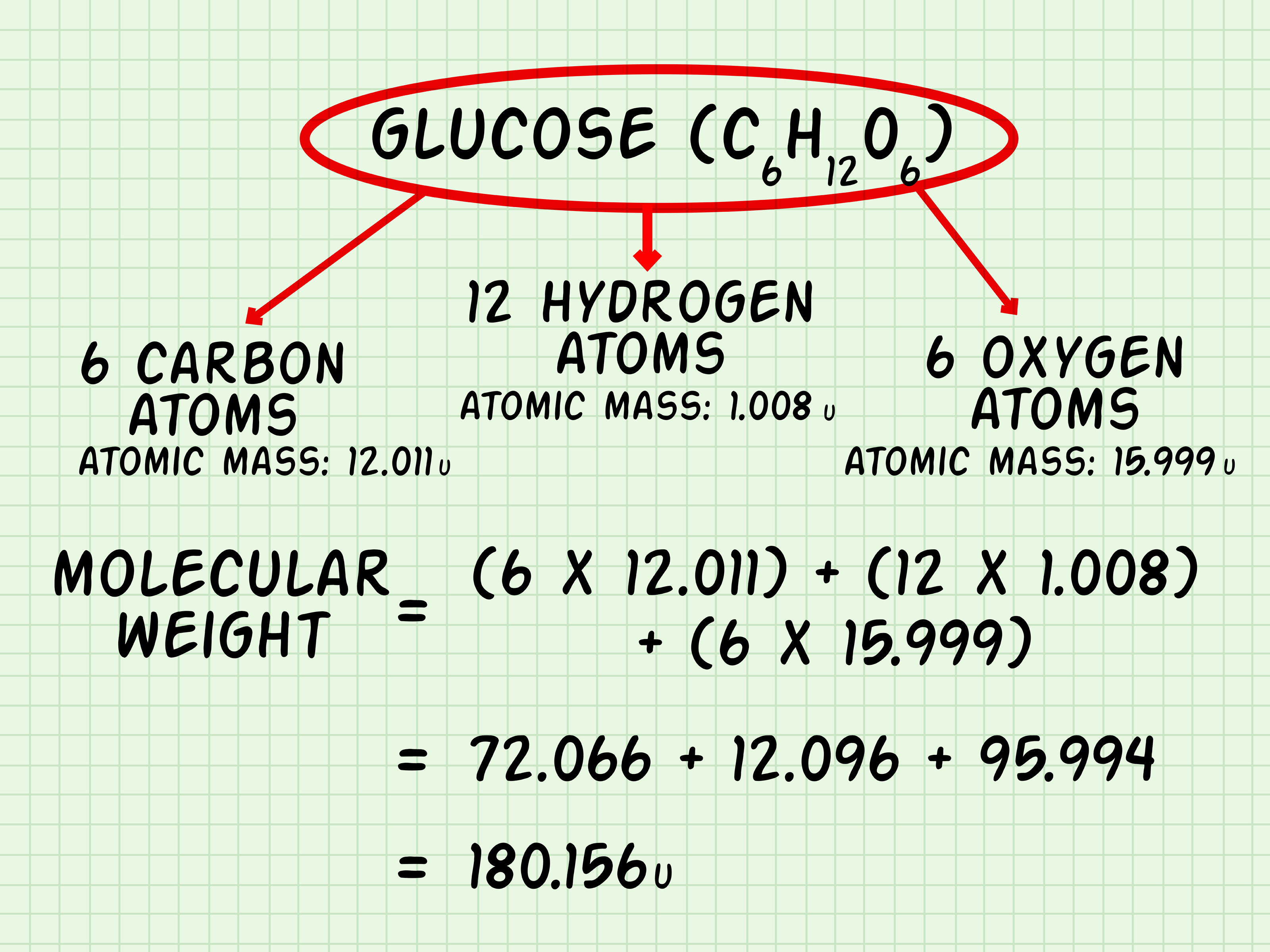
For example, glucose is written as C6H12O6. This formula tells you that one molecule contains:
- 6 carbon atoms
- 12 hydrogen atoms
- 6 oxygen atoms
Pay attention to capitalization. CO is carbon monoxide, made of one carbon atom and one oxygen atom. Co is cobalt, an element. One lowercase letter can change your chemistry problem from a gas calculation into a transition-metal surprise party.
Also distinguish between a subscript and a coefficient. In the equation 2H2O, the coefficient 2 means there are two water molecules. It does not change the molecular weight of one H2O molecule. When calculating molecular weight, use the formula itself, not the reaction coefficient in front of it.
Step 2: Count the Number of Atoms of Each Element
Next, make an atom inventory. Write down every element in the formula and count how many atoms of that element are present.
For a simple formula such as sulfuric acid, H2SO4, the count is easy:
- Hydrogen: 2 atoms
- Sulfur: 1 atom
- Oxygen: 4 atoms
Compounds with parentheses require more attention. Consider calcium hydroxide, Ca(OH)2. The subscript 2 outside the parentheses applies to everything inside them:
- Calcium: 1 atom
- Oxygen: 2 atoms
- Hydrogen: 2 atoms
A common mistake is to count Ca(OH)2 as one calcium, one oxygen, and two hydrogen atoms. That misses the fact that the entire OH group appears twice. The parentheses are not decoration. They are chemistry’s way of saying, “Multiply all of this, please.”
For a more advanced example, aluminum sulfate is Al2(SO4)3. Its atom inventory looks like this:
- Aluminum: 2 atoms
- Sulfur: 3 atoms
- Oxygen: 12 atoms
The oxygen total is 12 because there are four oxygen atoms inside the sulfate group, and the sulfate group appears three times: 4 × 3 = 12.
Step 3: Find Each Element’s Atomic Mass
Use a periodic table to find the atomic mass of every element in your formula. Atomic mass is usually printed as a decimal number beneath or near the element symbol.
For common introductory chemistry calculations, you may use values rounded to two decimal places:
- Hydrogen, H = 1.008
- Carbon, C = 12.01
- Nitrogen, N = 14.01
- Oxygen, O = 16.00
- Sodium, Na = 22.99
- Sulfur, S = 32.06
- Chlorine, Cl = 35.45
- Calcium, Ca = 40.08
Atomic masses are averages because naturally occurring elements can exist as mixtures of isotopes. That is why chlorine is listed near 35.45 rather than as a perfectly tidy whole number. Chemistry enjoys precision, but it also enjoys reminding us that nature does not always round politely.
Use the atomic masses from the same periodic table throughout your calculation. Different classroom tables may round values slightly differently, which can create tiny differences in the final answer. That is normal. A result of 180.16 g/mol versus 180.18 g/mol is usually a rounding difference, not evidence that the atoms have staged a rebellion.
Step 4: Multiply Each Atomic Mass by Its Atom Count
Now multiply the atomic mass of each element by the number of atoms of that element in the formula.
Let’s calculate the molecular weight of sulfuric acid, H2SO4.
- Hydrogen: 2 × 1.008 = 2.016
- Sulfur: 1 × 32.06 = 32.06
- Oxygen: 4 × 16.00 = 64.00
Do not round too early. Keep a few decimal places while multiplying, then round your final answer appropriately. Rounding every tiny part of a calculation can add up, much like buying “just one small snack” at an airport.
Here is another example using glucose, C6H12O6:
- Carbon: 6 × 12.01 = 72.06
- Hydrogen: 12 × 1.008 = 12.096
- Oxygen: 6 × 16.00 = 96.00
Step 5: Add the Element Totals
Add the mass contribution from each element. The result is the molecular mass in atomic mass units or the molar mass in grams per mole.
For sulfuric acid:
2.016 + 32.06 + 64.00 = 98.076
Therefore, sulfuric acid has a molecular mass of approximately 98.08 u and a molar mass of approximately 98.08 g/mol.
For glucose:
72.06 + 12.096 + 96.00 = 180.156
Therefore, glucose has a molar mass of approximately 180.16 g/mol.
Once you have that value, you can use it as a conversion factor. For example, one mole of glucose has a mass of about 180.16 grams. If you have 90.08 grams of glucose, you have about 0.500 moles.
Step 6: Check Parentheses, Hydrates, and Reasonableness
Before finalizing your answer, do a quick formula check. This step saves more points on chemistry assignments than almost any fancy calculator trick.
Ask yourself these questions:
- Did I count every element?
- Did I multiply all atoms inside parentheses?
- Did I include a hydrate if one is present?
- Did I confuse an element symbol with a similarly written formula?
- Does the final mass seem reasonable for the formula?
Hydrates deserve special attention. A hydrate includes water molecules as part of its crystal structure, usually written with a centered dot. For example, copper(II) sulfate pentahydrate is CuSO4·5H2O.
To calculate its molar mass, find the mass of CuSO4, then add the mass of five water molecules:
- Copper: 1 × 63.55 = 63.55
- Sulfur: 1 × 32.06 = 32.06
- Oxygen in sulfate: 4 × 16.00 = 64.00
- Five water molecules: 5 × [(2 × 1.008) + 16.00] = 90.08
63.55 + 32.06 + 64.00 + 90.08 = 249.69 g/mol
That final water contribution is not optional. Ignoring it would be like calculating the weight of a backpack while pretending the textbooks inside do not exist.
Worked Example: Calculating the Molecular Weight of Aluminum Sulfate
Let’s put all six steps together using aluminum sulfate, Al2(SO4)3.
1. Identify the elements
The formula contains aluminum, sulfur, and oxygen.
2. Count the atoms
There are 2 aluminum atoms, 3 sulfur atoms, and 12 oxygen atoms.
3. Find atomic masses
Al = 26.98, S = 32.06, and O = 16.00.
4. Multiply each atomic mass by the atom count
- Aluminum: 2 × 26.98 = 53.96
- Sulfur: 3 × 32.06 = 96.18
- Oxygen: 12 × 16.00 = 192.00
5. Add the totals
53.96 + 96.18 + 192.00 = 342.14 g/mol
6. Check the formula
The three sulfate groups each contain four oxygen atoms, so 3 × 4 = 12 oxygen atoms. The calculation is complete.
Aluminum sulfate has a molar mass of approximately 342.14 g/mol.
Common Molecular Weight Mistakes to Avoid
Most molecular weight errors are not math errors. They are formula-reading errors. Here are the repeat offenders.
Ignoring a Missing Subscript
No subscript means one atom. In NH3, nitrogen has no subscript, so there is one nitrogen atom. Hydrogen has a subscript of three, so there are three hydrogen atoms.
Forgetting to Multiply Parentheses
In Mg(NO3)2, there are two nitrogen atoms and six oxygen atoms. The subscript 2 applies to both nitrogen and oxygen inside the parentheses.
Using Atomic Number Instead of Atomic Mass
Atomic number tells you the number of protons in an atom. Atomic mass tells you the mass value used in molecular weight calculations. Oxygen has an atomic number of 8 but an atomic mass close to 16.00. Using 8 would make your answer very wrong, very confidently.
Skipping Water in a Hydrate
For a compound such as BaCl2·2H2O, the two water molecules contribute real mass and must be included.
Applying a Reaction Coefficient to One Molecule
A coefficient changes how many molecules or moles participate in a reaction. It does not change the molecular weight of a single molecule. The molecular weight of H2O is always about 18.015, whether the equation contains 1H2O or 100H2O.
Molecular Weight, Formula Mass, and Molar Mass: Which Term Should You Use?
For covalent substances that exist as separate molecules, such as water, carbon dioxide, or glucose, the term molecular mass is appropriate. For ionic compounds, such as sodium chloride, calcium carbonate, or magnesium oxide, chemists often use formula mass because ionic solids are made of repeating formula units rather than individual molecules.
In most classroom and laboratory situations, molar mass is the clearest term because it gives the usable laboratory unit: grams per mole.
For example:
- Water, H2O: molecular mass = 18.015 u; molar mass = 18.015 g/mol.
- Sodium chloride, NaCl: formula mass = 58.44 u; molar mass = 58.44 g/mol.
- Calcium carbonate, CaCO3: formula mass = about 100.09 u; molar mass = about 100.09 g/mol.
The math remains the same. You add the atomic masses of all atoms represented in the formula. Chemistry may use different labels, but it still expects you to do the multiplication.
Practical Experience: How Molecular Weight Calculations Become Easier
The first few molecular weight problems often feel slow because your brain is doing several jobs at once. You are reading symbols, decoding subscripts, checking parentheses, finding periodic-table values, multiplying, and wondering whether “Cu” is copper or a typo that will ruin your afternoon. With practice, the process becomes almost automatic.
One of the most useful habits is writing a mini table before doing any math. Instead of jumping directly into a calculator, list the element, its atom count, atomic mass, and total contribution. For example, when calculating the molar mass of caffeine, C8H10N4O2, make four neat rows: carbon, hydrogen, nitrogen, and oxygen. This takes a few extra seconds, but it prevents you from forgetting nitrogen or accidentally multiplying oxygen by four instead of two. A tidy setup is not glamorous, but neither is redoing an entire worksheet because one tiny subscript went missing.
Another reliable strategy is to circle parentheses and rewrite the actual atom totals before looking up atomic masses. For instance, Fe2(SO4)3 may look intimidating at first glance, but it becomes manageable when translated into 2 iron atoms, 3 sulfur atoms, and 12 oxygen atoms. Once the formula is expanded mentally, the rest is addition with a chemistry accent.
It also helps to estimate before calculating. You do not need a precise answer at first; you only need a rough expectation. A compound with several heavy elements, such as barium, iodine, lead, or bromine, should have a much larger molar mass than a small molecule made only of carbon, hydrogen, and oxygen. If your calculated molar mass for a barium compound is 41 g/mol, something has probably gone wrong. Barium alone is much heavier than that. Estimation is your built-in smoke alarm.
When preparing solutions, molecular weight becomes much more than a homework exercise. Suppose you need 0.100 moles of sodium chloride. Its molar mass is about 58.44 g/mol, so you would need roughly 5.844 grams. If your balance shows 58.44 grams instead, you have prepared ten times the intended amount. That is not necessarily catastrophic in every context, but it is definitely the kind of surprise that can make a lab notebook feel emotionally complicated.
Experience also teaches the value of recording units every time. Write atomic masses in u when discussing one molecule and g/mol when discussing one mole. Even though the numbers match, the concepts are not interchangeable. Units tell you what your answer means, and chemistry calculations become much easier when the units are treated as active participants rather than optional accessories.
Finally, use digital tools wisely. Molecular weight calculators and chemistry databases can verify your result, especially for long formulas, polymers, proteins, hydrates, and compounds with many elements. However, calculate at least one version by hand first. A calculator can confirm that a formula adds up, but it cannot always save you from entering the wrong formula. Technology is excellent at doing arithmetic quickly; it is less excellent at noticing that you typed CaOH2 when you meant Ca(OH)2.
After enough practice, calculating molecular weight stops feeling like a six-step obstacle course. It becomes a dependable chemistry skill: read the formula carefully, count every atom, multiply, add, label the result, and check your work. The periodic table is no longer a wall of mysterious boxes. It is simply your menu of atomic masses.
Conclusion
Learning how to calculate molecular weight is one of the most useful foundational skills in chemistry. The method is simple: start with the correct chemical formula, count the atoms, find atomic masses, multiply each mass by its atom count, add the totals, and double-check your notation.
The arithmetic is rarely the hardest part. Accuracy comes from paying attention to subscripts, parentheses, hydrates, and units. Once you master those details, you can calculate the molar mass of everything from water and glucose to complicated salts and laboratory reagents with confidence.
Note: Atomic-mass values may vary slightly depending on the periodic table and rounding convention used. Use your instructor’s required values when completing graded coursework or laboratory calculations.