
Note: Milligrams and teaspoons are not direct twins. One measures mass, the other measures volume. To convert accurately, you need the substance’s density or the product’s concentration. In other words, math alone is not enough; the ingredient has to tell you who it is first.
“How many teaspoons is this in milligrams?” sounds like the kind of question that should take five seconds and a calculator. Unfortunately, it is more of a “depends on what’s in the spoon” kind of situation. Milligrams (mg) measure how heavy something is. Teaspoons (tsp) measure how much space something takes up. That means you cannot jump from one to the other unless you know the substance’s density or, for a liquid product, its concentration in mg per mL.
Still, do not toss your measuring spoon dramatically across the kitchen just yet. Once you know the right piece of information, the conversion becomes much easier. This guide walks you through 7 practical steps, shows a few real-world examples, and explains why one teaspoon of sugar, salt, and baking powder can all weigh different amounts. Science is fun like that. Mildly rude, but fun.
Why Milligrams and Teaspoons Don’t Match Automatically
Before the steps, let’s clear up the biggest misunderstanding. A milligram is a unit of mass. A teaspoon is a unit of volume. If you are converting between mass and volume, you need one bridge in the middle:
- Density for a pure ingredient or powder
- Concentration (mg/mL) for a liquid medicine, supplement, or mixture
Think of it this way: a teaspoon of honey is not the same weight as a teaspoon of water, and a teaspoon of salt is not the same weight as a teaspoon of sugar. Same spoon. Different substance. Different answer. That is why any website, video, or random comment online that says “just divide milligrams by 5” is leaving out the part that matters most.
The 7 Steps to Convert Milligrams to Teaspoons
Step 1: Identify exactly what substance you are measuring
This is the non-skippable step. Ask yourself: What am I converting? Is it sugar, table salt, baking powder, water, a powdered supplement, cough syrup, or a prescription liquid? The correct answer depends entirely on the ingredient or product. Two substances can fill the same teaspoon and still have very different weights.
If the label gives the name of the product and the strength, great. If you only know the milligram number but not what it belongs to, stop there. You do not yet have enough information to get an accurate teaspoon value.
Step 2: Decide whether you need density or concentration
Here is the shortcut:
- If you are working with a liquid medicine or liquid product, look for mg per mL.
- If you are working with a dry ingredient, powder, or granule, look for density or a trusted reference that tells you how much one teaspoon weighs.
For example, a medicine label might say 250 mg per 5 mL. That is perfect, because 5 mL is about 1 teaspoon in standard U.S. dosing language. A food database may say 1 tsp granulated sugar = 4.2 g. That also works, because now you know the mass for one teaspoon of that specific substance.
Step 3: Convert milligrams to grams when needed
If you are using a density value or a household-weight reference for dry ingredients, it is often easier to convert milligrams into grams first.
1,000 mg = 1 g
So:
- 500 mg = 0.5 g
- 4,200 mg = 4.2 g
- 6,100 mg = 6.1 g
This step helps because many density values and food references are listed in grams rather than milligrams. It also makes the math easier to read, which is a gift to your future self.
Step 4: Convert mass to milliliters
Now you turn mass into volume.
If you know the concentration of a liquid:
mL = mg ÷ (mg per mL)
If you know the density of a pure substance in g/mL:
mL = g ÷ density
This is the step where the mystery disappears. Once you know how many milliliters your amount takes up, you are basically home free.
Example: Let’s say a liquid supplement contains 100 mg per mL, and you need to convert 500 mg.
500 mg ÷ 100 mg/mL = 5 mL
Nice. That means you now have a volume you can convert to teaspoons.
Step 5: Convert milliliters to teaspoons
In everyday U.S. measuring and medicine instructions, 1 teaspoon is about 5 mL.
So the formula becomes:
teaspoons = mL ÷ 5
Using the example above:
5 mL ÷ 5 = 1 teaspoon
That means 500 mg = 1 teaspoon in this example only because the liquid concentration is 100 mg/mL. Change the concentration, and the teaspoon answer changes too.
Step 6: Check whether a direct teaspoon weight is already available
For some common kitchen ingredients, a reputable reference may already tell you how much one teaspoon weighs. That can save a step.
Examples commonly used in U.S. food data include:
- Granulated sugar: about 4.2 g per teaspoon
- Table salt: about 6.1 g per teaspoon
- Baking powder: about 4.6 g per teaspoon
So if you know your amount in milligrams, you can compare it directly to the weight of one teaspoon for that exact ingredient.
Example: 4,200 mg of granulated sugar = 4.2 g = about 1 teaspoon.
Example: 6,100 mg of table salt = 6.1 g = about 1 teaspoon.
Example: 4,600 mg of baking powder = 4.6 g = about 1 teaspoon.
Same spoon. Three different milligram values. That is the whole lesson right there wearing a name tag.
Step 7: Measure safely and round carefully
Once you get your answer, use the correct tool. This matters most for medicines, supplements, and anything safety-sensitive.
- Use an oral syringe, dosing cup, or measuring spoon for liquids.
- Do not use an everyday kitchen spoon for medicine.
- For powders, use a proper measuring spoon only if the product instructions allow household measures.
- When the label gives doses in mL, stick with mL.
A regular spoon from the silverware drawer can vary wildly in size. That means your “teaspoon” may be too small, too large, or just plain chaotic. For medication, that is not charming. That is a dosing error waiting to happen.
Quick Formula Cheat Sheet
If you want the condensed version, here it is:
When concentration is known:
Teaspoons = mg ÷ (mg per mL) ÷ 5
When density is known:
1) Convert mg to g: g = mg ÷ 1000
2) Convert g to mL: mL = g ÷ density
3) Convert mL to tsp: tsp = mL ÷ 5
Worked Examples
Example 1: A water-like liquid
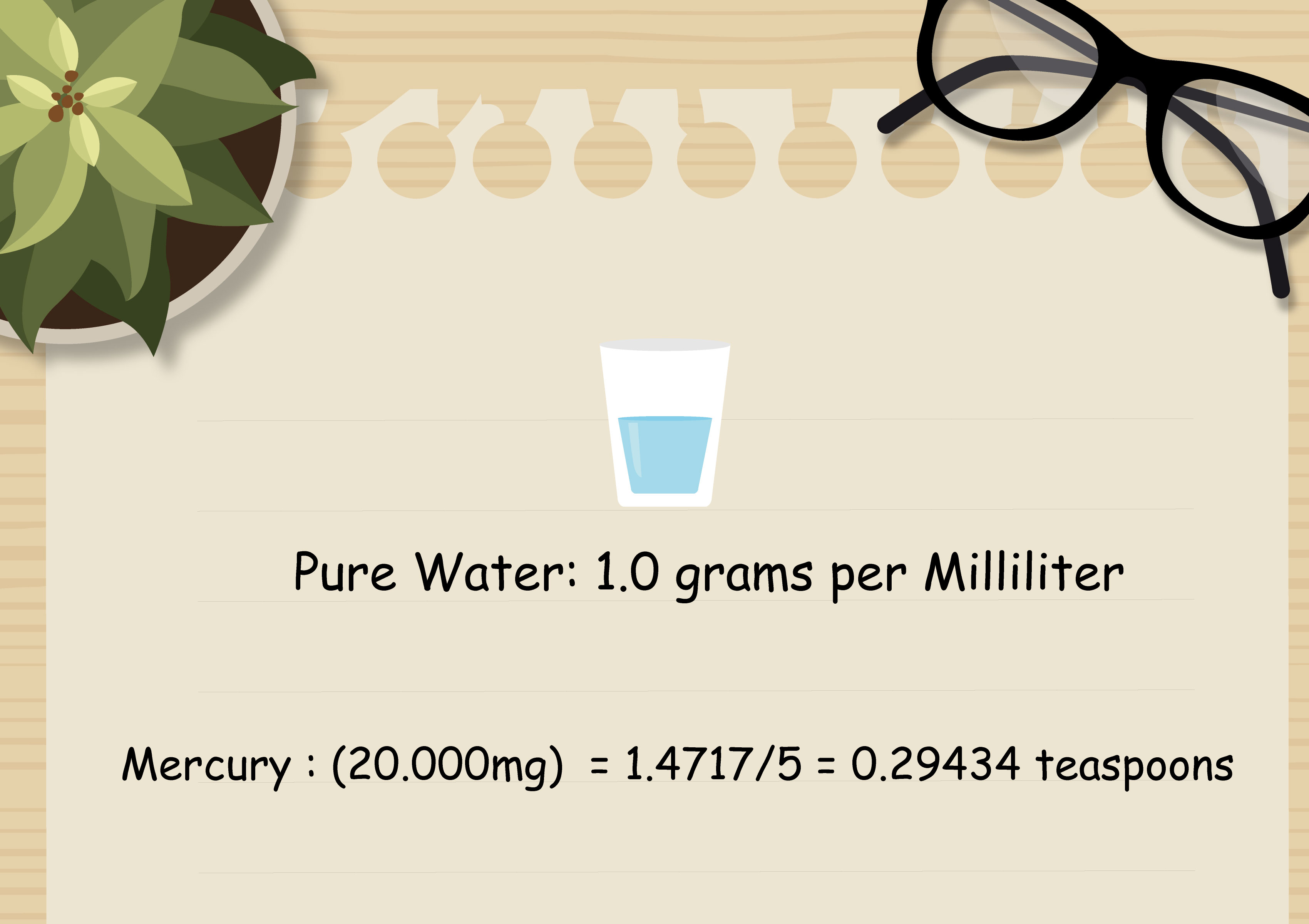
Water is often rounded to about 1 g per mL. That means 5 mL weighs about 5 g, or 5,000 mg. So for a water-like liquid, 5,000 mg is roughly 1 teaspoon.
But this is only a good rough example for substances with a similar density. Thicker or heavier liquids can shift the answer.
Example 2: Granulated sugar
If 1 teaspoon of granulated sugar weighs about 4.2 g, then:
4,200 mg sugar = 1 tsp
So 2,100 mg sugar would be about 1/2 teaspoon.
Example 3: Table salt
If 1 teaspoon of table salt weighs about 6.1 g, then:
6,100 mg salt = 1 tsp
So 3,050 mg salt would be about 1/2 teaspoon.
Example 4: A liquid product labeled 250 mg per 5 mL
This one is easier because the manufacturer already did most of the work.
If the label says 250 mg per 5 mL, then:
- 250 mg = 5 mL = about 1 teaspoon
- 125 mg = 2.5 mL = about 1/2 teaspoon
- 500 mg = 10 mL = about 2 teaspoons
In this case, using milliliters directly is still the better move. The teaspoon value is just a translation, not the safest measuring method.
Common Mistakes to Avoid
Using a universal mg-to-teaspoon rule
There is no universal conversion because every substance has its own density. Anyone giving you one magic number for all ingredients is simplifying the problem past the point of being useful.
Confusing mg with mL
This happens all the time. Milligrams tell you the amount of substance by weight. Milliliters tell you the amount by volume. They are not interchangeable without more information.
Using household spoons for medicine
A “teaspoon” from your drawer may be nowhere near a true measuring teaspoon. For medication, use a dosing syringe or cup marked in mL.
Ignoring the label’s concentration
If the bottle says 125 mg/5 mL or 100 mg/mL, use that number. It is the most reliable path to the right answer.
When You Should Not Convert to Teaspoons at All
Sometimes the best conversion is no conversion.
If you are measuring:
- Prescription medication
- Children’s medicine
- Concentrated supplements
- Anything with a narrow safety margin
Stick to the unit on the label, especially mL. Teaspoons may feel familiar, but familiar does not always mean accurate. And when a product has a labeled concentration, a dosing syringe beats a kitchen shortcut every time.
Real-World Experiences: Where People Usually Get Tripped Up
One of the most common experiences people have with this topic starts in the kitchen. Someone is baking, sees a nutrition fact in grams or milligrams, and thinks, “No problem, I’ll just turn that into teaspoons.” Then the confusion starts. Sugar seems light, salt feels heavier, honey behaves like it has its own opinions, and baking powder lands somewhere in the middle. That is usually the moment people realize a teaspoon is not a tiny universal bucket of identical weight. It is just a measure of space. What fills that space changes everything.
Another very common experience happens with supplements. A label might list a serving as 1,000 mg, but the scoop or household measure is described in teaspoons. People assume the numbers should line up neatly, then discover the powder may be fluffy, packed, fine, coarse, or blended with other ingredients. Suddenly, 1 teaspoon does not equal what they expected. This is why supplement containers often feel like they were written by a scientist and a mystery novelist working together. The answer is usually there, but you have to find the concentration, serving size, or exact weight reference instead of guessing.
Medicine creates the most stressful version of this problem. Parents and caregivers often want a fast, familiar measure, so “teaspoon” sounds more comforting than “5 mL.” But this is exactly where mistakes happen. A kitchen spoon might be too shallow, too deep, or suspiciously enormous. Someone means well, eyeballs a dose, and the result is off. That is why dosing syringes and cups exist. They are not glamorous, but neither is calling poison control because the soup spoon got promoted to pharmacist.
People also run into trouble when they assume water rules apply to everything. Water is often used as the easy classroom example because its density is close to 1 g/mL. That makes the math friendly. But the real world is less polite. Honey is denser. Salt crystals pack differently than sugar crystals. Powders can trap air. Liquids can be thick, thin, suspended, or concentrated. So while water gives you a nice starting point for understanding the concept, it should not become your one-size-fits-all shortcut.
The good news is that once people understand the basic idea, the confusion usually disappears fast. They learn to pause and ask one better question: “What is the density or concentration of this specific product?” That single shift turns a vague conversion into an accurate one. It also makes future measuring easier, whether you are baking, mixing, tracking nutrients, or reading a medication label at the worst possible hour of the night. In real life, the most helpful habit is not memorizing one magic formula. It is learning not to trust a conversion until you know exactly what is being converted.
Conclusion
Converting milligrams to teaspoons is absolutely possible, but only when you have the missing bridge: density or mg-per-mL concentration. Without that, the conversion is just a guess wearing a calculator costume. The smart method is simple: identify the substance, find the right reference value, convert to milliliters, and then convert milliliters to teaspoons if needed.
The practical takeaway is even simpler: for food ingredients, use trusted weight references for that exact ingredient. For liquids, use the labeled concentration. For medicines, stick to mL and use a proper dosing tool. Your spoon drawer may be full of confidence, but it is not a laboratory.














