
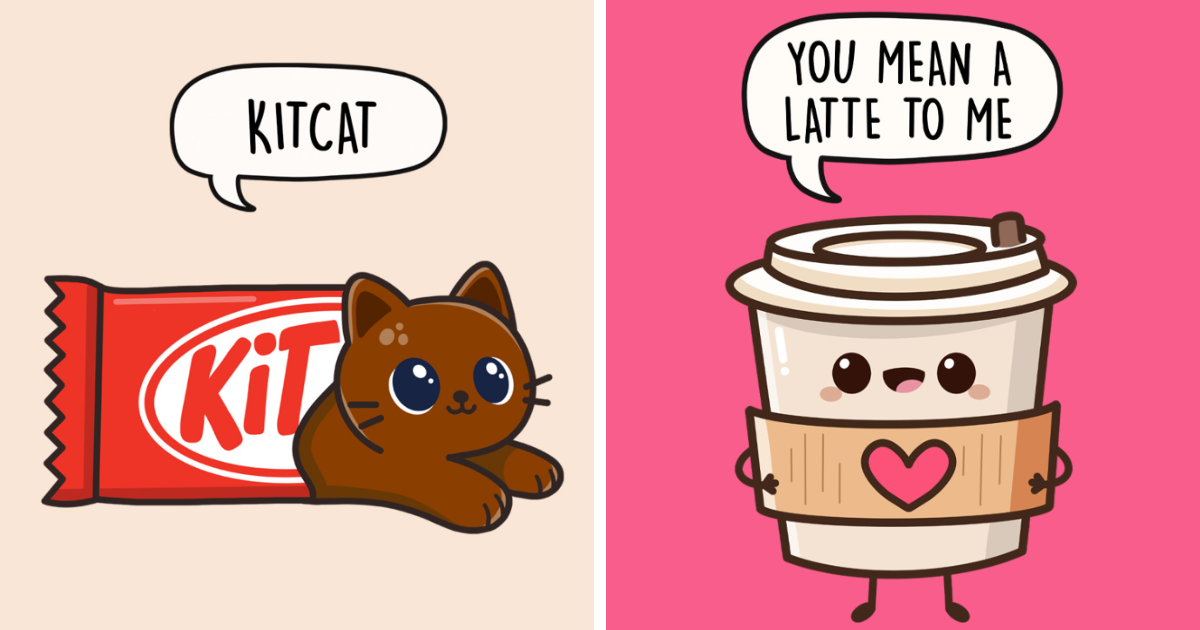
Some jokes enter the room with confidence. Puns trip over the doormat, spill coffee on the rug, and somehow still get invited back because everyone secretly loves them. That is the strange little magic behind illustrated puns: they are silly, simple, occasionally ridiculous, and absolutely impossible to ignore.
When I started illustrating 44 groan-worthy puns, I knew exactly what I was signing up for. There would be eye rolls. There would be dramatic sighs. There would be at least one person saying, “I hate that I laughed.” Perfect. That is the official sound of a pun doing its job.
This collection is built around the kind of wordplay that makes your brain take a tiny detour. You see a drawing, read a caption, pause for half a second, and then the meaning clicks. Suddenly, a pear is “pear-pressure,” a slice of bread has “loaf-esteem,” and a nervous mushroom is trying to be a “fungi” at the party. It is not high drama. It is not a 900-page literary masterpiece. But it is cheerful, bite-sized comedy with a tiny mustache drawn on its face.
Why Groan-Worthy Puns Still Work
A pun is a play on words that uses double meanings, similar sounds, or unexpected phrasing to create humor. In plain English, it is a joke that makes language misbehave. Instead of walking in a straight line, the sentence slips on a banana peel and lands in another meaning entirely.
That is why puns are so effective in illustrated cartoons. A drawing gives the joke a second engine. The words set up the meaning, while the image makes the punchline visible. A plain sentence like “I’m kind of a big dill” is mildly funny. But draw a pickle wearing sunglasses, standing under a spotlight, and suddenly the joke becomes a tiny celebrity with vinegar-based confidence.
Groan-worthy puns also have a special social power. They are rarely mean. They do not need a villain. They do not require deep background knowledge, complicated satire, or a dramatic explanation involving three historical footnotes and a detective board covered in yarn. Most puns are friendly. They simply ask the reader to enjoy a small collision between language and imagination.
The Joy of Turning Wordplay Into Art
Illustrating puns is different from writing ordinary jokes. The artist has to solve two puzzles at once: what does the joke say, and what should the joke look like?
For example, the phrase “shell-shocked” could become a frightened turtle peeking out of its shell after hearing surprising news. “A little chili” might become a tiny pepper wearing a winter scarf. “Nacho average snack” could become a tortilla chip with main-character energy. The best illustrated puns feel obvious after you see them, but getting there takes a surprising amount of sketching, crossing out, and staring into space like a philosopher who has just discovered a talking avocado.
The goal is not to make the art overly complicated. In fact, the simpler the illustration, the faster the joke lands. Clean shapes, expressive faces, and a clear caption help readers understand the pun instantly. If the viewer has to decode the drawing like an ancient map, the joke loses its fizz.
What Makes a Pun “So Bad It’s Good”?
The phrase “so bad it’s good” was practically invented for puns. A polished pun can be clever, but a shameless pun can be delightful. The groan is not failure. The groan is applause wearing a disguise.
Bad-good puns usually have three qualities. First, they are predictable enough to feel familiar. Second, they are surprising enough to create a tiny mental spark. Third, they are delivered with complete commitment. A pun cannot apologize for itself. It must stand there proudly, wearing socks with sandals, and say, “Yes, I meant that.”
That is why illustrated puns often work best when the character in the drawing looks completely sincere. A worried coffee cup saying, “I’ve bean better,” should not wink too hard at the audience. The joke is funnier if the cup appears genuinely exhausted. Comedy loves contrast, and nothing is more charming than a deeply emotional vegetable.
44 Illustrated Pun Ideas That Inspired the Collection
Instead of treating each pun like a throwaway gag, I imagined every illustration as a tiny scene. Some are food-based, some are animal-based, and some are built around ordinary objects having surprisingly dramatic lives. Here are the kinds of pun concepts that shaped the collection:
Food Puns With Too Much Personality
Food puns are the bread and butter of illustrated wordplay. They are familiar, visual, and endlessly flexible. A loaf of bread can have “loaf-esteem.” A potato can say, “I yam trying my best.” A taco can be “nacho problem.” A grape can have “raisin awareness.” A slice of pizza can feel “crust-fallen.” A waffle can be stuck in an “awful waffle” mood. A corn cob can be “all ears.” A cucumber can remain “cool as a cuke.” A donut can be “glazed and confused.” A pea can ask for “peas and quiet.”
These jokes work because food already has strong shapes and associations. A banana is instantly recognizable. A mushroom practically begs for a party hat. A pickle with confidence is comedy before the caption even arrives.
Animal Puns That Refuse To Behave
Animal puns are another gold mine. A sheep can say, “I’m feeling baaa-d.” A crab can be “shellfish.” A bee can be “buzzed about good news.” A cow can be “moo-ving on.” A cat can be “purr-suasive.” A fish can be “hooked on reading.” A snail can say, “I’m slowly getting there.” A frog can feel “un-frog-ettable.” A horse can be “stable emotionally.” A duck can say, “I’m winging it.”
Animals give illustrated puns a built-in personality. You can make a sheep dramatic, a bee ambitious, or a snail oddly inspirational. The viewer does not need much setup because the animal’s body already helps carry the joke.
Everyday Object Puns With Big Feelings
The most unexpectedly funny puns often come from boring objects behaving like they have a diary. A pencil can feel “pointless.” A clock can have “second thoughts.” A candle can be “burned out.” A broom can “sweep someone off their feet.” A chair can “support you.” A lightbulb can have a “bright idea.” A sock can feel “left out.” A mirror can “reflect on life.” A blanket can be “covering up emotions.” A book can have “too many stories.”
This category is especially fun because it transforms the ordinary into the absurd. We spend all day around pencils, mugs, pillows, and lamps, but we rarely imagine them having workplace stress, relationship drama, or motivational breakthroughs. Illustrated puns make objects feel like tiny actors auditioning for a sitcom.
How Visual Humor Makes Puns More Shareable
In digital culture, quick visual jokes travel well. People scrolling through social media do not always want a long setup. They want something they can understand in two seconds and send to a friend in three. Illustrated puns are perfect for that.
A good pun cartoon is compact. It has a clear image, a short caption, and an emotional reaction baked into the joke. The reader does not merely laugh; they think of someone. A cat pun gets sent to the cat person. A coffee pun gets sent to the friend who considers espresso a personality trait. A plant pun gets sent to the person who names their houseplants and probably apologizes when they forget to water them.
That shareability is not accidental. Puns are social little creatures. They create a tiny moment of connection, even when the joke is terrible. Especially when the joke is terrible.
The Anatomy of a Great Illustrated Pun
Behind every simple pun cartoon is a surprisingly practical structure. The best ones usually include four parts: a familiar subject, a double meaning, a visual twist, and an emotional expression.
The familiar subject makes the joke accessible. A potato, turtle, pencil, or coffee cup is easier to understand than an abstract concept. The double meaning creates the pun. The visual twist makes the wordplay visible. The emotional expression gives the character charm.
Imagine a candle with droopy eyes saying, “I’m burned out.” The phrase already means exhaustion, but the candle literally burns. Add a tired little face, a tiny desk, and maybe a half-finished to-do list, and the joke becomes instantly readable. The humor is not only in the words. It is in the poor candle looking like it just survived a Monday meeting.
Why Eye Rolls Are Part of the Fun
Many jokes aim for laughter. Puns aim for a more complex emotional cocktail: laughter, embarrassment, admiration, and mild betrayal. A good pun makes people react before they decide whether they approve of reacting.
That is why the eye roll matters. It is not rejection. It is participation. When someone groans at a pun, they are acknowledging the twist. They understood it. Their brain completed the little puzzle, and now their face is filing a complaint.
Illustrated puns make that reaction even stronger because the image removes any doubt. Once you see a pear in a therapist’s chair discussing “pear pressure,” there is nowhere to hide. The joke has found you. It is too late. You are involved now.
Making Simple Art Feel Expressive
One of the biggest lessons from creating pun illustrations is that small details do a lot of work. A raised eyebrow can turn a harmless pickle into a smug pickle. A tiny sweat drop can make a mushroom socially anxious. A crooked smile can make a slice of toast look like it knows exactly how cheesy the joke is.
Facial expressions are especially important because many pun characters are not naturally expressive. A carrot does not come with eyebrows. A muffin does not have posture. A paperclip does not have hands, dreams, or tax problems. The illustrator has to invent just enough human emotion to make the object relatable without making it visually crowded.
Color also helps guide the mood. Soft, friendly palettes make the jokes feel warm and approachable. Bold colors help characters pop on small screens. Simple backgrounds keep the punchline from getting buried. The art should support the joke, not elbow it out of the spotlight.
Why Puns Are Perfect For All Ages
Another reason illustrated puns remain popular is that they are usually clean, friendly, and easy to enjoy across generations. Kids like the funny pictures. Adults like the wordplay. Parents like jokes that do not require an emergency explanation in the grocery store.
Puns also support language learning in a playful way. They teach readers to notice sound, meaning, spelling, and context. A pun works because words can do more than one thing at once. That makes wordplay useful for writers, teachers, artists, and anyone who enjoys watching language put on a fake mustache.
For visual artists, puns are also excellent creative prompts. They force you to think metaphorically. What does “feeling crumby” look like? How would a “smart cookie” dress? What expression does a “hot dog” make at the beach? Each question becomes a miniature design challenge.
My Experience Illustrating 44 Groan-Worthy Puns
Creating 44 illustrated puns taught me that silliness is not as effortless as it looks. The final drawing may appear light and spontaneous, but the process often begins with a messy list of word combinations, half-jokes, almost-jokes, and jokes that deserve to be escorted out of the building.
I usually start by writing a cluster of related words. If the theme is breakfast, I list toast, egg, jam, butter, waffle, pancake, cereal, spoon, mug, and coffee. Then I look for phrases that sound similar or carry double meanings. “Egg-cited” is obvious, but obvious is not always bad. A familiar pun can still work if the drawing adds freshness. Maybe the egg is bouncing on a trampoline. Maybe it is opening a college acceptance letter. Maybe it is just very passionate about brunch.
The next step is choosing which puns deserve illustrations. Some wordplay looks funny in text but collapses visually. Other ideas become funnier once drawn. “A pencil with no point” is simple, but give that pencil a tiny existential crisis and suddenly it has emotional range. A joke about “thyme management” becomes much better when the herb is wearing a headset and holding a clipboard.
Sketching is where the puns start developing personalities. I learned to keep poses readable and expressions exaggerated. A stressed-out lemon should look dramatically stressed. A confident taco should stand like it has just won an award. A sleepy teabag should droop like it has been answering emails since sunrise.
One challenge was avoiding visual clutter. Because puns rely on quick recognition, every extra detail has to earn its place. If the joke is about a “smart cookie,” the cookie needs glasses, maybe a book, and perhaps a tiny graduation cap. It does not need a full library, a desk lamp, a coffee mug, and a detailed academic transcript. Too many props turn a simple joke into a Where’s Waldo scene with carbohydrates.
Another challenge was pacing. A collection of 44 puns needs variety. If every joke uses the same formula, the reader gets tired. I mixed food puns with animal puns, object puns, emotional puns, and tiny situational scenes. Some were one-character cartoons. Others had two characters reacting to each other. A few worked like mini comic panels, where the caption and expression completed the punchline together.
The most rewarding part was seeing how people responded. Some readers love the clever ones. Others prefer the painfully obvious ones. A few proudly announce that they hate puns while laughing at them, which is basically the official fan club uniform. The best reactions are when someone tags a friend because a pun feels weirdly personal. A burned-out candle goes to the overworked friend. A dramatic avocado goes to the brunch friend. A nervous potato goes to anyone who has ever tried their best and still felt a little mashed.
Illustrating puns reminded me that humor does not always need to be loud. Sometimes it can be small, gentle, and absurd. A smiling dumpling can brighten a lunch break. A punny frog can interrupt a doom-scroll. A worried slice of toast can make someone feel seen in the most ridiculous way possible.
And yes, there were puns that did not make the final collection. Some were too confusing. Some were too forced. Some were so bad that even I had to stare out the window and reconsider my choices. But that is part of the process. For every pun that works, there are several quietly waiting in the sketchbook, wearing fake glasses and hoping for a second chance.
Why We Keep Coming Back To Corny Humor
In a world full of complicated news, endless notifications, and group chats that somehow require project-management software, corny humor offers a tiny break. It asks very little from us. Look at the picture. Read the words. Groan. Smile. Continue being a person.
That simplicity is valuable. Illustrated puns are not trying to solve life’s biggest problems. They are trying to make the next ten seconds a little lighter. Sometimes that is enough. Sometimes a silly drawing of a dramatic banana is exactly the emotional support fruit we did not know we needed.
The beauty of groan-worthy puns is that they invite everyone into the joke. You do not have to be a comedy expert, an art critic, or a professional linguist. You just need to enjoy the moment when a word suddenly turns sideways and reveals a second meaning hiding behind it.
Conclusion: Long Live the Eye Roll
Illustrating 44 groan-worthy puns was an exercise in cheerful nonsense, visual storytelling, and affectionate word crimes. Each cartoon began with a simple question: what if this ordinary object, animal, or snack had one tiny joke to tell?
The answer, apparently, is a lot of giggles, a few dramatic sighs, and enough eye rolls to power a small wind farm. But that is the charm of pun illustrations. They are not funny despite being corny. They are funny because they are corny. They celebrate the playful side of language and remind us that even the smallest joke can create a real moment of connection.
So the next time someone groans at your pun, do not be discouraged. That groan means the joke landed. It may have landed wearing clown shoes, but it landed.
Note: This article is an original, web-ready draft synthesized from real humor-writing, wordplay, cartooning, and reader-engagement principles. Source links are intentionally not inserted, as requested.














