
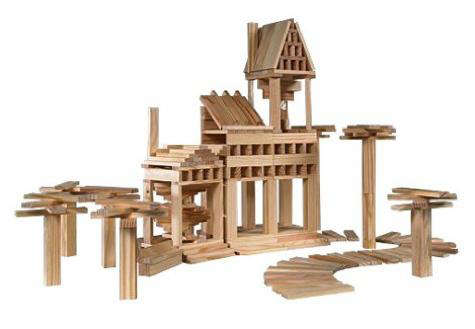
The Kapla 200 Blocks Set is one of those rare toys that looks almost suspiciously simple at first glance. Open the box, and there they are: 200 identical wooden planks. No buttons. No batteries. No blinking lights. No tiny plastic wizard yelling instructions from a speaker. Just smooth pine planks waiting for someone with imagination, patience, and possibly a strong desire to build a tower taller than the family dog.
And that is exactly the magic. Kapla blocks are designed around one clean idea: children and adults can build impressive structures using only balance, gravity, and creativity. There are no connectors, clips, magnets, glue, or complicated pieces hiding under the couch. Every plank is the same shape and size, so the challenge comes from planning, stacking, adjusting, testing, and occasionally watching a masterpiece collapse with the dramatic flair of a movie villain’s castle.
For parents, teachers, homeschoolers, and gift-givers searching for a high-quality wooden construction toy, the Kapla 200 Blocks Set offers a strong balance of simplicity, educational value, durability, and replay potential. It is not the loudest toy in the room. In fact, it is proudly quiet. But give it five minutes, and it can turn a living room floor into an architecture studio, an engineering lab, a zoo, a bridge-building contest, or a very serious “do not breathe near my tower” zone.
What Is the Kapla 200 Blocks Set?
The Kapla 200 Blocks Set, often called the Kapla 200 Box, includes 200 natural wooden planks made from pine. The official Kapla concept is based on identical planks with precise proportions. Each plank can be placed flat, on its side, or upright, allowing builders to create towers, bridges, animals, castles, letters, patterns, furniture shapes, marble-run-style ramps, and surprisingly elegant abstract sculptures.
Unlike many construction toys, Kapla does not rely on locking mechanisms. The pieces stay in place through careful stacking and balance. That means every project becomes a small lesson in physics. Build too fast, and the tower complains. Place a plank slightly off-center, and gravity sends a polite but firm memo. Adjust carefully, and suddenly a child has built a bridge that looks like it deserves its own ribbon-cutting ceremony.
Typical Contents of the Set
A standard Kapla 200 Blocks Set usually includes 200 natural wooden planks, a storage box, and a small building booklet or pamphlet with ideas. The box is designed to help keep the planks together, which is good news for anyone who has ever stepped on a toy at midnight and briefly reconsidered all life choices.
The 200-piece size is popular because it gives builders enough material for meaningful projects without becoming overwhelming. Smaller sets can feel limiting once children learn basic techniques, while very large sets may be more suitable for classrooms, clubs, or families with multiple enthusiastic builders. The 200 set sits comfortably in the middle: generous, flexible, and manageable.
Why Kapla Blocks Are Different from Regular Wooden Blocks
At first, Kapla blocks may seem similar to ordinary wooden building blocks, but their uniform plank design changes the entire play experience. Traditional block sets often include cubes, arches, cylinders, triangles, and rectangles. Those shapes are useful, but they also guide the child toward certain types of structures. Kapla’s identical planks create a more open-ended challenge. Every shape must be invented from the same basic unit.
This is where the Kapla 200 Blocks Set shines. Because all planks are identical, children learn to think in patterns, layers, angles, weight distribution, symmetry, repetition, and scale. A wall is not a special wall piece; it is a clever arrangement of planks. A roof is not a pre-made triangle; it is a balancing act. A spiral staircase is not included in the box; it is discovered plank by plank.
The Beauty of No Connectors
Toys with connectors are fun, but they often reward snapping parts together. Kapla rewards observation. Builders must notice whether a structure is leaning, whether weight is evenly distributed, and whether the base is wide enough. This makes the toy feel calmer, slower, and more thoughtful. It encourages children to pause, look, adjust, and try again.
That process is valuable. A falling tower is not really a failure; it is feedback with sound effects. Children learn that designs can improve, mistakes can be useful, and rebuilding is part of the game. In a world full of instant results, Kapla quietly teaches patience without turning into a lecture. Nobody needs to announce, “Today we are developing perseverance.” The blocks handle that naturally.
Educational Benefits of the Kapla 200 Blocks Set
The Kapla 200 Blocks Set is often described as an educational toy because it supports multiple areas of development at once. It fits comfortably into STEM learning, Montessori-style play, creative play, early math activities, and classroom building centers. But the educational value does not feel like homework. Children are not filling out worksheets about gravity; they are discovering gravity when their giraffe-shaped tower suddenly becomes modern art.
Spatial Reasoning and Early Engineering
Building with Kapla planks encourages spatial reasoning, which is the ability to understand how objects relate to one another in space. Children think about height, width, balance, direction, distance, and proportion. These skills are important for math, science, engineering, architecture, art, and everyday problem-solving.
A child building a bridge must decide where to place supports. A child making a tall tower must create a stable base. A child designing a house must think about walls, openings, and roof lines. These are early engineering questions dressed up as play. The child may call it “my castle for dinosaurs,” but underneath the dinosaur real estate development, there is real thinking happening.
Fine Motor Skills and Hand-Eye Coordination
Kapla blocks require careful hand placement. The planks are light enough for young children to handle, but precise enough to reward gentle movement. Stacking them helps strengthen fine motor skills, hand-eye coordination, finger control, and careful movement. Builders quickly learn that a dramatic hand wave near a tower is not recommended unless they enjoy starting over.
This makes the set useful for preschoolers, elementary-age children, and even older builders who enjoy detailed construction. The same plank that helps a young child stack a simple wall can help an older child create a complex geometric dome. The toy grows with the builder instead of being outgrown after one weekend.
Problem-Solving and Creative Confidence
One of the best features of the Kapla 200 Blocks Set is that it has no single correct outcome. A child can build a tower, knock it down, build a bridge, change it into a train station, add a “dragon garage,” and still be playing correctly. This flexibility supports creative confidence because children are free to test ideas without worrying about following strict instructions.
When a design fails, the child can troubleshoot: Was the base too narrow? Did the top become too heavy? Were the side walls uneven? Should the next version use a repeating pattern? These questions are the seeds of analytical thinking. The child is not just playing with wood; the child is experimenting with cause and effect.
Is the Kapla 200 Blocks Set Good for Montessori-Style Play?
Yes, the Kapla 200 Blocks Set fits very well with Montessori-style play because it is simple, hands-on, self-correcting, and open-ended. It invites children to choose their own work, explore independently, repeat activities, and learn through direct experience. There are no flashing rewards or electronic applause. The satisfaction comes from the child’s own construction.
The natural wooden design also appeals to families and classrooms that prefer simple materials. Kapla planks have a clean look and a pleasing tactile quality. They do not overwhelm the senses, and they blend easily into a playroom, classroom shelf, or homeschool environment. If toys had personalities, Kapla would be the calm one wearing linen and quietly solving a geometry puzzle.
Best Age Range for Kapla 200 Blocks
Kapla sets are commonly recommended for young children starting around age two or three and can remain engaging for much older children, teenagers, and adults. Younger children may begin with simple stacking, lining up planks, making roads, and building low walls. Older children can create more advanced structures such as bridges, towers, spirals, animals, buildings, and collaborative city layouts.
Adult supervision is always wise for younger children, especially when tall structures are involved. The pieces are wooden, and gravity is not known for being gentle. A safe play area with enough floor space helps prevent dramatic collapses from becoming dramatic toe incidents.
For Preschoolers
Preschoolers can use Kapla blocks for counting, sorting, stacking, naming shapes, building simple houses, and exploring balance. Adults can ask questions like, “What happens if we make the base wider?” or “Can you build a bridge for this toy car?” These small prompts encourage thinking without taking over the play.
For Elementary-Age Children
Elementary-age children can handle more complex challenges. They may enjoy timed building games, symmetry tasks, tower competitions, alphabet construction, marble ramp experiments, or designing landmarks. The 200-piece quantity is especially useful at this stage because it allows larger projects without requiring a classroom-sized collection.
For Families and Adults
Kapla blocks are not just for kids. Adults often become suspiciously invested once the first tower reaches knee height. Family play can turn into cooperative building, friendly competition, or quiet evening creativity. It is a screen-free activity that works well across ages because everyone uses the same pieces but can build at different levels of complexity.
What Can You Build with 200 Kapla Blocks?
A 200-piece Kapla set gives builders enough planks to create a wide variety of projects. It is large enough for one child to build a detailed structure or for two children to collaborate on a shared design. It may not be enough for a full-scale living room kingdom with suburbs, but it is plenty for impressive play.
Simple Beginner Ideas
Beginners can start with walls, towers, fences, roads, letters, numbers, and small houses. These projects teach basic placement and balance. A simple square house with four walls and a roof is a satisfying first build. So is a tall tower, though the tower may eventually meet the floor in a loud educational moment.
Intermediate Building Challenges
Once builders understand the planks, they can try bridges, staircases, castles, garages, tunnels, and patterned towers. Repeating patterns help children understand symmetry and rhythm. Bridges introduce the idea of support. Staircases teach gradual height changes. Castles, naturally, teach the importance of defending snacks from imaginary dragons.
Advanced Creative Projects
Advanced builders can create animals, domes, spirals, abstract sculptures, famous landmarks, and chain-reaction layouts. With patience, 200 planks can become surprisingly artistic. Because the pieces are identical, the final result often looks elegant and architectural, even when the builder’s original plan was simply “make something huge.”
Kapla 200 Blocks Set vs. Other Building Toys
Compared with plastic bricks, Kapla blocks offer a quieter, more organic building experience. Plastic brick systems are excellent for detailed models and imaginative scenes, but they depend on interlocking pieces. Kapla depends on balance. That makes the play feel more like architecture and physics, while plastic bricks often feel more like assembly and storytelling.
Compared with magnetic tiles, Kapla blocks are less colorful and less instantly stable, but they offer a deeper balancing challenge. Magnetic tiles are wonderful for quick shapes and bright visual play. Kapla requires more patience and precision. The reward is the feeling that the structure is standing because the builder truly figured it out.
Compared with classic wooden blocks, Kapla’s identical plank system allows for more refined, lightweight, vertical, and patterned constructions. Classic blocks are chunky and varied; Kapla is slim and precise. Both are valuable, but Kapla has a distinct architectural personality.
Why Parents Like the Kapla 200 Blocks Set
Parents often appreciate toys that are durable, quiet, versatile, and not destined for the donation box after three afternoons. The Kapla 200 Blocks Set checks those boxes. It can be used alone or with others. It does not require charging. It does not become obsolete after a software update. It does not sing the same song 400 times until everyone in the house develops a nervous twitch.
Storage is also straightforward. The planks are uniform, so cleanup is simpler than sorting a mixed construction set with tiny specialty parts. Of course, children may still argue that a half-built tower must remain in the hallway “because it is important.” That is less a toy problem and more a junior architect problem.
How Teachers and Homeschoolers Can Use Kapla Blocks
In classrooms and homeschool spaces, Kapla blocks can support structured and unstructured learning. Teachers can place the set in a building center for free exploration or use it for specific challenges. For example, students can build the tallest freestanding tower, create a bridge that spans a certain distance, make a pattern that repeats three times, or design a structure inspired by a book or history lesson.
Kapla blocks also support language development. Children naturally describe what they are building, negotiate with partners, explain why a structure fell, and tell stories about their creations. A simple building session can include vocabulary such as balance, support, stable, equal, taller, wider, pattern, edge, center, and symmetry.
Easy Learning Prompts
Adults can enrich play by asking thoughtful questions instead of giving too many directions. Try prompts such as: “How can we make this stronger?” “What part is holding the most weight?” “Can you build the same shape twice?” “What would happen if the bridge were longer?” These questions invite children to observe and reason while keeping the activity playful.
Buying Tips for the Kapla 200 Blocks Set
When buying a Kapla 200 Blocks Set, look for authentic Kapla branding, a natural wood finish, 200 planks, and the included storage box or building booklet. Because Kapla is a well-known construction toy, similar plank-style sets exist. Some alternatives may be fine, but authentic Kapla planks are known for their precise proportions and smooth finish.
Consider how the set will be used. For one child at home, 200 blocks is a strong starter size. For siblings who love to build together, 200 may still work, though larger sets can reduce negotiations that sound like tiny city council meetings. For classrooms, libraries, and playgroups, larger collections may be more practical.
Care and Storage Tips
Kapla blocks are easy to maintain. Keep them dry, store them in their box, and wipe them with a clean cloth when needed. Because they are wooden planks, they should not be soaked in water or cleaned with harsh chemicals. A simple routine keeps the planks ready for years of building.
It is also helpful to create a building zone. A flat floor, low table, or rug-free surface gives structures the best chance of survival. Thick carpet may add wobble, which is exciting if the goal is suspense but less helpful if the goal is a stable tower.
Real Experiences with the Kapla 200 Blocks Set
The first thing many families notice about the Kapla 200 Blocks Set is how quickly it pulls people into the same activity. A child starts with a small tower. A parent says, “Nice tower.” Then the parent casually adds one plank. Three minutes later, everyone is on the floor discussing structural integrity like a very small engineering committee. The dog is confused. The coffee is forgotten. The tower is now a family member.
One of the best real-life experiences with Kapla is watching children move from random stacking to intentional design. At first, they may simply pile planks upward and laugh when they fall. Soon, they start making wider bases. Then they discover patterns. Then they realize that two vertical planks can support a flat plank like a doorway. That tiny discovery feels enormous because they found it themselves.
The 200-block size is especially satisfying during family play. It gives enough pieces for a child to build a tower while another child makes a road, a fence, or a tiny apartment complex for toy animals. It also teaches sharing in a very practical way. When there are only 200 planks and someone wants 196 of them for “a secret project,” negotiation skills appear quickly.
Kapla also works beautifully as a calm-down activity. Because the play requires focus and gentle movement, it can help shift the mood after a noisy day. Children who struggle to sit still for traditional quiet activities may enjoy the physical yet controlled nature of building. It is active, but not chaotic. It is creative, but not messy. It gives hands something meaningful to do.
Another memorable experience is the first truly big collapse. It sounds like a wooden rainstorm. For a moment, everyone freezes. Then comes the emotional decision: laugh, rebuild, or dramatically flop onto the carpet. Over time, children learn that collapse is part of the process. They become less afraid of mistakes and more interested in improving the next version. That lesson is worth more than a perfect tower.
The set is also excellent for mixed-age play. A younger child can build a simple wall while an older sibling creates a bridge. A parent can demonstrate a pattern, then step back. A grandparent can join in without needing instructions, apps, passwords, or a firmware update. The toy’s simplicity makes it welcoming.
In everyday home use, the Kapla 200 Blocks Set tends to become more than a toy. It becomes a go-to activity for rainy afternoons, screen-free evenings, playdates, homeschool breaks, and “I’m bored” emergencies. It is not flashy, but it is dependable. Like a good wooden spoon or a favorite hoodie, it quietly proves its value again and again.
Final Thoughts: Is the Kapla 200 Blocks Set Worth It?
The Kapla 200 Blocks Set is worth considering for families, teachers, and gift-givers who want a beautiful, durable, open-ended wooden construction toy. It encourages creativity, fine motor skills, spatial reasoning, patience, cooperation, and early engineering thinking. It is simple enough for young children and challenging enough for older builders.
Its greatest strength is that it does not tell children what to build. It simply gives them 200 precise wooden planks and lets imagination take the wheel. Sometimes the result is a castle. Sometimes it is a bridge. Sometimes it is a mysterious structure that the child insists is “a robot hotel with a pancake roof.” Either way, the learning is real, the play is rich, and the possibilities keep expanding.
For anyone looking for a screen-free, STEM-friendly, Montessori-style toy with long-term play value, the Kapla 200 Blocks Set deserves a serious spot on the shortlist. Just remember one important household rule: when the tower reaches waist height, walking nearby becomes a privilege, not a right.
Note: Product details such as packaging, booklet inclusion, dimensions, and recommended age may vary slightly by retailer or market. Always check the current product label and safety guidance before purchase.












