For years, software pricing followed a wonderfully tidy formula: count the users, multiply by the monthly seat price, and send an invoice large enough to make procurement request “a quick call.”
Then software stopped behaving like a simple tool used by one human at one desk. Cloud infrastructure scaled automatically. APIs performed millions of invisible tasks. Artificial intelligence began completing work without needing an employee login. Suddenly, charging by seat looked less like a universal rule and more like one option in an increasingly crowded pricing toolbox.
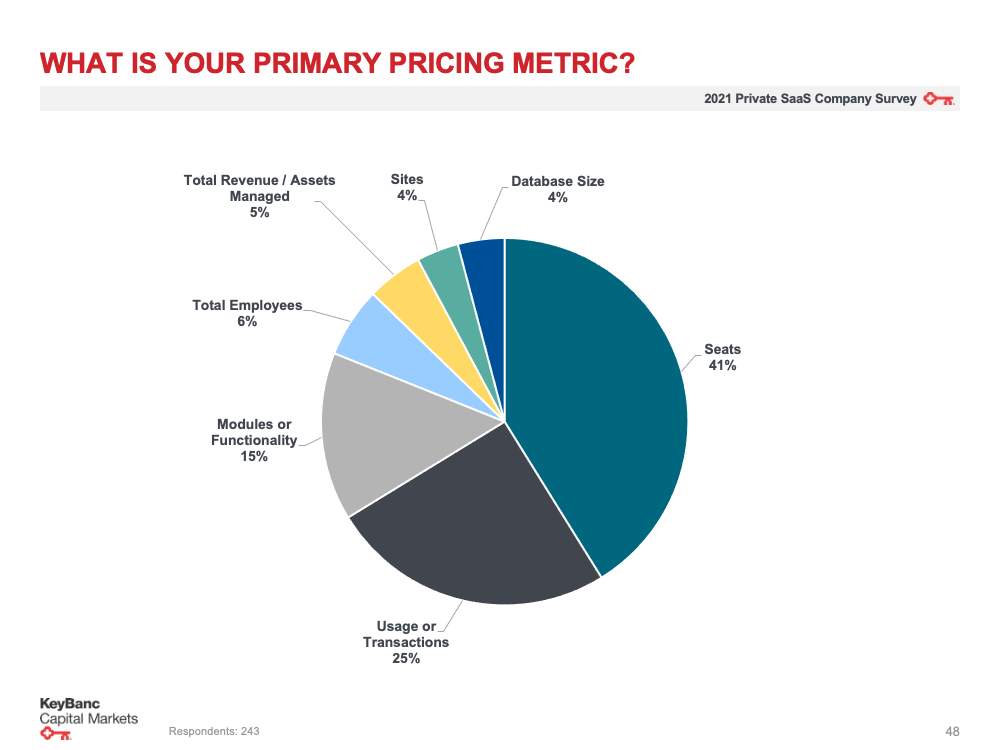
The headline-grabbing KeyBanc figure captures that transition: only 41% of respondents identified seats as their primary pricing metric. However, the date matters. The number came from the 2021 KeyBanc Capital Markets Private SaaS Company Survey, conducted during June and July 2021. More than 350 private SaaS companies participated, while 243 answered the primary-pricing-metric question. Therefore, 41% should not be treated as a live 2026 market-share estimate. It is better understood as an early, influential snapshot of SaaS pricing diversification.
What the KeyBanc SaaS Pricing Data Actually Showed
Seats remained the largest individual category in the survey, accounting for 41% of primary pricing metrics. Yet most surveyed businesses59%used something else.
Usage or transactions represented 25%. Modules or functionality accounted for 15%. Other companies priced according to total employees, revenue or assets managed, the number of sites, or database size. In other words, per-seat pricing was still the plurality winner, but it no longer owned the whole neighborhood.
The survey population also included horizontal applications, vertical SaaS platforms, infrastructure-management products, cybersecurity tools, data infrastructure companies, communications software, fintech providers, and e-commerce technology. A developer API and an employee scheduling application naturally create value in different ways, so expecting both to use the same billing metric would be like charging for pizza by the number of people who looked at the menu.
Primary Pricing Metrics in the 2021 Survey
- Seats: 41%
- Usage or transactions: 25%
- Modules or functionality: 15%
- Total employees: 6%
- Total revenue or assets managed: 5%
- Sites: 4%
- Database size: 4%
SaaStr’s interpretation was appropriately cautious: per-seat pricing remains excellent when it matches how customers want to buy, but the broad SaaS market contains far too many product categories for seats to serve as the automatic answer.
Why Per-Seat Pricing Became the SaaS Default
Seat-based pricing became popular for good reasons. It is easy to explain, quote, forecast, contract, and audit. A customer with 50 licensed users understands why its bill is larger than that of a customer with 10. The vendor can estimate annual recurring revenue without consulting a meteorologist, a data scientist, and the phases of the moon.
Predictable Revenue and Budgets
Recurring seat licenses help finance teams forecast revenue and give buyers a relatively stable software budget. Sales representatives can negotiate around a familiar quantity, procurement can compare vendors, and accounting can recognize subscription revenue with fewer surprises.
A Natural Fit for Human-Centered Applications
Seats still make sense when product value grows with the number of people actively using the software. Customer relationship management, project collaboration, design, support, and workforce applications often fit this pattern.
Salesforce, for example, continues to offer major CRM products with per-user monthly pricing. Slack similarly prices paid plans according to active users rather than charging for every message, emoji, or heroic use of the “remind me later” button.
Easy Expansion Revenue
When a customer hires more employees or deploys the product to another department, additional licenses produce expansion revenue. That connection between customer headcount and vendor growth helped define the classic SaaS land-and-expand playbook.
Why Only Pricing by Seat Is Becoming Harder
The problem is not that seats suddenly became bad. The problem is that many modern software products no longer create value in direct proportion to the number of humans holding logins.
Automation Breaks the Seat-to-Value Connection
Imagine an AI platform that allows one analyst to complete work that previously required five people. Under a pure per-seat model, the software vendor might earn less precisely because its product made the customer more productive. That is an impressive demonstration of value followed by an oddly self-defeating invoice.
AI agents make the mismatch even more obvious. Agents can process support cases, create content, analyze documents, generate code, or complete workflows around the clock. They do not need coffee, health insurance, or individual swivel chairs. Pricing exclusively around employee licenses can undercharge heavy automated use while overcharging teams that maintain many occasional users.
Infrastructure Costs Scale With Consumption
Cloud, data, communications, and AI products often incur costs as customers consume compute, storage, messages, API calls, or tokens. A small customer making 10,000 requests and an enterprise making 100 million requests may have the same number of developers, but they do not create the same cost or receive the same economic value.
AWS uses pay-as-you-go pricing across much of its portfolio. Snowflake meters compute through credits based on warehouse size and running time. Twilio charges for communications activity such as messages, phone numbers, channels, and other usage dimensions. These models connect customer spending more closely to consumption than a simple login count could.
Customers Are Scrutinizing Unused Licenses
During periods of generous technology spending, companies often purchased more licenses than employees actively used. Tighter budgets changed the conversation. Finance and procurement teams now examine activation, engagement, overlapping applications, and dormant seats before renewals.
A buyer who discovers that 35% of paid licenses are inactive does not usually celebrate the vendor’s revenue predictability. The buyer asks for fewer seats, a lower rate, or a pricing model that better reflects actual adoption.
Product-Led Growth Rewards Low-Friction Entry
Usage-based pricing can reduce the initial commitment required to try a product. A startup may begin with a tiny monthly bill, prove value, and expand naturally as activity increases. This approach can complement self-service onboarding because customers do not need to predict their eventual team size before testing the software.
The Rise of Usage-Based and Hybrid SaaS Pricing
Research published after the 2021 KeyBanc survey shows continued interest in consumption pricing, but the market is not simply replacing subscriptions with utility bills.
Chargebee’s research across more than 300 SaaS businesses reported that 63% used some form of usage-based pricing. It also emphasized that usage pricing was frequently layered onto recurring subscriptions rather than deployed alone. Metronome’s 2025 report found that 77% of the largest software companies it analyzed incorporated consumption pricing somewhere in their revenue models, while 78% of companies using it had adopted it within the previous five years.
Maxio’s 2025 pricing research similarly found that hybrid businessesthose combining subscription and usage componentsreported the highest median growth rate in its dataset. The report also highlighted the growing importance of variable-revenue forecasting, transparent billing, and AI monetization.
What Hybrid Pricing Looks Like
A hybrid plan normally includes a predictable base commitment plus a variable component. Common structures include:
- A platform fee plus API usage
- Per-seat licenses plus AI credits
- A monthly subscription with included transactions and overage charges
- An annual spending commitment that customers draw down through consumption
- A core product subscription plus separately priced modules
Stripe describes hybrid pricing as a way to combine a flat subscription with metered charges, tiered usage rates, or minimum spending commitments. The goal is to preserve some revenue predictability while allowing customer spending to scale with consumption.
Even Major Vendors Are Mixing Models
Salesforce illustrates the wider transition. Its traditional CRM products remain strongly associated with per-user licensing, while Agentforce offers consumption-based choices such as Flex Credits and Conversations alongside per-user options. The lesson is not that every vendor must abandon seats. It is that a single company may need different value metrics for humans, automated agents, transactions, and specialized workloads.
Per-Seat Pricing Is Not Dead
Pronouncing the death of seat-based SaaS pricing makes for an exciting conference slide, but it is not especially accurate. Seats remain useful when access, collaboration, governance, or individual productivity drives value.
The latest KeyBanc and Sapphire Ventures Private SaaS Company Survey adds an important twist. Its 2025 findings indicated that 67% of participating companies were already monetizing AI, but respondents tended to favor subscription models over usage-based and hybrid approaches for that monetization. That does not reverse the consumption trend. It shows that subscriptions remain attractive because businesses and customers still value simplicity and predictable spending.
Seat Pricing Works Best When:
- Every licensed user receives clear and recurring value.
- Customer usage does not vary dramatically between accounts.
- The vendor’s service costs are mostly fixed rather than consumption-driven.
- Collaboration and adoption increase as more employees join.
- Buyers can easily manage licenses and remove inactive users.
Seat Pricing Struggles When:
- Automated systems perform more work than human users.
- Infrastructure costs vary sharply with consumption.
- A few users can generate enormous workloads.
- Customers receive measurable value from transactions or outcomes.
- Charging for every viewer discourages broad adoption.
How SaaS Companies Should Choose a Pricing Metric
The best value metric should grow as the customer receives more value, remain understandable, and be measurable without turning the invoice into a detective novel.
1. Start With the Customer’s Unit of Value
Ask what changes after the customer adopts the product. Is more revenue processed? Are more documents analyzed? Are more employees productive? Are more incidents resolved? The answer may point toward seats, transactions, assets managed, workflows, credits, storage, or outcomes.
2. Check Whether the Metric Scales Fairly
Model several customer profiles. A good metric should not punish small but highly engaged customers or allow giant enterprises to consume enormous resources for a tiny flat fee. Pricing should feel proportionate on both sides of the table.
3. Protect Predictability
Pure pay-as-you-go billing can produce volatile revenue for vendors and uncomfortable invoices for buyers. Minimum commitments, included allowances, spending alerts, volume tiers, and caps can make variable pricing easier to manage.
Usage visibility is essential. Customers should be able to see consumption, understand the rate, estimate the coming invoice, and identify what caused a spike before the finance team begins sending emails written entirely in capital letters.
4. Test the Billing Infrastructure
Metered pricing requires reliable event collection, rating, invoicing, revenue recognition, credits, contract management, and dispute handling. A theoretically perfect pricing model becomes a practical disaster when three internal systems disagree about how many events occurred.
5. Align Sales Compensation and Customer Success
Seat-based contracts usually produce a known booking value at signature. Consumption models may expand after adoption. Compensation plans must reward representatives for landing suitable customers without encouraging unrealistic commitments. Customer success teams also need to help buyers achieve useful consumption rather than merely increase activity for activity’s sake.
6. Treat Pricing as a Product
Pricing should evolve as the product, customer mix, competitive environment, and cost structure change. Companies can test packaging, included usage, minimum commitments, credit systems, and enterprise agreements before performing a dramatic companywide migration.
Practical Experience: What SaaS Teams Commonly Learn
The following are composite operating experiences based on recurring SaaS pricing patterns. They are illustrative rather than claims about one unnamed company.
Experience 1: The Ghost-Seat Renewal
A collaboration platform sells an enterprise customer 1,000 seats. The initial contract looks magnificent. Twelve months later, the customer’s software-management team discovers that only 620 employees are active in a typical month. Procurement requests a 38% license reduction and questions the renewal altogether.
The vendor learns that selling shelfware produces revenue today but creates a credibility problem tomorrow. It introduces active-user billing for selected plans, improves administrative reporting, and gives customers tools to reassign licenses. The vendor sacrifices some theoretical seat volume but gains a cleaner renewal conversation and fewer arguments about users who left the company eight months ago.
Experience 2: The Usage-Based Bill That Became a Horror Movie
An API company launches pure consumption pricing because it appears fair and elegant. Customers love the low starting cost. Then one customer experiences a viral traffic spike and receives a bill several times larger than expected.
The calculation is accurate, but accuracy does not prevent surprise. The customer feels punished for succeeding, while support spends days explaining rate tables. The company adds real-time dashboards, threshold alerts, estimated month-end charges, volume discounts, and optional committed-use plans. The lesson is simple: usage-based pricing without usage visibility is not customer-friendly pricing. It is merely a surprise generator with excellent mathematics.
Experience 3: The Hybrid Model That Calmed Everyone Down
A workflow-automation vendor struggles to choose between seats and task volume. Seat pricing undercharges small teams that automate millions of tasks. Pure task pricing worries enterprise buyers who need annual budget certainty.
The company introduces a base platform subscription that includes administrative access, security features, support, and a block of monthly tasks. Additional consumption is charged through predictable tiers. Finance gains a recurring revenue floor, customers gain a known allowance, and the vendor captures expansion when automation grows.
The model is not perfectly simple, but it reflects two types of value: access to the platform and the work performed through it.
Experience 4: The Value Metric Customers Could Not Understand
A SaaS team invents a proprietary credit system combining compute time, document complexity, storage, and AI processing. Internally, it is technically elegant. Externally, it resembles a board game designed during a power outage.
Sales representatives cannot estimate customer costs without a spreadsheet. Buyers cannot compare plans. Customer success cannot explain why two similar workflows consume different credit amounts. The company eventually simplifies the metric, publishes concrete examples, and gives each account a usage simulator.
The experience demonstrates that a metric can be economically precise and commercially terrible. A successful pricing unit must be measurable by the vendor and understandable to the customer.
Experience 5: The Migration That Needed More Than a Pricing Page
A mature SaaS company decides to replace seat pricing with consumption billing. Product updates its meters, but other teams are not ready. Sales compensation still rewards total contract value at signature. Revenue operations lacks procedures for variable invoices. Customer contracts define users but not billable events. The data warehouse records activity differently from the billing platform.
The rollout slows while legal, finance, sales, product, engineering, and customer success redesign their processes. The final lesson is perhaps the most important: changing a pricing model is not a website-editing project. It is a company operating-model change wearing a pricing-page costume.
Conclusion: Price the Value, Not the Fashion
The KeyBanc finding that only 41% of surveyed SaaS companies primarily priced by seat was not proof that licenses had disappeared. It showed that SaaS had already become too diverse for one universal pricing metric.
Today’s market is even more varied. Human-centered applications may continue thriving with per-user subscriptions. Infrastructure products naturally lean toward consumption. AI tools may use seats, credits, conversations, tokens, outcomes, or several of them at once. Hybrid pricing often provides a workable compromise between customer fairness and revenue predictability.
The winning strategy is not to chase whichever model currently receives the loudest applause on social media. It is to identify how customers experience value, select a metric that grows with that value, make costs understandable, and build the operational systems required to support it.
Seats are not dead. They simply have roommates now.