
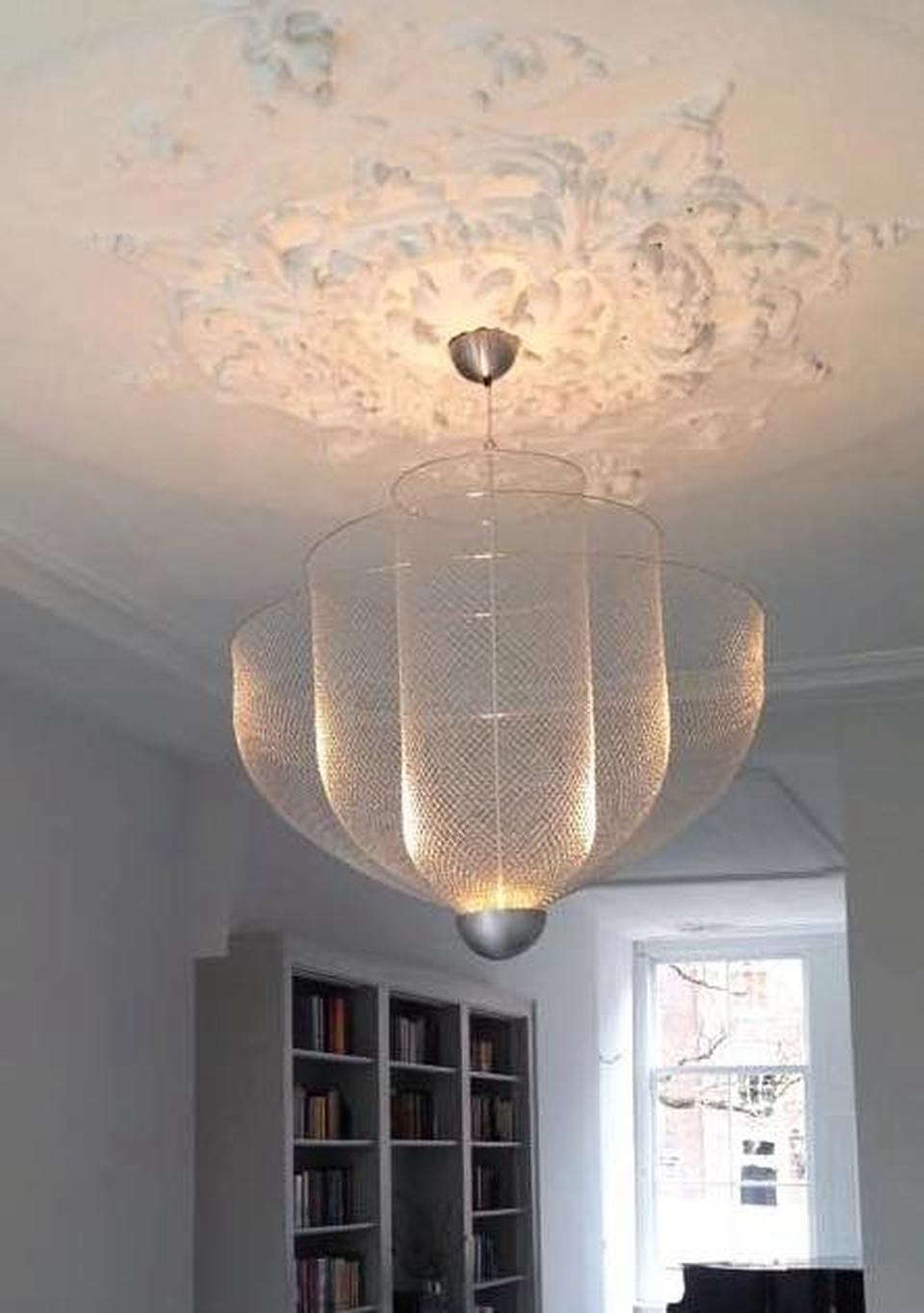
The Large Meshmatics Chandelier is what happens when humble wire mesh gets invited to a black-tie event. Designed by Rick Tegelaar for Moooi, this sculptural pendant turns an ordinary industrial material into a delicate, layered centerpiece that appears to float in the room.
At approximately 35.4 inches in diameter and height, the large version has enough scale to command attention over a dining table, in an open living area, or beneath a tall entryway ceiling. Yet its transparent construction prevents it from behaving like a giant visual roadblock. Instead of filling the room with solid mass, it creates depth, shadow, and a warm ambient glow.
This guide explores the chandelier’s design story, specifications, lighting performance, placement options, installation requirements, maintenance, advantages, limitations, and realistic ownership experience.
What Is the Large Meshmatics Chandelier?
The Large Meshmatics Chandelier is a contemporary suspension light made from three carefully shaped layers of fine galvanized steel mesh supported by brass structural details. The fixture was developed by Dutch designer Rick Tegelaar and produced by Moooi, a design brand known for turning unconventional ideas into dramatic furniture and lighting.
Tegelaar did not simply find a roll of mesh, bend it into a rough circle, and call it Tuesday. He developed specialized machinery and forming tools that allowed the flexible wire material to be stretched over molds with considerable accuracy. Tension created during the forming process helps the mesh retain its sculptural shape.
The resulting fixture looks simultaneously engineered and organic. From one angle, it resembles an inverted fishing net. From another, it looks like a translucent seedpod, a floating architectural model, or a very fashionable jellyfish that has developed excellent taste in interiors.
Research basis:
The Design Story: Making Modest Materials Magnificent
Wire Mesh Becomes a Luxury Material
The central idea behind Meshmatics is material transformation. Galvanized wire mesh is normally associated with fencing, workshops, ventilation systems, and practical construction. It is inexpensive, flexible, and rarely treated as decorative.
Tegelaar saw more potential. By controlling the way the mesh stretches, contracts, and settles over a form, he created a lightweight structure with surprising precision. The material becomes visually refined without losing its industrial identity. You can still recognize the hexagonal grid, but it now behaves more like metallic lace than hardware-store fencing.
Three Layers Create Depth
The chandelier’s three nested mesh forms are essential to its appearance. Their overlapping patterns create shifting levels of transparency. When viewed from different positions, the grids align, separate, and visually vibrate.
This layered construction produces a moiré-like effect without relying on printed decoration. The ornament comes directly from the material and geometry. Even when the light is switched off, the chandelier remains a three-dimensional object with strong architectural presence.
Transparency Keeps the Large Fixture Airy
A chandelier measuring nearly three feet across could easily overpower a room. Meshmatics avoids that problem because most of its apparent volume is actually open air. Sightlines continue through the fixture, allowing ceilings, windows, artwork, and architectural details to remain visible.
This makes the large version particularly useful when a room needs a strong focal point without a heavy shade blocking the view. The chandelier announces itself confidently, but it does not stand in the middle of the room yelling, “Please stop looking at everything else.”
Research basis:
Large Meshmatics Chandelier Specifications
Specifications can vary slightly by regional electrical configuration, production revision, and authorized retailer listing. The following figures represent commonly published U.S. specifications for the large model.
| Designer | Rick Tegelaar |
|---|---|
| Manufacturer | Moooi |
| Approximate fixture size | 35.4 inches in diameter by 35.4 inches high |
| Approximate fixture weight | About 5.7 pounds in several U.S. listings |
| Primary materials | Galvanized steel mesh and brass |
| Light source | Integrated LED |
| Color temperature | Warm white, commonly listed at 2700K |
| Common U.S. electrical listing | Approximately 9 watts, with published output varying by configuration |
| Dimming | Compatible with specified electronic low-voltage or reverse-phase dimming systems |
| Location | Indoor, dry-location use |
| Manufacturing origin | Made in the Netherlands |
Some U.S. technical sheets list approximately 388 delivered lumens, while other product pages publish different lumen figures or electrical details. Before ordering, obtain the current specification sheet for the exact SKU, voltage, dimming system, and cord length you plan to purchase.
Research basis:
What Kind of Light Does It Produce?
The Large Meshmatics Chandelier should be understood primarily as an ambient and decorative light. Its integrated LED directs light upward through the layered mesh and toward the ceiling. The mesh reflects, scatters, and softens the illumination, producing shimmering highlights and an intricate network of shadows.
The warm 2700K color temperature is suited to dining rooms, lounges, bedrooms, reception spaces, and other environments where comfort matters more than clinical brightness. The light can make brass, warm woods, terracotta, cream upholstery, and textured walls look especially inviting.
However, this is not the fixture to choose as the only source of practical illumination in a large room. Its greatest strength is atmosphere rather than raw lumen output. A successful lighting plan may combine it with recessed lights, wall sconces, floor lamps, under-cabinet lights, or discreet directional fixtures.
Think of the chandelier as the room’s lead singer. It delivers mood and personality beautifully, but it still benefits from a competent supporting band.
Research basis:
Best Places to Install a Large Meshmatics Chandelier
Over a Dining Table
A dining room is one of the most natural settings for the large Meshmatics. Its round form can soften a rectangular table, echo a circular table, and visually define the dining zone within an open floor plan.
Because the fixture is transparent, people seated across from one another can usually maintain comfortable sightlines. The shadow pattern also creates a memorable evening atmosphere when the chandelier is dimmed.
In an Entryway or Foyer
An entryway gives the chandelier room to behave like a suspended sculpture. In a two-story foyer, the long suspension cable can emphasize vertical space while the 35.4-inch form provides enough scale to remain visible from both floors.
Before installation, check the view from the front door, staircase, upper landing, and adjacent rooms. A few inches of adjustment can make the difference between “perfectly centered” and “why does it look like it is trying to escape?”
In a Living Room
The fixture works well over a central seating group, particularly in a room with neutral furniture and strong architectural lines. Its mesh adds texture without introducing a large opaque shade.
Published residential projects have used Meshmatics as an anchor in modern living rooms, including a renovated Brooklyn townhouse and a colorful California interior. These installations demonstrate that the chandelier can complement both restrained and highly expressive spaces.
Research basis:
In a Bedroom
A large chandelier in a bedroom can feel luxurious, but scale and clearance require attention. It is usually most comfortable when centered over the bed or positioned where people will not walk directly beneath its lowest point.
The warm, dimmable glow suits evening relaxation, while the open mesh keeps the fixture from turning the ceiling into a heavy visual lid.
In Hospitality and Commercial Interiors
Meshmatics can also work in boutique hotels, restaurants, executive lounges, galleries, and reception spaces. Its unusual construction gives visitors something to notice and discuss, while its transparent form allows architects to preserve visual continuity through a large room.
It has appeared in workplace, hotel, and editorially featured residential installations, reinforcing its ability to function as both lighting and identifiable design art.
Research basis:
How to Choose the Correct Hanging Height
Over a dining table, a common starting point is to place the bottom of a chandelier roughly 30 to 36 inches above the tabletop. The ideal position may be higher when the fixture is especially large, when ceilings exceed standard height, or when the table is used for more than dining.
In an open walkway, maintain generous head clearance. A fixture that looks charming in a rendering becomes significantly less charming after the third forehead collision.
Use painter’s tape, a cardboard circle, or a lightweight balloon approximately 35 inches wide to test the volume before purchasing. Evaluate the mock-up during the day and at night from every major doorway. Meshmatics is transparent, but its overall silhouette is still substantial.
Interior Styles That Work With Meshmatics
Modern Minimalism
Against white walls, pale oak, concrete, or monochromatic furniture, the chandelier adds complexity without introducing visual clutter. Its engineering becomes the decoration.
Industrial Interiors
The galvanized mesh relates naturally to exposed beams, brick, metal windows, and polished concrete. Brass details prevent the fixture from feeling too utilitarian.
Scandinavian-Inspired Rooms
Warm wood, soft textiles, restrained color, and sculptural lighting provide a comfortable setting for Meshmatics. The chandelier contributes texture while preserving the lightness associated with Scandinavian interiors.
Eclectic and Maximalist Spaces
Despite its disciplined geometry, the fixture can hold its own among colorful upholstery, patterned walls, contemporary artwork, and unusual objects. Its neutral metallic finish acts as a visual pause between louder elements.
Transitional Interiors
In a room containing traditional molding, classic cabinetry, or antique furniture, the chandelier introduces a contemporary counterpoint. The contrast is often more interesting than matching every object to the same historical period.
Installation Considerations
The chandelier should be installed by a qualified electrician familiar with integrated LED fixtures and compatible dimming controls. Although the mesh body is relatively lightweight, it is large, delicate, and easy to deform if handled carelessly.
Confirm the following before installation:
- The ceiling junction box and mounting surface are suitable for the fixture.
- The selected dimmer matches the current product specification.
- The suspension cable is long enough for the ceiling height.
- The canopy can accommodate the driver and required electrical connections.
- The chandelier will clear doors, cabinets, walkways, and tall occupants.
- The electrician has the manufacturer’s instructions for the exact model.
Do not grip, pull, or press the mesh while lifting the chandelier. Support the fixture according to the installation manual and keep packaging materials until the light is fully installed and inspected.
Research basis:
Cleaning and Maintenance
The open mesh can collect dust, particularly in kitchens or rooms with active fireplaces. Fortunately, routine care is simple when performed gently.
- Turn off the power and allow the fixture to cool.
- Use a soft feather duster or clean microfiber duster.
- Use low-pressure compressed air from a safe distance for difficult areas.
- Avoid wet cloths, aggressive sprays, abrasive cleaners, and heavy vacuum attachments.
- Never scrub the mesh or press against its layered form.
Frequent light dusting is safer than waiting until the chandelier develops enough buildup to qualify as a small weather system.
Research basis:
Advantages of the Large Meshmatics Chandelier
- Distinctive design: It is immediately recognizable without copying a traditional crystal chandelier.
- Large but visually light: The transparent mesh provides scale without creating a solid obstruction.
- Beautiful shadow effects: Layered grids animate ceilings and nearby surfaces.
- Warm ambience: The integrated LED creates a comfortable decorative glow.
- Versatile styling: It can suit minimal, industrial, eclectic, and transitional interiors.
- Material innovation: The fixture tells a genuine design story rather than relying only on ornament.
Potential Drawbacks
- It is not a task-lighting powerhouse: Additional illumination may be necessary.
- The mesh requires careful handling: Accidental pressure can damage its precise form.
- Integrated LED service matters: Buyers should ask how the driver or LED module can be serviced in their region.
- Dimming compatibility must be confirmed: The wrong dimmer can cause flickering or poor performance.
- Large scale limits placement: Compact rooms and low walkways may not provide enough breathing room.
- It is a premium design purchase: The price reflects original design, specialized manufacturing, and brand positioning.
Is the Large Meshmatics Chandelier Worth It?
It can be worthwhile for buyers seeking a functional design object rather than a purely practical ceiling light. Its value lies in the combination of innovative manufacturing, transparent volume, warm illumination, and sculptural impact.
It is less appropriate for someone who needs maximum brightness, effortless replacement bulbs, or a fixture that quietly disappears into the ceiling. Meshmatics does not disappear. It floats politely, shimmers elegantly, and waits for guests to ask where it came from.
A 500-Word Real-World Experience With the Large Meshmatics Chandelier
Living with a Large Meshmatics Chandelier is less like owning a conventional lamp and more like sharing the room with a suspended piece of kinetic-looking art. Although the fixture does not physically move, its appearance changes as you walk around it. The overlapping mesh becomes denser from one angle and more transparent from another. During the day, sunlight can reveal the galvanized texture and fine geometry. At night, the integrated LED shifts the focus toward reflection, warmth, and shadow.
The first practical surprise is how little visual territory it occupies compared with its measurements. On paper, a chandelier nearly 36 inches wide sounds enormous. In a real room, the open construction allows the background to remain visible. A painting, window, staircase, or paneled wall does not vanish behind a solid shade. This is especially valuable in an open-plan home where the fixture may be seen from the kitchen, dining area, and living room simultaneously.
The second noticeable experience is that the chandelier changes the ceiling. Ordinary fixtures illuminate objects below them; Meshmatics also treats the ceiling as part of the composition. Its layered grid can produce delicate shadows and subtle reflections, particularly when the surrounding surfaces are light-colored. On a heavily textured or dark ceiling, the pattern may be less obvious, but the fixture still develops a warm halo.
Dimming makes a major difference. At a brighter setting, the chandelier feels crisp, graphic, and architectural. Reduce the output and it becomes softer and more intimate. Over dinner, the dimmed mesh can create enough atmosphere to make an average weeknight meal feel suspiciously well organized. However, reading paperwork or preparing food directly beneath it may require additional task lighting.
Owner comments and published installations frequently emphasize that photographs struggle to capture the chandelier’s depth. That observation makes sense because a camera compresses its overlapping layers into a flat image. In person, the eye detects separation between each mesh form, as well as small changes in transparency caused by movement.
Research basis:
Guests are likely to notice the fixture even in a room filled with strong furniture. The material invites questions because it appears simultaneously familiar and unexpected. Many people recognize that it resembles wire netting, but the precision and scale make the material feel too refined to be ordinary mesh. That moment of recognition is part of the design’s charm.
Maintenance is manageable but should not be postponed indefinitely. Light, regular dusting is far easier than a major cleaning session. The mesh discourages the enthusiastic use of wet rags, vacuum nozzles, or household sprays. A delicate duster and patience are better tools. This is not the chandelier to clean while wearing boxing gloves or attempting to break a speed record.
The most important ownership lesson is to plan the entire room’s lighting rather than expecting Meshmatics to perform every job. Pairing it with discreet architectural or portable lights allows the chandelier to concentrate on what it does best: creating atmosphere, visual identity, and a sense of depth. When specified correctly, carefully installed, and properly supported by other light sources, it can transform a plain room into a space that feels intentionally designed.
Conclusion
The Large Meshmatics Chandelier succeeds because it balances opposites. It is large but airy, industrial but delicate, technical but poetic, and dramatic without becoming visually oppressive. Rick Tegelaar’s inventive forming process turns common wire mesh into a sophisticated three-layer structure, while the warm integrated LED gives the material a second life after dark.
For dining rooms, living areas, foyers, bedrooms, and hospitality interiors that need a memorable focal point, Meshmatics offers something more interesting than another predictable globe or crystal fixture. Just remember that it is primarily an ambient statement light, not a substitute for a complete lighting plan.
Note: Dimensions, lumen output, wattage, dimming protocols, cord options, pricing, availability, and warranty terms may vary by market or product revision. Verify the current U.S. specification sheet and installation requirements with Moooi or an authorized dealer before purchasing.














