
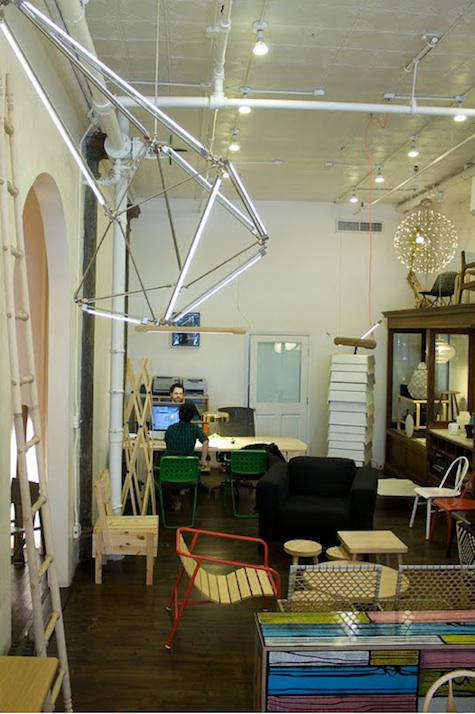
The Shy Lamp at Matter in New York is one of those rare lighting designs that makes the word “lamp” feel hilariously inadequate. A lamp usually sits on a table, behaves itself, and helps you find the remote. Bec Brittain’s SHY light does something more ambitious: it sketches a three-dimensional object in the air using slender illuminated tubes, precise metal joints, and geometry that seems to hover somewhere between a crystal, a constellation, and a very sophisticated science experiment.
Introduced as Brittain established her independent studio in 2011, SHY became a defining example of contemporary New York lighting design. Its impact came not from decorative excess but from a disciplined idea: let the light source become the structure. Rather than hiding bulbs inside a shade, the fixture exposes linear LEDs and uses them to draw the edges of a luminous volume.
Matter, the influential New York design gallery and showroom, was an ideal setting for the piece. Known for presenting experimental furniture, lighting, and objects with the seriousness of collectible art, Matter helped place SHY within a broader conversation about American design, local production, modular systems, and the increasingly blurry line between a useful fixture and an art installation.
Why the Shy Lamp Still Commands Attention
Many statement lights depend on size, glitter, or an alarming number of dangling objects. SHY takes a different route. Its visual drama comes from proportion and restraint. Thin tubes meet at carefully engineered points, forming an open framework that does not block the room behind it. You see the fixture, but you also see through it.
That transparency is one reason the design remains relevant. Modern interiors often ask lighting to provide identity without creating visual congestion. A dense chandelier may dominate a compact dining room or interrupt a long view through an open-plan apartment. SHY occupies volume while preserving negative space. In normal language, it is a large object that somehow avoids acting like a large object.
The fixture also changes when viewed from different positions. A configuration that resembles a sharp polygon from one angle may flatten into a zigzag of light from another. Although the lamp itself remains still, this shifting perspective gives it the energy of kinetic sculpture.
Bec Brittain and the Origins of SHY
Bec Brittain founded her Brooklyn studio in 2011 after exploring product design, metalwork, architecture, philosophy, and lighting. Before launching her own practice, she worked with New York lighting designer Lindsey Adelman. These experiences help explain why SHY feels conceptual and practical at the same time. It is not simply a geometric sketch enlarged for a showroom; it is a working system designed around connections, tube lengths, electrical requirements, balance, and installation.
A Name with Personal Meaning
The name SHY comes from the initials of Brittain’s grandmother. That personal detail gives the futuristic-looking fixture an intimate foundation. Brittain has spoken about her grandmother’s ability to combine well-made objects from different periods and about her own desire to create work that people will keep rather than quickly replace.
The fixture may resemble a crystalline molecular model, but it does not feel emotionally cold. Warm metal finishes soften the technical character of the LEDs, while the family connection prevents the design from becoming an anonymous exercise in minimalism.
Crystals, Growth, and Modular Systems
Crystalline structures were an important influence on SHY. Crystals follow internal rules, yet those rules can produce forms that seem complex, irregular, and alive. SHY operates in a similar way. Repeated components connect through modular hardware, but the overall fixture can stretch, nest, expand, or respond to a specific room.
This makes SHY less like one lamp and more like a design language. The family has grown to include chandeliers, wall-mounted fixtures, standing pieces, beams, nested compositions, and custom installations. Each version uses the same vocabularylinear light, open geometry, and precise metal junctionsbut creates a different sentence.
Matter in New York Was More Than a Retail Backdrop
Matter was founded in 2003 and developed a reputation for discovering emerging designers, presenting international work, and supporting contemporary American design. Its Broome Street showroom became a destination for people who wanted to see unusual furniture and lighting before those ideas became familiar, copied, and eventually available in twelve suspiciously cheerful colors.
Showing SHY at Matter positioned it within New York’s design culture rather than treating it as an ordinary lighting product. Visitors could study the hardware, walk around the form, and observe how the illuminated lines interacted with nearby furniture and architecture.
The setting also reflected the fixture’s combination of art, fabrication, engineering, and small-studio entrepreneurship. SHY is visually ambitious but structurally resourceful, using recognizable lighting components and carefully developed custom hardware to create something unfamiliar. That combinationpragmatic underneath and theatrical on topis extremely New York.
How the SHY Lighting System Works
The Light Source Becomes the Frame
Traditional fixtures usually separate structure from illumination. A metal arm supports a socket, a shade controls glare, and a bulb supplies light. SHY collapses those roles. Its LED tubes define the edges of the object, meaning the visible frame is also the luminous element.
There is no need to ask which part is decorative and which part is functional. The answer is both. Every glowing line contributes to the geometry, and every geometric decision affects how light is distributed through the room.
Warm Metal Balances Technical Light
Linear LEDs can look clinical when paired with cool surfaces and harsh color temperatures. SHY avoids the laboratory effect by combining ethereal tubes with substantial metal connectors. Brass and related finishes introduce warmth, reflection, and a sense of craft. They also give the eye a clear point of reference at every junction.
Some current SHY configurations specify warm 2700K illumination and a 90 color rendering index, making them suitable for interiors where wood, fabric, stone, food, and artwork should appear natural. Optional diffusers can soften the tubes while preserving the impression of a line drawn with light.
Customization That Actually Changes the Design
Customization is sometimes a marketing term meaning “choose beige or slightly different beige.” SHY’s modularity is more meaningful. Its hardware allows configurations to respond to ceiling height, furniture placement, sightlines, and architectural constraints.
A long composition can emphasize a dining table or reception desk. A compact polyhedral form can anchor an entryway. A wall-mounted version can bring the same geometric language into a corridor or bedroom. In an atrium, multiple forms can be combined into an installation that reads at architectural scale.
What the Shy Lamp Does to a Room
SHY does more than brighten the surfaces beneath it. It reorganizes how the room is perceived. During daylight, an unlit or dimmed fixture appears as a delicate metal drawing. At night, the illuminated tubes become dominant and the hardware visually recedes. The piece effectively has two personalities without needing to wear a reversible lampshade.
Because the structure remains open, it frames views rather than concealing them. In a loft, it can float beneath exposed beams without fighting the ceiling. In a traditional room, its contemporary geometry can contrast with plaster moldings, antique furniture, or patterned rugs. In an extremely minimal room, it prevents simplicity from turning into visual fasting.
The light can also define zones. Suspended over a table, it creates a room within a larger room. Installed beside a staircase, it encourages the eye to move upward. In a hotel lobby or showroom, it can identify the central gathering point without adding another wall.
Designing a Space Around a SHY Lamp
Begin with Scale, Not Decorating Style
The first question is not whether the room is modern enough. The first question is whether the proportions work. Measure the ceiling height, furniture dimensions, clearances, suspension distance, and primary sightlines. A sculptural fixture requires breathing room around its outer edges.
Over a dining table, the composition should relate to the table’s width and length without overwhelming seated guests. In a double-height space, a taller arrangement may be needed so the fixture does not resemble a tiny glowing snack suspended in a canyon.
Plan the Electrical Details Early
Dimming is essential for a fixture that must function as both centerpiece and practical illumination. Full brightness may be useful for cleaning, events, or commercial activity. Lower output is more comfortable for dinners and evenings when nobody wants to feel interrogated by the ceiling.
Drivers, canopies, mounting stems, ceiling structure, and lighting-control systems should be coordinated with the designer, authorized dealer, and a qualified electrician before installation. The glamorous part is the floating geometry. The less glamorous part is ensuring that the ceiling can safely support it. Both are design.
Choose Supporting Materials Carefully
SHY pairs especially well with materials that react subtly to light. Honed stone provides a quiet backdrop. Dark wood increases contrast and warmth. Polished metal creates small reflections of the tubes. Glass and mirrors can multiply the geometry, although too many reflective surfaces may produce a “constellation trapped inside a jewelry box” situation.
Furniture should not compete with the lamp line for line. Filling the room with angular chairs, triangular tables, gridded rugs, and polygonal artwork can make the fixture look as though it has wandered into a geometry convention. Curved upholstery, textured textiles, and restrained furniture allow SHY’s structure to remain readable.
Lessons Designers Can Borrow from SHY
Not every project has the budget, ceiling, or courage for a large SHY installation. The useful lesson is not to reproduce its exact geometry. It is to understand the principles behind it.
- Use light to draw space: Linear fixtures can define an area without introducing a heavy visual mass.
- Build around one clear system: Repetition of a simple component often feels more coherent than a collection of unrelated decorative gestures.
- Balance technology with warmth: Pair LEDs with brass, bronze, wood, stone, or textured plaster.
- Preserve negative space: Open fixtures can feel lighter than solid shades of comparable dimensions.
- Consider every viewpoint: A ceiling fixture should look intentional from the entrance, seating area, staircase, and adjoining rooms.
These principles can guide anything from a modest linear pendant to a large commercial installation. The objective is not to make a counterfeit SHY. It is to let lighting participate in the architecture instead of merely hanging from it.
Experiencing the Shy Lamp at Matter in New York
Imagine approaching the fixture in Matter’s New York showroom for the first time. From the entrance, it registers as a bright angular symbol floating in the room. It is clearly lighting, yet its form refuses to settle into a familiar category. It is not quite a chandelier, mobile, cage, or conventional sculpture. Your brain begins sorting through comparisons and then quietly gives up, which is often the beginning of a good design experience.
As you move closer, the object becomes less mysterious and more impressive. The illuminated tubes look thin and direct, while the connecting hardware reveals the labor behind the apparent simplicity. At a distance, SHY is a confident gesture. Up close, it is a collection of solved problems: joints, electrical paths, alignments, finishes, suspension points, and tolerances. The lamp demonstrates how minimalism can require an almost rude amount of work.
Walking around it changes the composition. From one side, the lines may look balanced and nearly symmetrical. A few steps later, tubes overlap, corners disappear, and the structure appears denser. Continue moving and an opening emerges through the center. This is where the showroom experience differs from looking at photographs. A picture can document the object, but it cannot fully reproduce parallaxthe way separate lines slide across one another as the viewer changes position.
The surrounding furniture influences the experience as well. Above a restrained table, SHY becomes architectural, almost like a temporary ceiling drawn underneath the real one. Near richly textured materials, it appears glamorous. Against a plain wall, it resembles graphic art. In a darker section of the room, the illuminated edges can seem to detach from the hardware and hover independently.
There is also an emotional difference between seeing the fixture switched off and illuminated. Unlit, it emphasizes metal, proportion, and construction. It can appear intellectual and reserved. Turned on, it becomes more social. Warm lines spread across the room, reflections emerge on nearby surfaces, and the structure gains theatrical confidence. For something named SHY, it is remarkably comfortable being noticed.
A visitor may gradually become aware of the empty volume enclosed by the lamp. That absence is not leftover space; it is part of the composition. The fixture makes air visible by outlining it. This is why the design can feel larger than its material footprint. It does not fill a volume with fabric, glass, or solid metal. It defines a volume and allows the surrounding room to complete the object.
After leaving the showroom, the most memorable detail may not be a specific finish or dimension. It may be the realization that illumination can behave like a construction material. SHY does not decorate a shape that already exists. The light creates the shape. That reversal stays with the viewer and changes how other fixtures are perceivedparticularly the ones that suddenly appear to be wearing unnecessarily large hats.
Conclusion
The Shy Lamp at Matter in New York represents a pivotal idea in contemporary lighting: a fixture can be functional, modular, architectural, and emotionally resonant at the same time. Bec Brittain transformed thin LED tubes and metal connectors into a system whose form is inseparable from its illumination. Matter provided a setting where that system could be understood not merely as merchandise, but as part of New York’s evolving design culture.
SHY still feels distinctive because it was created around a strong principle rather than a passing visual effect. It draws instead of fills, adapts instead of repeats, and commands attention without becoming visually heavy. It may be called Shy, but in the history of American sculptural lighting, it has never exactly hidden in the corner.
Note: Availability, pricing, finishes, dimensions, and electrical specifications may vary by configuration and can change over time. Confirm current information with the designer, gallery, and a qualified installer before specifying the fixture.














