
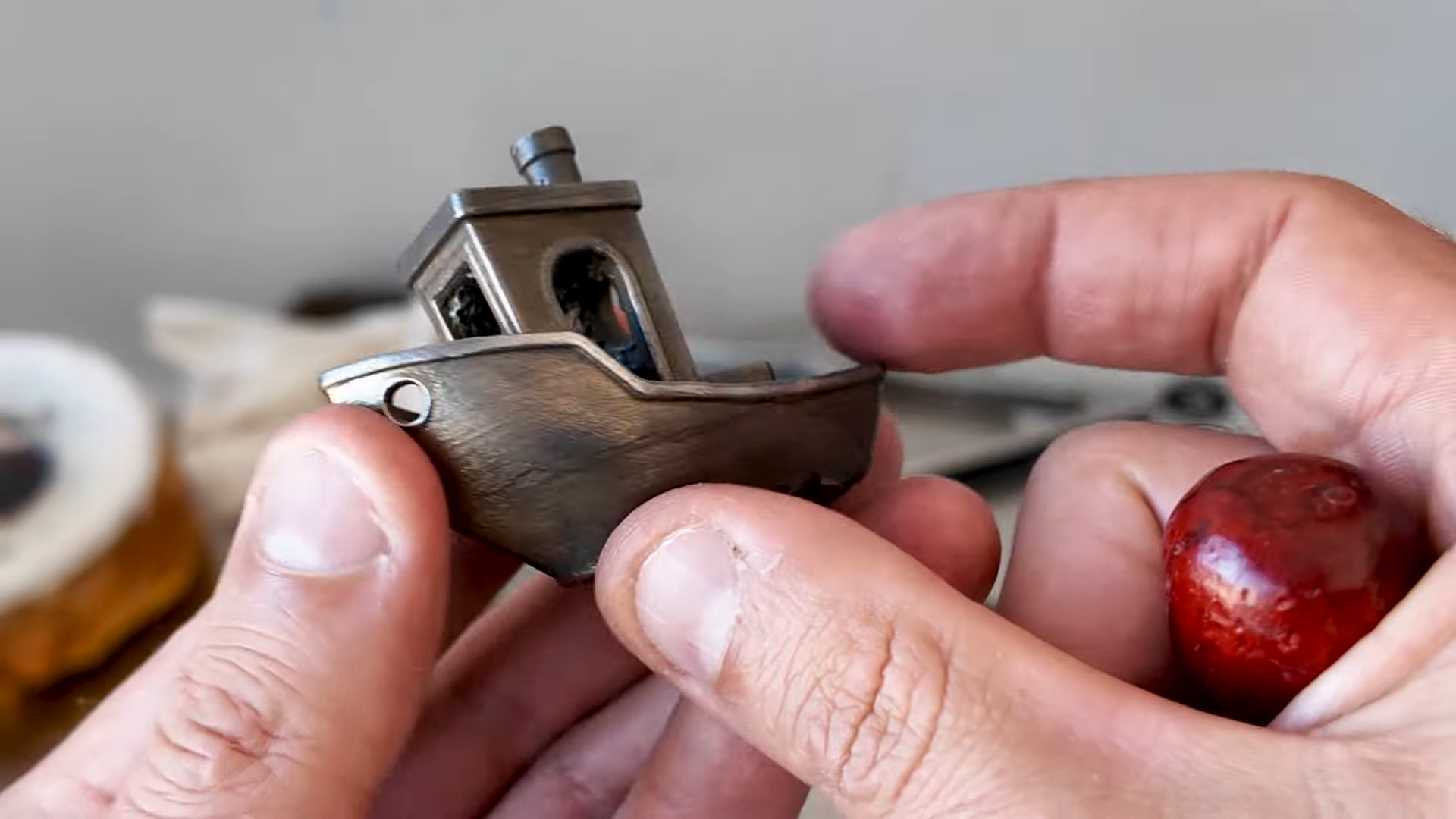
There are two kinds of people in the maker world: those who print a 3DBenchy to tune their printer, and those who look at that tiny tugboat and think, “Yes, but what if it were cast in iron and doomed to the bottom of the nearest puddle?” The project behind Microwave Forge Casts The Sinking-est Benchy Ever sits gloriously in the second camp. It takes the most cheerful calibration boat in desktop 3D printing and gives it the density, drama, and nautical confidence of a brick wearing a captain’s hat.
At first glance, the idea sounds like a workshop joke: use a consumer microwave, a compact kiln, a 3D-printed PLA model, and some foundry chemistry to cast an iron Benchy. But underneath the comedy is a surprisingly serious demonstration of small-scale metal casting. The build combines microwave kiln design, lost-PLA casting, silicon carbide materials, sodium silicate mold bonding, and patient iteration. It is not just a stunt. It is a miniature lesson in how digital fabrication and old-school molten metal can shake hands without either one losing a finger.
Why Benchy Became the Perfect Victim
The 3DBenchy is famous because it is adorable and mildly judgmental. Designed as a 3D printer torture test, it includes overhangs, bridges, curves, small details, symmetry checks, and surface features that reveal whether a printer is tuned or simply expressing itself through plastic spaghetti. Its hull, cabin roof, smokestack, portholes, nameplate, and deck geometry make it a compact exam for extrusion, cooling, bed adhesion, layer alignment, and dimensional accuracy.
That makes Benchy a natural candidate for creative abuse. Makers have printed it tiny, huge, transparent, edible-looking, multicolor, flexible, and in materials that probably made the slicer sigh. Casting one in iron pushes the joke into new territory. A normal PLA Benchy may float because of trapped air and infill structure. An iron Benchy, however, has no interest in buoyancy. It is a boat-shaped object with the soul of an anchor.
The Microwave Forge Idea: Tiny Foundry, Big Ambition
The phrase “microwave forge” is catchy, although technically this project is closer to a tiny foundry than a forge. Forging means heating metal until it can be shaped by force. Casting means melting metal and pouring it into a mold. Here, the star of the show is casting. The microwave provides energy, the kiln traps heat, the crucible holds molten metal, and the mold decides whether the final object looks like a beloved tugboat or a tragic archaeological blob.
Consumer microwave ovens usually heat food by exciting polar molecules, especially water, with microwave-frequency electromagnetic energy. In a microwave kiln, the goal is different. Materials such as silicon carbide can absorb microwave energy and convert it into intense heat. Surround that heat source with insulating ceramic fiber, place a suitable crucible inside, and the humble kitchen appliance becomes a compact thermal beast. It is still not something anyone should improvise casually, but as a maker concept, it is wonderfully elegant: instead of building a large propane furnace, the project turns a small insulated chamber into a focused heat trap.
From PLA Tugboat to Iron Paperweight With Maritime Delusions
The workflow begins in familiar territory: print a Benchy in PLA. PLA is popular in desktop 3D printing because it is easy to print, dimensionally friendly, and accessible. In lost-PLA casting, the printed part acts as a sacrificial pattern. The pattern is embedded in a mold material, then burned out or removed so molten metal can fill the empty cavity. It is the maker-age cousin of lost-wax casting, except the wax has been replaced by a tiny plastic boat that once lived on a spool.
For this project, the mold material used finely ground silicon carbide blasting medium mixed with sodium silicate, commonly called water glass. Sodium silicate can act as a binder, helping sand or granular refractory material hold shape after curing. That matters because molten iron is not polite. It is heavy, extremely hot, and very willing to exploit weak molds, poor vents, narrow gates, and any tiny design mistake you made while feeling optimistic.
The Raw Material: A Broken Barbell Weight
The project’s iron source was a busted-up barbell weight, which is delightfully appropriate. A gym weight is already a dense object designed to make people suffer; transforming it into an iron Benchy simply redirects the suffering toward fluid dynamics. Cast iron is attractive for small casting experiments because it melts at a lower temperature than pure iron, thanks to its carbon content. It also flows better than many steels when molten, which is why cast iron has historically been used for cookware, machine bases, pipes, stoves, and ornamental metalwork.
But cast iron is not beginner-friendly just because it is useful. It requires much higher temperatures than aluminum or zinc alloys, and the risks rise sharply with heat. Molten iron can crack damp molds, destroy weak crucibles, and create spectacularly bad afternoons. The project’s charm comes partly from watching the process evolve through failures rather than pretending the first try was a perfect fairy tale with safety glasses.
The Three-Pour Drama
The first pour looked promising but did not completely fill the mold. The metal failed to reach the tip of Benchy’s funnel, which is a classic casting problem in miniature form. Thin sections, narrow channels, cooling rates, trapped air, mold temperature, and metal flow all conspire against fine detail. Benchy may look simple on a printer bed, but as a casting cavity it becomes a tiny obstacle course.
The second attempt brought more excitement than anyone wants during metal casting: a cracked crucible and spilled molten metal. That detail is important because it keeps the project honest. Online maker builds can sometimes look like magic tricks with jump cuts. Real fabrication is more like a negotiation with physics, and physics has a reputation for being rude when overheated.
The third attempt succeeded. The mold filled completely after vibrations from a reciprocating saw helped the molten metal settle into the fine details. This is a clever, practical example of problem-solving: when gravity and metal flow are not enough, vibration can encourage material to move into tight areas and reduce voids. Foundries use controlled vibration, vacuum assist, pressure, gating design, and mold preparation for similar reasons. In a balcony-scale experiment, a reciprocating saw is a wonderfully maker-ish substitute for industrial equipment.
Why the Microwave Kiln Method Is So Fascinating
The most interesting part of the project is not only that it produced an iron Benchy. It is that the setup suggests a compact path into metal casting for people who lack space for a traditional furnace. A propane or oil-fired furnace needs fuel handling, ventilation, refractory construction, open flame management, outdoor workspace, and enough room to move safely. A microwave kiln can shrink the equipment footprint dramatically.
That does not make it casual. Ceramic fiber insulation can release irritating fibers when cut or handled. Molten metal can injure, ignite, or explode if moisture is present. Crucibles can fail. Microwave ovens modified or repurposed for kiln work should never return to food service. Fumes from burnout materials require serious ventilation and respiratory protection. This is maker territory, not a dorm-room weekend craft next to the ramen.
Still, the compactness is impressive. Using ceramic insulation, Kapton tape, silicon carbide crucibles or susceptors, and careful heating cycles, a small microwave kiln can reach temperatures far beyond anything associated with reheating leftovers. It reframes the microwave from “popcorn box” to “tiny dragon cave,” which is both inspiring and a little concerning.
The Science Behind the Sinking-est Benchy
Why does the iron Benchy sink so enthusiastically? Density. PLA is relatively light, and printed parts often contain internal air pockets or infill patterns. Cast iron is much denser and, in this case, the final Benchy is essentially a solid metal object shaped like a boat. Boats float by displacing enough water to equal their weight before they sink below the surface. A hollow ship can do that. A solid iron tugboat the size of a desk toy cannot. It has the maritime strategy of a dropped socket wrench.
This makes the final piece funny because it reverses Benchy’s visual promise. It looks like a boat. It has a hull, cabin, and smokestack. But its material identity says, “I belong underwater immediately.” In maker culture, that contradiction is gold. The best projects often combine technical achievement with a punchline you can understand in one glance.
Finishing Touches: Patina, Fettling, and Microwave-Melted Water
After casting, the iron Benchy needed cleanup. Fettling is the process of removing unwanted casting material such as gates, sprues, rough edges, and flashing. Small castings often emerge with evidence of the entire process attached, like souvenirs from a stressful vacation. Grinding, filing, brushing, and surface treatment bring the part closer to its intended shape.
The saltwater bath added patina, giving the iron surface a weathered look. That artistic choice matters. A raw casting can be interesting, but a patinated iron Benchy feels like an artifact recovered from a tiny shipwreck. The final display went even further by using microwave-melted blue glass as a stand-in for water. This is where the project leaves “technical demonstration” and becomes sculpture. The boat that cannot float gets its own dramatic ocean, frozen in glass, forever performing its one true talent: sinking with confidence.
Digital Fabrication Meets Foundry Craft
The broader lesson is that 3D printing is not limited to plastic end-use parts. A printer can make patterns, jigs, tools, fixtures, molds, burnout forms, alignment guides, and test objects for other manufacturing processes. Lost-PLA casting turns a desktop printer into the front end of a metalworking pipeline. Instead of asking, “Can my printer make the final part?” the better question becomes, “Can my printer help me make the thing that makes the final part?”
This is especially useful for custom hardware, jewelry, small sculptures, knobs, brackets, decorative parts, and experimental designs. A 3D print can be iterated quickly, then translated into metal once the shape is right. The microwave Benchy is silly, yes, but it demonstrates a serious workflow: digital model, printed pattern, refractory mold, burnout or cavity preparation, molten metal pour, cleanup, and finishing.
What Makers Can Learn From This Tiny Iron Tugboat
1. Materials Matter More Than the Meme
The project works because each material has a job. PLA provides the pattern. Silicon carbide handles heat and mold structure. Sodium silicate binds the mold. Ceramic fiber insulates the kiln. Cast iron supplies density and drama. Blue glass creates the display effect. This is not random junk drawer engineering; it is a chain of material choices that happen to end with a very funny boat.
2. Failure Is Data Wearing Work Gloves
The incomplete first pour and cracked second attempt are not embarrassing footnotes. They are the reason the final result is interesting. Small-scale casting depends on learning how metal flows, how molds vent, how crucibles age, and how heat behaves. Every failed pour is a test report, although sometimes the report is written in smoke.
3. Scale Does Not Remove Danger
A tiny foundry is still a foundry. The volume of molten metal may be small, but the temperatures are extreme. Proper personal protective equipment, dry molds, safe handling tools, ventilation, fire control, and a dedicated non-food microwave setup are not optional details. The project is inspiring, but it should not be copied casually by anyone who thinks “I saw a video” counts as training.
4. Humor Makes Technical Work Memorable
An iron Benchy is funny enough to share, but the joke carries real education. People remember the sinking boat, and then they remember lost-PLA casting, silicon carbide, mold vibration, crucible failure, patina, and microwave kilns. That is excellent science communication disguised as a tiny nautical disaster.
Why This Project Works So Well as Maker Storytelling
Great maker projects usually have three ingredients: a familiar object, an unexpected process, and a satisfying result. This one checks all three boxes. Benchy is familiar to almost anyone in 3D printing. Microwave metal casting is unexpected enough to make people stop scrolling. The finished iron tugboat displayed in blue glass is visually satisfying, technically interesting, and comically doomed.
It also bridges communities. 3D printing fans understand the Benchy reference. Metalworkers appreciate the casting challenge. Materials nerds notice the silicon carbide and sodium silicate. Safety-minded readers immediately start muttering about PPE. Artists see a miniature sculpture. Everyone else sees a boat that would lose a fight with a bathtub.
Experiences and Reflections: What This Topic Teaches Beyond the Build
Projects like Microwave Forge Casts The Sinking-est Benchy Ever remind us why hands-on experimentation remains so addictive. Reading about casting is useful, but watching a plastic print become an iron object changes how you think about manufacturing. The object carries a story. You can see the digital origin in its shape, the mold in its surface, the pour in its imperfections, and the finishing work in its final character.
For anyone who has spent time around 3D printers, Benchy has a weird emotional status. It is not just a calibration model; it is a rite of passage. Your first Benchy tells you whether your printer is behaving, whether your filament is dry, whether your cooling is adequate, and whether your slicer settings are secretly plotting against you. Turning that same model into cast iron feels like a graduation ceremony conducted by a blacksmith with a sense of humor.
The experience also highlights the value of cross-disciplinary tinkering. Many makers begin in one lane: electronics, printing, woodworking, coding, robotics, or metalwork. The most exciting projects happen when those lanes merge. A microwave kiln build requires electrical awareness, thermal understanding, material selection, mechanical design, safety planning, and artistic finishing. It is not one hobby. It is six hobbies in a trench coat pretending to be a weekend project.
Another useful lesson is patience. Casting rewards preparation more than bravery. A print with poor surface quality becomes a poor pattern. A mold mixed too wet can become dangerous. A crucible used beyond its safe life can fail at the worst possible moment. A rushed burnout can leave residue that causes defects. A pour that is too cold may freeze before filling the mold. A pour that is too hot can damage the mold or alter surface quality. Every step whispers, “Slow down,” usually right before a maker does not slow down and learns something memorable.
There is also a design lesson in the Benchy shape itself. The model was designed for additive manufacturing, not casting. A shape that prints well may not cast well without adjustments. Thin features, enclosed details, sharp transitions, and narrow funnels behave differently when filled with molten metal instead of built layer by layer. That is a powerful reminder that manufacturing methods are not interchangeable magic portals. Each process has its own personality, and casting’s personality is ancient, hot, and occasionally sarcastic.
Finally, the iron Benchy shows why novelty projects matter. Some people dismiss playful builds as impractical, but playful builds often teach faster than practical ones. Nobody urgently needs a cast iron Benchy. That is exactly why it works. With no commercial pressure, the project can focus on exploration. The result is memorable, shareable, and educational. It invites people to ask how microwave kilns work, why silicon carbide gets hot, how lost-PLA casting differs from lost-wax casting, why iron sinks, and why molten metal should be treated with deep respect. That is a lot of learning for one tiny boat-shaped anchor.
Conclusion
Microwave Forge Casts The Sinking-est Benchy Ever is the kind of maker project that looks like a joke until you notice how much engineering is hiding inside it. A 3D-printed PLA tugboat becomes a sacrificial pattern. A compact microwave kiln becomes a miniature foundry. Silicon carbide and sodium silicate become the supporting cast. A broken barbell weight becomes molten iron. After failed pours, a cracked crucible, vibration-assisted success, fettling, patina, and a glassy blue display, the final Benchy emerges as both a technical achievement and a perfect punchline.
It is not a beginner shortcut into metal casting, and it is definitely not a casual kitchen experiment. But as a demonstration of digital fabrication meeting foundry craft, it is brilliant. The sinking-est Benchy ever proves that the maker mindset is at its best when it combines curiosity, humor, persistence, and just enough absurdity to turn a calibration model into a miniature monument to controlled chaos.
Note: This article is an original synthesis based on real public information about the microwave-cast iron Benchy project, 3DBenchy calibration models, lost-PLA casting, microwave kiln concepts, silicon carbide materials, sodium silicate mold binding, and general foundry safety principles. It is written for informational publishing purposes and is not a step-by-step safety manual.














