
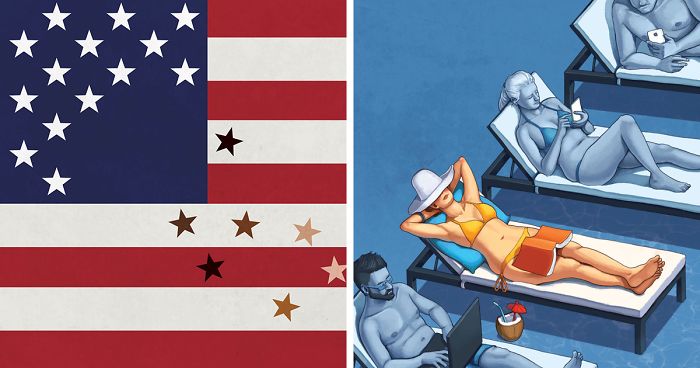
Some problems are too slippery for speeches. Try explaining modern society in a meeting and someone will make a pie chart, schedule a follow-up, and ask whether “loneliness” has a quarterly KPI. But draw a person hugging a phone while ignoring the human beside them, and suddenly everyone gets quiet. That is the strange magic of satirical illustration: it grabs society by the collar, points at the mess, and says, “Look. This is us. Weird outfit, right?”
My 40 new illustrations that show what’s wrong with our society are not meant to scold people from a mountain of moral superiority. Nobody wants a lecture wearing a tiny black turtleneck. Instead, these illustrations use humor, irony, exaggeration, and visual metaphors to explore the everyday contradictions we keep stepping over: social media addiction, fake success, loneliness, consumerism, climate denial, burnout, misinformation, privacy loss, and the tiny emotional disasters hidden behind very nice profile pictures.
Modern society is not broken in one dramatic movie-scene explosion. It is broken in small, familiar ways. We scroll when we are tired, buy things when we feel empty, compete with strangers we do not know, and call it “staying connected” while becoming harder to reach. These illustrations turn those patterns into images because sometimes a picture can say what a 900-word essay cannotalthough, awkwardly, here we are in a 2,000-word article.
Why Satirical Illustrations Hit Harder Than Another Angry Post
Satirical art works because it bypasses our defenses. If someone says, “You spend too much time online,” we immediately prepare a TED Talk titled Actually, My Screen Time Is Mostly Productive. But if an illustration shows a person walking a phone on a leash while the phone drags them through traffic, we laugh first. Then we wince. Then we check our notifications, which proves the point with athletic efficiency.
Illustrations about society also create room for nuance. A drawing can criticize social media without pretending technology is evil. It can show loneliness without blaming lonely people. It can question consumer culture without demanding that everyone move to a cave and knit socks out of moss. Good social commentary does not say, “Everyone is terrible.” It asks, “What are we becoming, and did we keep the receipt?”
The Main Problems Reflected in These 40 Illustrations
The collection explores 40 visual ideas, each built around one uncomfortable truth. Together, they form a cartoon mirror of modern lifeslightly distorted, but only because reality has been making strange faces first.
1. The Phone as a Pacifier
One illustration shows adults soothed by glowing screens like toddlers with digital pacifiers. The joke is obvious; the discomfort is not. Phones are useful tools, but they also become emotional escape hatches. Waiting in line, feeling awkward, avoiding silence, dodging sadnessthere is an app for all of it. Unfortunately, there is no app that teaches us how to sit peacefully with ourselves, though someone is probably pitching one with a monthly subscription.
2. Social Media as a Talent Show for Insecurity
Another image imagines social platforms as a stage where everyone performs happiness while the audience performs envy. The applause is measured in likes. The costume is “effortless authenticity,” which usually takes 47 minutes, three filters, and a suspiciously casual coffee cup. This is not just vanity; it is a system that rewards comparison and turns ordinary life into a brand presentation.
3. Loneliness in a Crowded Room
One of the most painful illustrations shows a packed room where every person is sealed inside a transparent bubble. They are close enough to touch, but emotionally miles apart. That is the paradox of modern connection: we can message anyone instantly, yet many people feel unseen. The problem is not simply that we lack contact. It is that we often lack presence.
4. Consumerism Wearing a Crown
Several illustrations focus on consumer culture. In one, a shopper pushes a cart full of things while their own heart sits on the shelf with a discount tag. The image is funny until it feels personal. We are constantly told that the next purchase will make us cooler, calmer, younger, richer, cleaner, smarter, and possibly better at assembling furniture. But consumption is a terrible therapist. It listens poorly and always charges extra.
5. Work Burnout as a Badge of Honor
Another illustration shows a worker polishing a trophy labeled “exhaustion.” That may be the most American image ever drawn without including a drive-through coffee. We often admire busyness as if rest were a character flaw. People answer emails at midnight, skip lunch, and call it ambition. But when exhaustion becomes identity, productivity stops being productive. It becomes a very organized collapse.
6. Misinformation as Fast Food for the Mind
In one piece, people line up at a drive-through window labeled “instant outrage.” The menu offers rumors, half-truths, conspiracy fries, and a large soda of confirmation bias. It is absurdand familiar. Misinformation spreads because it is emotionally efficient. It gives people a villain, a shortcut, and a sense of certainty. Truth, by comparison, often arrives wearing reading glasses and asking for patience.
7. Privacy as a Vanishing Shadow
Another illustration shows a person standing under a spotlight while invisible hands collect pieces of their shadow. It captures a modern fear: we are not merely using platforms; we are being measured by them. Our clicks, pauses, searches, routes, moods, purchases, and preferences can become data points in systems we barely understand. The creepy part is not only that someone may know what we like. It is that they may know what we are likely to do before we do.
8. Climate Anxiety in Cartoon Form
Several illustrations use dark humor to address environmental neglect. One shows a person watering a plastic plant while a real tree burns in the background. Another shows Earth sweating under a blanket labeled “business as usual.” These images work because they reveal the absurdity of pretending the problem is distant. Extreme weather, polluted air, rising costs, and ecological damage are not abstract issues for future textbooks. They are already knocking on the front door, and frankly, they look overheated.
9. Childhood Under Pressure
One illustration shows a child carrying a backpack stuffed with grades, expectations, social pressure, online judgment, and the word “future” written on a brick. It is a small figure under a huge load. Today’s young people are asked to be high-achieving, emotionally resilient, digitally fluent, socially aware, career-ready, and photogenic by Tuesday. No wonder the backpack looks ready to file a complaint.
10. Success as a Golden Cage
Another image shows a person trapped inside a shiny trophy. From outside, it looks like winning. From inside, it looks like suffocation. This illustration challenges the idea that success should always be visible, profitable, and impressive to strangers. Sometimes the life people applaud is the one quietly draining the person living it.
What These Illustrations Say About Modern Society
The strongest theme across these 40 satirical illustrations is not that society is doomed. That would be lazy, and also terrible for brunch conversation. The deeper message is that our priorities are often upside down. We measure visibility instead of value, speed instead of wisdom, growth instead of well-being, and convenience instead of consequence.
Modern society loves optimization. We optimize sleep, meals, workouts, schedules, dating profiles, productivity systems, and even relaxation, which is how you end up stressed about whether you are relaxing correctly. Yet all this optimization often avoids the main question: optimized for what? A life can be efficient and still feel empty. A feed can be full and still leave us hungry. A society can be technologically advanced and emotionally underdeveloped.
That is why visual satire matters. It does not provide a 12-step solution with a downloadable worksheet. It creates recognition. It helps people notice what has become normal. And noticing is not small. Every change begins with the moment someone says, “Wait, why are we doing this?”
40 Illustration Ideas That Capture What’s Wrong With Society
Here are 40 original illustration concepts that fit the theme, each designed to expose a modern social problem with humor and bite:
- A person taking a selfie while standing in front of a mirror that reflects only loneliness.
- A family at dinner, each feeding their phone while the food gets cold.
- A worker plugged into a laptop like a battery being drained.
- A person buying a “happiness” box that is empty except for a receipt.
- A crowd wearing masks labeled “fine,” “busy,” and “successful.”
- A child building a sandcastle while an adult builds a wall of expectations around them.
- A newsfeed shaped like a blender mixing facts, fear, and sponsored rage.
- A planet holding a thermometer while humans argue about whether thermometers are biased.
- A person chasing a carrot labeled “next promotion” on a treadmill.
- A heart with low battery, ignored while the phone charges at 100%.
- A privacy policy so long it wraps around a person like a trap.
- A shopping cart rolling downhill with a person inside screaming, “But it was on sale!”
- A classroom where students are watered like plants but graded like machines.
- A person standing on a mountain of packages asking why life feels cluttered.
- A politician painting a crack in the wall instead of fixing it.
- A person trying to sleep under a blanket made of notifications.
- A “breaking news” alarm clock ringing every five minutes.
- A teenager holding a mirror that reflects comments instead of a face.
- A tree wearing an oxygen mask while humans debate quarterly profits.
- A boss handing out medals shaped like dark circles under the eyes.
- A social media influencer selling authenticity from a factory assembly line.
- A person eating fast content with a fork labeled “attention span.”
- A handshake where both hands are actually checking watches.
- A city full of windows glowing blue, with no one looking at the stars.
- A person carrying debt, rent, groceries, and medical bills in grocery bags labeled “normal.”
- A fake smile hanging on a coat rack beside a work ID.
- A brain wrapped in caution tape reading “under construction.”
- A family portrait where everyone is present except their attention.
- A person drowning in tabs: browser tabs, mental tabs, unpaid tabs.
- A scale weighing kindness against popularity, with popularity cheating.
- A clock with hands shaped like deadlines chasing a person around the face.
- A smartphone fishing for humans with a hook shaped like a notification bell.
- A person sweeping problems under a rug labeled “later,” now shaped like a mountain.
- A trophy case displaying burnout, comparison, and overthinking.
- An online comment section drawn as a tiny gladiator arena.
- A person watering plastic flowers while real ones wilt nearby.
- A bridge labeled “community” missing planks labeled trust, time, and empathy.
- A person trying to hug a shadow made of data points.
- A child drawing the future while adults erase parts for profit.
- A mirror showing society as a machine powered by attention, fear, and snacks.
Why Humor Belongs in Serious Social Commentary
Humor is not the opposite of seriousness. Sometimes it is the only way seriousness can get through the door without being tackled by defensiveness. A funny illustration about burnout can make a tired worker feel seen. A sarcastic image about consumerism can make someone laugh at a pattern they are ready to change. A cartoon about misinformation can invite reflection without immediately starting a digital fistfight in the comments.
The best satirical illustrations do not punch down. They punch through fog. They reveal systems, habits, incentives, and contradictions. They make us laugh at the absurdity of modern life while quietly asking whether we want to keep living this way.
What We Can Learn From These 40 Illustrations
The lesson is not “delete everything, quit your job, move to a cabin, and communicate only with birds.” Birds are unreliable with scheduling. The lesson is more practical: pay attention to what gets your attention. Ask whether the tools in your life serve you or quietly train you. Notice when buying replaces feeling, when scrolling replaces resting, when outrage replaces understanding, and when ambition replaces health.
Society changes when people stop treating harmful patterns as inevitable. We can build better digital habits. We can create workplaces that respect human limits. We can teach media literacy without making everyone suspicious of reality itself. We can talk about loneliness without shame. We can take climate risk seriously without turning every conversation into a disaster movie trailer.
Most importantly, we can restore empathy. Many of the problems shown in these illustrations come from forgetting that people are people, not profiles, metrics, labor units, consumers, or opponents. A society that remembers this simple fact has already started repairing itself.
Personal Experiences Behind the Topic
The reason this theme feels so powerful is that almost everyone has lived inside at least one of these illustrations. I have seen people sit together at a café, silent under the glow of their phones, each person technically connected to hundreds of others while ignoring the person two feet away. The scene is not evil. It is not even unusual. That is what makes it interesting. The problem no longer announces itself with dramatic music. It simply becomes the background.
I have also noticed how often people describe exhaustion as if it were proof of importance. “I’m slammed,” “I’m buried,” “I haven’t slept,” “I’m running on coffee”these phrases function like social currency. Somewhere along the way, rest became suspicious. If you are calm, someone assumes you are not trying hard enough. If you have free time, someone tries to fill it. This is why an illustration of a person receiving a medal for burnout feels funny and sad at once. It captures a culture where being depleted can look like being successful.
Consumerism is another experience most people recognize instantly. We buy small things to soften big feelings. A package arriving at the door can feel like a tiny holiday, even when we barely remember ordering it. There is nothing wrong with enjoying nice things, but the danger begins when shopping becomes emotional first aid. The relief fades quickly, and then the cart fills again. A good illustration can show this cycle in a second: a person holding ten bags and still feeling empty.
Social media comparison may be the most common modern trap. We know people edit their lives online. We know the vacation photo did not include the airport delay, the argument, the overpriced sandwich, or the 17 attempts to look candid. Still, the brain compares. It says, “Their life looks easier.” “Their career is moving faster.” “Their kitchen has better lighting.” The rational mind understands the trick, but the emotional mind still falls for it. Satirical art helps because it exaggerates the performance until the trick becomes visible.
The topic also feels relevant because many people are tired of being treated as data. We click “accept” because the alternative is reading a privacy policy longer than a Victorian novel. We understand that free platforms are not truly free, but the cost is abstract. Then ads follow us around the internet like needy ghosts, and suddenly the abstract feels personal. An illustration of a person being measured, scanned, and sorted by invisible hands can express that uneasy feeling better than a technical report.
Finally, these illustrations matter because they remind us that criticism can be hopeful. To point out what is wrong with society is not to hate society. It is to care enough to notice. The goal is not cynicism; cynicism is just disappointment wearing sunglasses indoors. The goal is awareness, and awareness can become action. A drawing will not fix loneliness, misinformation, climate change, or burnout by itself. But it can start a conversation, and sometimes a conversation is the tiny hinge that swings open a much larger door.
Conclusion
My 40 New Illustrations That Show What’s Wrong With Our Society is more than a title; it is an invitation to look closely at the habits we normalize. These illustrations turn everyday contradictions into sharp, memorable images: people connected but lonely, successful but exhausted, informed but misled, entertained but distracted, surrounded by choices but hungry for meaning.
The value of satirical illustration is that it makes the invisible visible. It gives shape to social pressure, emotional fatigue, digital addiction, consumer emptiness, and environmental denial. It also gives us permission to laugh, which matters. Laughter creates distance, and distance helps us think. Once we can see the absurdity, we can decide whether to keep participating in it.
Society may be messy, but it is not beyond repair. The first step is noticing the cracks. The second is refusing to decorate them and call it progress. If these 40 illustrations make readers pause before scrolling, question before sharing, rest before collapsing, or speak to someone instead of simply reacting online, then the drawings have done their job. And honestly, that is a pretty good return on ink.












