
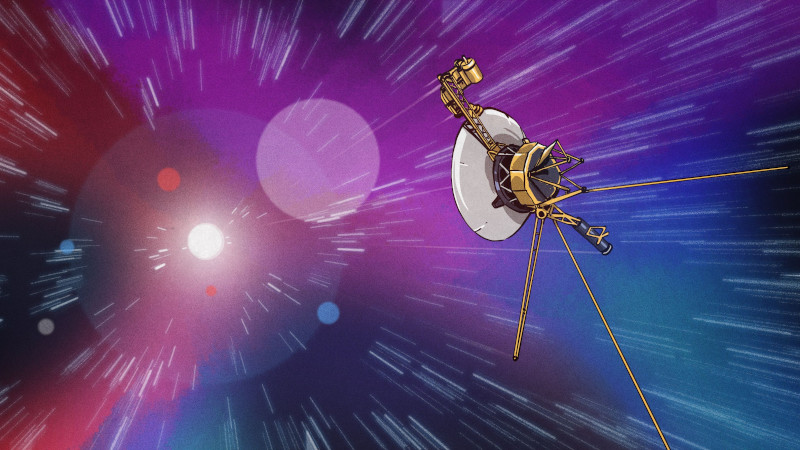
Some software updates are annoying. Your laptop restarts at the worst possible moment, your phone demands Wi-Fi, and your smart TV suddenly decides it has feelings. Then there is NASA’s Voyager team at the Jet Propulsion Laboratory, calmly sending software patches to spacecraft launched in 1977, now operating billions of miles from Earth in interstellar space. That is not a routine update. That is cosmic-level tech support.
The headline sounds almost absurd: NASA JPL’s Voyager team is patching up both Voyagers’ firmware. Yet the story is very real, very serious, and very NASA. Voyager 1 and Voyager 2 are the only human-made spacecraft operating beyond the heliosphere, the protective bubble of solar wind and magnetic fields created by the Sun. Their signals are faint, their hardware is ancient by modern computing standards, and their power supply is slowly fading. Still, they continue to send back unique data from a region no other spacecraft has directly sampled.
To keep these interstellar explorers alive, NASA engineers have been managing two major problems: a software issue tied to Voyager 1’s attitude articulation and control system, and a mechanical aging problem involving residue buildup in the spacecraft thrusters. In plain English, the team is trying to keep the probes thinking clearly, pointing correctly, and talking to Earth. Easy? Not even close. Important? Absolutely.
Why the Voyager Firmware Patch Matters
The Voyager spacecraft were built for a grand tour of the outer planets, not for a half-century career as humanity’s most distant long-distance callers. Voyager 2 launched on August 20, 1977, followed by Voyager 1 on September 5, 1977. Both flew past Jupiter and Saturn, while Voyager 2 also visited Uranus and Neptune, giving humanity its only close-up looks at those two ice giants.
After the planetary flybys, the mission became the Voyager Interstellar Mission. Voyager 1 crossed into interstellar space in 2012. Voyager 2 followed in 2018. Since then, both spacecraft have been studying particles, magnetic fields, and plasma waves outside the Sun’s protective bubble. That data helps scientists understand the boundary between our solar system and the wider galaxy.
The challenge is that the Voyagers are not sleek modern spacecraft running spacious software on powerful processors. Their onboard computers were designed in the 1970s, when a few kilobytes of memory were precious and “cloud computing” meant looking nervously at the weather before launch. Every command has to be crafted with extreme care. Every update carries risk. A mistake cannot be fixed by sending a technician with a screwdriver and a cup of coffee.
The AACS Glitch: When Voyager 1 Started Talking Nonsense
In 2022, Voyager 1 developed a strange problem. Its attitude articulation and control system, known as AACS, began sending garbled status reports back to Earth. The spacecraft itself appeared to be operating normally. It was still pointed in the right direction and still receiving commands, but the telemetry made about as much sense as a printer error message written by a raccoon.
The AACS is crucial because it helps control spacecraft orientation. In other words, it helps Voyager keep its high-gain antenna pointed toward Earth. Without that alignment, the spacecraft cannot reliably send data home or receive instructions. At Voyager distances, antenna pointing is not a polite suggestion. It is the whole conversation.
NASA engineers eventually determined that the AACS had entered an incorrect mode. The system was misdirecting commands, writing them into computer memory instead of executing them properly. One of those missed commands affected the status report before it reached mission controllers. The team corrected the immediate issue, but the root cause remained uncertain. That uncertainty is why the new software patch matters. It is designed as an insurance policy to prevent the same kind of problem from recurring on Voyager 1 or appearing on Voyager 2.
Why NASA Tested the Patch on Voyager 2 First
NASA’s approach was cautious: test the software patch on Voyager 2 first, then consider applying it to Voyager 1. That may sound surprising because Voyager 1 had experienced the earlier AACS glitch. But Voyager 1 is farther away, and its scientific data is especially valuable. Voyager 2, while still incredibly distant, is closer to Earth and had not suffered the same issue. It made sense to use the healthier, nearer spacecraft as the first testbed.
This is the deep-space equivalent of trying a risky update on the spare laptop before installing it on the only computer that contains your family photos, tax documents, and half-finished novel about detective squirrels. NASA engineers spent months writing, reviewing, checking, and validating the code before uploading it. The danger was not imaginary. A software patch sent to a 1970s spacecraft could overwrite essential code or trigger unintended behavior.
At the time of the update effort, Voyager 1 was more than 15 billion miles from Earth, while Voyager 2 was more than 12 billion miles away. A one-way command could take more than 18 hours to arrive. By 2026, Voyager 1 is so far away that a signal takes roughly 23 hours one way. That means even a simple “Did it work?” becomes a multi-day exercise in patience.
The Thruster Problem: Spacecraft Arthritis, Basically
The firmware patch was only one part of the Voyager maintenance plan. NASA JPL engineers were also dealing with a slow-building thruster issue. The Voyagers use small thrusters to keep their antennas pointed at Earth. These thrusters fire tiny bursts of propellant, gently adjusting the spacecraft’s orientation.
After decades of use, residue from the propellant has been accumulating in extremely narrow inlet tubes inside the thrusters. These tubes are much smaller than the main fuel lines, and each firing adds a little more buildup. It is not dramatic. There is no Hollywood explosion, no villain, no dramatic countdown. It is just chemistry and time, quietly gumming up the works.
To slow the clogging, the Voyager team changed how often the thrusters fire. Instead of making frequent tiny corrections, the spacecraft are allowed to drift slightly farther before the thrusters activate. The adjustment lets each Voyager rotate almost one degree farther in each direction than before. The team also uses fewer, longer firings, reducing the total number of thruster events and therefore slowing residue accumulation.
The trade-off is small but real. If the spacecraft drift a bit more before correction, small bits of science data may occasionally be lost, similar to a phone call cutting out for a moment. But the mission team concluded that this strategy should return more data over time because it helps extend thruster life. In deep-space engineering, “slightly imperfect but alive” often beats “precisely controlled but dead.”
Remote Repair at Interstellar Distance
Repairing the Voyagers is difficult not only because they are far away, but because they are old. The people who designed and built many of the systems are retired, and some are no longer alive. Documentation exists, but working with a spacecraft of this age requires a blend of archival research, engineering judgment, and institutional memory. It is less like updating an app and more like restoring a vintage airplane while it is still flying over the ocean.
The Voyager spacecraft contain multiple computer systems, including the command computer subsystem, the flight data subsystem, and the attitude articulation and control system. Each has a specific role. The command system handles sequencing and control. The flight data subsystem packages science and engineering data for transmission. The AACS keeps the spacecraft properly oriented. When one part misbehaves, the team has to understand how that behavior affects the entire spacecraft.
The complexity became even clearer in late 2023, when Voyager 1 stopped sending readable science and engineering data. The spacecraft was still receiving commands, but its data stream became unusable. NASA later traced the issue to a failed memory chip in the flight data subsystem. Because the chip could not be repaired, engineers developed a workaround: move affected code into other areas of memory, divide it into sections, and update references so the scattered code could still function as a whole.
That repair restored engineering data in April 2024 and helped bring science data back later. It was a remarkable achievement: engineers remotely rearranged decades-old code inside the most distant human-made object ever launched. Somewhere in the universe, a 1970s spacecraft accepted a memory workaround from Earth and got back to work. Your Wi-Fi router could learn humility from that.
The Deep Space Network: Earth’s Giant Cosmic Router
None of this would be possible without NASA’s Deep Space Network, or DSN. The DSN is an international system of giant radio antennas located in California, Spain, and Australia. Because the sites are spread around the globe, Earth’s rotation does not leave spacecraft unsupported for long. As one antenna complex rotates out of view, another can take over.
For Voyager, the DSN is the lifeline. It sends commands, receives science data, tracks spacecraft health, and measures radio signals to help determine position and velocity. The signals from the Voyagers are incredibly weak by the time they reach Earth. Receiving them requires enormous antennas, sensitive receivers, careful scheduling, and a team that understands how to listen to whispers from billions of miles away.
Imagine trying to hear a kitchen timer from another continent during a thunderstorm while someone runs a blender next to your ear. Now make the timer older than most people in the room and place it outside the solar bubble. That is the general vibe of Voyager communications.
Power Is the Next Big Enemy
Even if the software behaves and the thrusters keep working, the Voyagers face another unavoidable problem: declining power. Both spacecraft use radioisotope thermoelectric generators, or RTGs, which convert heat from decaying plutonium-238 into electricity. These systems have been extraordinarily reliable, but their power output decreases over time.
NASA has already shut down several instruments and heaters to conserve energy. The team has to balance science goals with survival. Turn off too much, and the spacecraft lose valuable capabilities. Leave too much running, and the probes risk power faults or frozen fuel lines. This is not a glamorous part of space exploration, but it is one of the most important. Deep-space missions often survive because engineers make careful, unromantic decisions about watts, temperature, and risk.
In 2026, NASA shut off Voyager 1’s low-energy charged particle instrument to preserve power. Voyager 2’s corresponding instrument had already been shut down in 2025. The decision was not made lightly. These instruments helped measure charged particles and cosmic rays, contributing to our understanding of interstellar space. But after nearly five decades, keeping the spacecraft alive requires sacrifice.
NASA engineers have also been developing a broader energy-saving strategy nicknamed “the Big Bang.” The idea is to swap out groups of powered devices and replace them with lower-power alternatives where possible, helping the spacecraft stay warm enough and functional enough to continue returning science. Voyager 2 is expected to be the safer test subject because it is closer and has slightly more margin.
What This Means for the Future of Space Exploration
The Voyager firmware patch is more than a technical footnote. It is a lesson in mission longevity. Modern spacecraft designers can learn from Voyager in both positive and cautionary ways. The positive lesson is that robust design, redundancy, and thoughtful operations can stretch a mission far beyond its original expectations. The cautionary lesson is that long-lived missions need maintainable software, readable documentation, and knowledge transfer plans that can outlast careers.
Future missions to the outer solar system, interstellar space, and possibly nearby star systems will face similar challenges. They will need autonomy, fault protection, flexible software, and communications strategies that can handle enormous delay. The Voyagers show that it is possible to maintain a spacecraft long after its prime mission ends, but they also show how hard it becomes when hardware ages, power declines, and the original design world disappears into history.
There is also a human lesson. The Voyager story is not just about machines. It is about teams. Engineers, scientists, mission planners, antenna operators, software specialists, archivists, and managers have all contributed to keeping the spacecraft alive. Every successful patch is a team achievement across generations.
Why People Still Love the Voyagers
Part of the public fascination with Voyager comes from the scale. These probes are farther away than anything else humanity has built, yet they are still connected to us by radio waves and careful mathematics. Another part comes from the Golden Records, the famous messages aboard each spacecraft containing sounds and images from Earth. They make the Voyagers feel like ambassadors, tiny messengers carrying a hello from a noisy, complicated, occasionally brilliant planet.
But the deeper reason may be simpler: the Voyagers refuse to quit. They were built for a mission measured in years, and they are still working after nearly half a century. They have survived radiation, cold, distance, aging electronics, memory faults, power shortages, and the loneliness of interstellar space. In a world where gadgets become obsolete before the warranty expires, Voyager feels almost mythological.
The firmware patch reminds us that exploration does not always look like a rocket launch. Sometimes it looks like a careful line of code, a conservative test plan, a thruster adjustment, or a team waiting almost two days to find out whether a command worked. Space exploration is not only about going farther. It is also about staying connected.
Experience-Based Reflections: What the Voyager Patch Teaches Us About Old Technology
Anyone who has maintained an old computer, a legacy website, a vintage car, or even a stubborn office printer can feel a tiny emotional connection to the Voyager team. Obviously, most of us are not debugging spacecraft in interstellar space. The office printer is not 15 billion miles away, although it may behave as if it is. Still, the basic experience is familiar: an old system keeps doing valuable work, but every fix requires respect for its limits.
Working with aging technology teaches patience. New systems often invite quick solutions: reboot, reinstall, replace. Old systems demand questions first. What changed? What still works? Which part is fragile? What hidden dependency will break if we touch this setting? NASA’s Voyager engineers live at the extreme edge of that mindset. They cannot casually reboot. They cannot swap hardware. They cannot push a patch and immediately watch the result. They must think before acting, then wait while physics delivers the message.
There is also a lesson in documentation. Many businesses run on legacy software that only one or two people fully understand. When those people retire, leave, or simply forget why something was built that way, the system becomes harder to maintain. Voyager shows the value of preserving technical knowledge. The mission has survived because teams kept records, learned from predecessors, and treated institutional memory as mission-critical infrastructure.
The Voyager patch also highlights the importance of humility. Engineers working on old systems know that confidence is useful, but overconfidence is expensive. A tiny change can have strange consequences. That is why NASA tested carefully and chose the safer spacecraft for the first upload. The principle applies far beyond spaceflight. Whether updating medical equipment, banking software, factory controls, or a family business database from 1998, the smartest move is often slow, deliberate, and boring. Boring is beautiful when the alternative is disaster.
For writers, technologists, students, and everyday readers, the Voyager story is inspiring because it blends imagination with maintenance. We love the romance of discovery, but discovery depends on unglamorous care. Someone has to monitor power levels. Someone has to check old code. Someone has to schedule antenna time. Someone has to ask, “What happens if this patch overwrites something important?” That quiet discipline is what keeps the grand adventure going.
In the end, NASA JPL’s Voyager firmware patch is not merely a story about software. It is a story about stewardship. Humanity sent two machines into the dark, and decades later, people are still listening, still learning, and still trying to help them last a little longer. That is a beautiful kind of loyalty. The Voyagers may be old, underpowered, and impossibly far away, but they remain part of our shared story. And as long as they keep whispering back, Earth will keep leaning toward the speakers.
Conclusion
NASA JPL’s Voyager team patching up both Voyagers’ firmware is one of the most impressive examples of long-distance engineering ever attempted. The work combines software maintenance, spacecraft operations, radio communication, aging hardware management, and a healthy respect for risk. The AACS patch helps protect against a past glitch. The thruster strategy helps slow mechanical aging. Power-saving plans aim to keep the probes operating as long as possible.
The Voyagers are not just machines from the 1970s. They are still-active scientific instruments, cultural icons, and proof that careful engineering can outlive expectations by decades. Every bit of data they return from interstellar space is unique. Every successful command is a small victory over distance, time, and entropy. And every patch reminds us that sometimes the future depends on taking very good care of the past.
Note: This article is an original synthesis based on publicly available NASA/JPL mission information and reputable U.S. space technology coverage, written for web publication without embedded source links.














