The Game Boy Camera is one of those gadgets that sounds like it escaped from a very specific fever dream: “What if we plugged a tiny digital camera into a handheld game console and let children print ghostly sticker portraits on receipt paper?” Somehow, Nintendo did exactly that in 1998, and the result became one of the strangest, most beloved pieces of retro tech ever made.
Now add neural nets to the mix. Suddenly, those chunky, four-shade, postage-stamp-sized faces can be cleaned up, colorized, enlarged, and interpreted by modern machine learning systems. It is like asking a supercomputer to restore a cave painting drawn by a battery-powered potato. And weirdly, it works.
The relationship between neural nets and Game Boy Cameras is not just a cute internet experiment. It is a surprisingly useful way to understand how artificial intelligence deals with missing information, low-resolution images, data limitations, retro digital photography, and the fuzzy line between restoration and invention.
What Made the Game Boy Camera So Weirdly Important?
Released in 1998, the Game Boy Camera turned the Game Boy into a portable digital camera at a time when most families were still using film cameras. Digital photography existed, of course, but it was expensive, clunky, and often about as portable as a loaf of bread with buttons. Nintendo took the opposite approach: make it cheap, playful, small, and slightly ridiculous.
The Game Boy Camera captured tiny monochrome images using a very limited grayscale palette. Depending on how the image was processed and displayed, users saw blocky portraits with a greenish Game Boy mood that made every family member look like a witness in a paranormal documentary. The images were rough, but they were recognizable. That was the magic.
The camera also came with editing tools, mini-games, stamps, frames, animations, and strange built-in faces that felt more like Nintendo art than serious photography software. It was not trying to compete with professional cameras. It was trying to make image-making feel like a toy, a game, and a tiny digital art studio all at once.
Why Neural Nets Care About Ugly Little Pictures
Neural networks are very good at finding patterns. Give them enough examples, and they can learn relationships between one kind of data and another. In image processing, that means a neural net can learn to map a low-quality input image to a higher-quality output image. It can learn how grayscale relates to color, how pixelated edges relate to facial structure, and how blurry details might correspond to sharper ones.
That is why the Game Boy Camera is such a fun test case. Its images are not just low resolution. They are aggressively limited. They have few tones, harsh dithering, strange contrast, and a visual style so crunchy it practically needs dental insurance. A neural net looking at a Game Boy Camera portrait has very little information to work with.
But that limitation is exactly what makes the experiment interesting. If a machine learning model can generate a believable face from a tiny four-shade portrait, it is not simply “enhancing” the original. It is making an educated guess based on patterns learned from training data.
The Roland Meertens Experiment: Turning Game Boy Faces Into Color Portraits
One of the most famous projects connecting neural nets and Game Boy Cameras came from research engineer Roland Meertens. His idea was simple in concept and delightfully nerdy in execution: train a neural network to convert Game Boy Camera-style images into more photorealistic color portraits.
The biggest problem was training data. Ideally, the model would need pairs of images: a real high-resolution color face and a matching Game Boy Camera version of that same face. But there was no giant public archive of “professional portrait next to Game Boy potato portrait.” Shocking, yes. Society failed us.
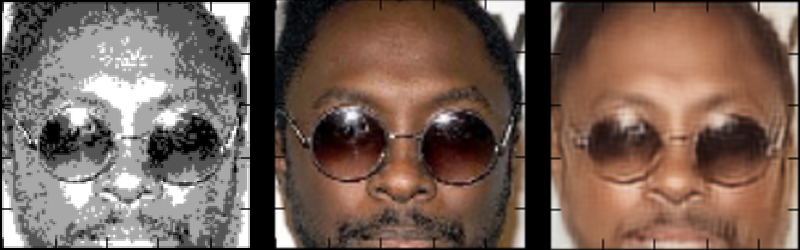
So Meertens created a workaround. He used face images, reduced them into a Game Boy-like four-tone grayscale style, and trained the neural network to reverse that transformation. In other words, the model learned from simulated Game Boy Camera images paired with their original color versions.
Once trained, the neural network could take a Game Boy-style face and produce a colorized, more detailed version. The results were not perfect, but they were impressive. Faces gained skin tones, eyes became more defined, and the output sometimes looked like a dreamy low-fi portrait rather than a strict restoration.
How Image-to-Image Translation Fits In
The Game Boy Camera experiment belongs to a broader field called image-to-image translation. This is the machine learning idea behind systems that can turn sketches into photos, maps into satellite-like images, black-and-white photos into color images, or edge drawings into believable objects.
A common approach is to train a neural network on paired examples. One image is the input style, and the other is the desired output style. The network learns the mapping between the two. If the input is a low-resolution grayscale face and the output is a color portrait, the model learns what kinds of colors, shadows, and facial details usually correspond to those grayscale patterns.
This sounds magical, but it is not magic. It is statistics wearing a superhero cape. The neural net does not “remember” the person in the photo unless that exact person was in the training set. Instead, it predicts what a plausible version of that image could look like based on what it has learned from many examples.
Restoration vs. Imagination: The Big Catch
Here is where things get important. When a neural net improves a Game Boy Camera image, it is not recovering hidden detail like a detective zooming in on security footage in a TV drama. The original file does not contain high-resolution skin texture, eye color, hair highlights, or accurate color information. Those details are gone, or more accurately, they were never captured in the first place.
So when an AI model creates a sharp, colorful face from a tiny monochrome image, it is generating plausible detail. That can be beautiful, useful, and fun, but it is not the same as historical truth. If the output gives someone blue eyes, that does not mean the original person had blue eyes. It means the model made a guess that fit the input pattern and training data.
This distinction matters for digital restoration, archival work, and AI image enhancement in general. Neural nets can help us imagine what old images might have looked like, but they can also invent details with great confidence. And as anyone who has ever confidently guessed on a math test knows, confidence and correctness are not the same animal.
Why the Game Boy Camera Aesthetic Still Works
The Game Boy Camera remains popular because its limitations are not just technical flaws. They are part of its personality. The rough pixels, limited tones, and strange contrast create an instantly recognizable style. In an age of hyper-polished smartphone photography, the Game Boy Camera feels refreshingly imperfect.
Modern cameras try to remove noise, smooth skin, balance exposure, detect faces, correct color, and make every sunset look like it has a personal branding consultant. The Game Boy Camera does none of that. It looks at your face, shrugs, and says, “You are now four shades of haunted pea soup.”
That is why artists, hackers, photographers, and retro gaming fans keep returning to it. It is not valuable because it is technically superior. It is valuable because it forces creativity. You cannot rely on detail, so you focus on shape, expression, contrast, and mood.
Neural Nets as Retro Tech Translators
Neural nets can act like translators between eras of technology. A Game Boy Camera image belongs to the late 1990s: tiny memory, low resolution, limited display, playful interface, and hardware constraints everywhere. Modern AI belongs to a world of GPUs, massive datasets, cloud computing, and models that can process images at scales Nintendo engineers in 1998 probably would have considered wizardry.
When you connect the two, something charming happens. The old device provides character, while the neural network provides interpretation. The result is not purely retro and not purely modern. It becomes a hybrid artifact: half toy-camera photo, half machine-learning dream.
This is why Game Boy Camera AI projects feel different from ordinary photo filters. A filter usually applies a style on top of an existing image. A neural net trained for reconstruction or translation tries to infer structure. It is not just adding color; it is estimating what the subject may have looked like beyond the original limitations.
Specific Examples of What Neural Nets Can Do With Game Boy Camera Images
1. Colorization
Since Game Boy Camera images are monochrome, one obvious use is colorization. A neural network can learn common relationships between facial shading and skin tone, hair tone, background color, and lighting. The output may not be historically accurate, but it can make the subject feel more lifelike.
2. Super-Resolution
Super-resolution uses machine learning to enlarge small images while generating believable detail. For Game Boy Camera photos, this can make portraits easier to view on modern screens. The model may sharpen edges, smooth blocky regions, and create textures that look natural.
3. Denoising
The Game Boy Camera’s crunchy image quality includes noise and harsh tonal transitions. Neural nets can reduce noise while preserving the overall composition. Used carefully, this can make the photo clearer without completely erasing its retro charm.
4. Face Reconstruction
Face-focused models can infer facial structure from limited input. This is where results become most impressiveand most ethically tricky. A reconstructed face may look convincing, but it can include invented details. For creative use, that is exciting. For identification or documentation, caution is essential.
5. Style Transfer
Neural style transfer can move visual characteristics from one image style to another. A Game Boy Camera photo can be transformed into an oil-painting-like portrait, a modern digital illustration, or a higher-contrast black-and-white artwork. It can also work in reverse, turning modern photos into Game Boy-inspired images.
The Technical Challenge: Too Few Pixels, Too Much Guesswork
The Game Boy Camera gives a neural net very little to chew on. Human viewers are excellent at recognizing faces from minimal cues. We can see two dark dots and a line and think, “That is Uncle Dave, probably about to ask where the remote went.” Machines need training to make those leaps.
A neural network trained on faces learns patterns such as the typical position of eyes, noses, mouths, shadows, cheekbones, eyebrows, and hairlines. When it sees a Game Boy Camera portrait, it tries to map the sparse pixel data onto those learned patterns.
But the smaller the input, the more uncertainty exists. If a shadow near the eye could represent eyelashes, glasses, wrinkles, or simply bad lighting, the neural net must choose one. That choice may look realistic while still being wrong.
This is why AI-enhanced Game Boy Camera images are best treated as creative interpretations. They can be visually compelling, but they should not be mistaken for exact restorations.
Why Hackers Love the Game Boy Camera
The Game Boy Camera has become a favorite object in hardware hacking because it is simple, weird, and durable enough to survive decades in drawers, closets, and mysterious plastic bins labeled “misc cables.” Enthusiasts have extracted images from cartridges, connected cameras to modern systems, modified lenses, used them for astrophotography, and built custom workflows around them.
Part of the fun is that the device was never designed for modern convenience. Getting images off the original hardware can be awkward. The Game Boy Printer created tiny thermal prints, but those prints fade over time. Direct digital extraction often requires additional hardware, cartridge readers, or creative capture methods.
That inconvenience is strangely motivating. Every step feels like a tiny archaeological dig. You are not just opening a camera roll; you are negotiating with a 1998 toy that has strong opinions and probably low battery power.
What This Teaches Us About Modern AI
Neural nets and Game Boy Cameras make a perfect teaching pair because the stakes are easy to understand. You begin with a tiny, obviously limited image. You then watch a model produce something cleaner, sharper, and more colorful. The transformation is dramatic, but the limitations are visible.
This helps explain a core truth about generative AI: models are not simply retrieving reality. They are producing outputs based on learned patterns. Sometimes that output is useful. Sometimes it is beautiful. Sometimes it is wrong in a way that looks completely reasonable.
For artists, that is a feature. For historians, archivists, journalists, or researchers, it is a warning label with flashing lights and maybe a tiny Mario sound effect.
Creative Uses for Neural Nets and Game Boy Camera Images
Artists can use Game Boy Camera photos as raw material for AI-assisted portraits, zines, album covers, social media graphics, and retro-futurist design. The camera’s native style already has personality, and neural networks can extend that personality in surprising directions.
A practical workflow might begin with capturing or extracting a Game Boy Camera image. Then the creator can upscale it, colorize it, denoise it, or run it through a style-transfer model. The final image can preserve the original pixel structure or intentionally blend it with modern photographic detail.
The key is deciding whether the goal is restoration, reinterpretation, or transformation. Restoration should preserve the original as much as possible. Reinterpretation can add tasteful detail. Transformation can go wild and turn a four-shade selfie into a cinematic portrait from an alternate universe where the Game Boy won the camera wars.
SEO-Friendly Takeaway: Tiny Camera, Big AI Lesson
The story of neural nets and Game Boy Cameras is not just about nostalgia. It is about how modern artificial intelligence handles limited visual information. The Game Boy Camera shows us what happens when hardware captures only the bare bones of an image. Neural networks show us how software can fill in the missing flesh, color, and atmosphere.
Together, they create a wonderful contradiction. One device removes nearly everything from a photo; the other tries to put it back. One is a toy from the late 1990s; the other is part of the modern AI revolution. One gives us crunchy pixels; the other gives us plausible dreams.
And that is why this topic continues to fascinate photographers, developers, retro gamers, machine learning enthusiasts, and digital artists. It proves that old technology does not become irrelevant just because newer technology arrives. Sometimes old technology becomes more interesting when the future finally catches up to it.
Extra Experiences: What It Feels Like to Work With Neural Nets and Game Boy Cameras
Working with Game Boy Camera images is a lesson in patience, charm, and accepting that “high quality” is not always the same thing as “interesting.” The first experience most people have is surprise. The camera is tiny, the interface is playful, and the results look bad in a way that quickly becomes lovable. You point it at a face, press a button, and receive a portrait that appears to have been faxed through a haunted toaster. Yet somehow, the person is there. The expression survives. The mood survives. The personality often survives better than expected.
Bringing neural nets into that workflow changes the experience completely. Suddenly, the ugly little image becomes a puzzle. The model has to decide what each block of shadow might mean. Is that dark patch hair, an eyebrow, a hat, or just the lighting attacking from the side? Is that bright square a cheek, a wall, or the Game Boy screen reflecting like a tiny green mirror? The AI tries to answer, and the result can be surprisingly emotional. A face that once looked like a pixelated cave drawing may become soft, colorful, and almost photographic.
But the best experience comes from comparing the original and the AI-enhanced version side by side. The original has honesty. It tells you exactly what the hardware captured, no more and no less. The neural net version has imagination. It suggests what might have been there. The tension between those two images is the whole appeal. One is evidence; the other is interpretation.
For creators, this process encourages experimentation. Some images look better when gently upscaled. Others become more interesting when the neural net is allowed to exaggerate the face, soften the tones, or invent color. A portrait with strong lighting may produce dramatic results, while a flat image may turn into something muddy. In that sense, the Game Boy Camera still behaves like a real camera: lighting matters, composition matters, and faces with clear contrast usually work best.
There is also a nostalgic pleasure in forcing modern AI to collaborate with obsolete hardware. The Game Boy Camera does not care about megapixels, HDR, portrait mode, or cloud sync. It offers a tiny frame and says, “Good luck, artist.” Neural networks respond by doing what they do best: finding patterns, filling gaps, and occasionally making confident nonsense. When the results succeed, they feel like time travel. When they fail, they are still entertaining.
The biggest practical lesson is to keep expectations flexible. Neural nets can improve Game Boy Camera images, but they cannot restore facts that were never recorded. Treat the outputs as creative reconstructions, not perfect truth. Save the original files, compare every edit, and enjoy the weirdness. The imperfections are not obstacles; they are the reason the project has personality.
Conclusion
Neural nets and Game Boy Cameras make an unlikely but brilliant pair. The Game Boy Camera represents the playful limits of early consumer digital photography: tiny images, four-tone visuals, awkward output, and unforgettable personality. Neural networks represent the modern ability to infer, colorize, upscale, and reinterpret visual data from limited clues.
When combined, they reveal both the promise and the caution of AI image processing. A neural net can transform a blocky Game Boy portrait into something warmer and more detailed, but it is not simply recovering lost truth. It is generating a plausible version based on what it has learned.
That is what makes the topic so compelling. It is nostalgic, technical, artistic, and philosophical all at once. It reminds us that creativity often begins where technology falls short. Sometimes the most interesting images are not the sharpest ones. Sometimes they come from a 1998 cartridge camera, a few stubborn pixels, and a neural network trying very hard to imagine the rest.