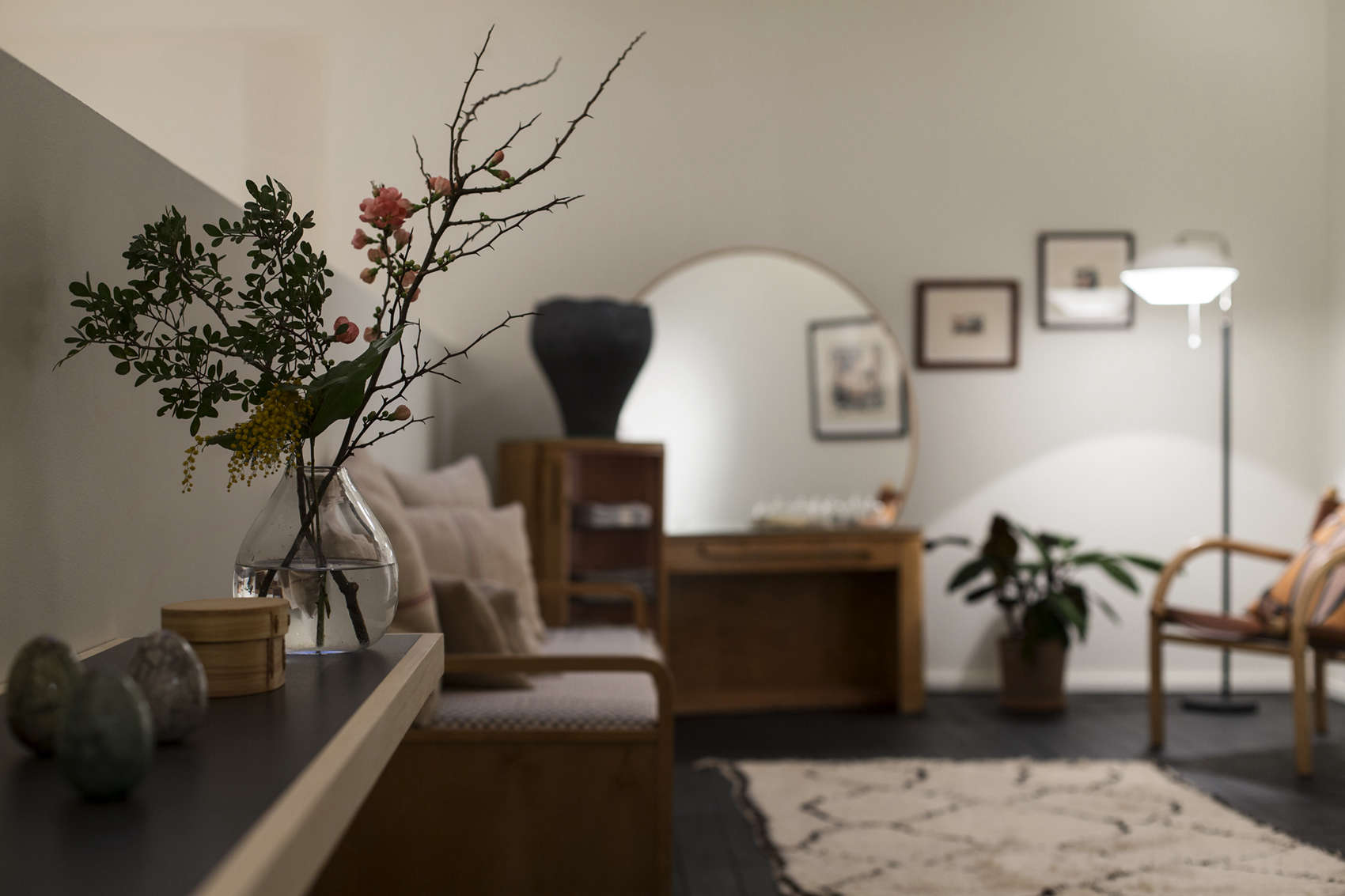
Samuji House was never designed to feel like a conventional boutique. When the Helsinki concept opened in 2016, it presented fashion, furniture, art, lighting, and household objects inside rooms arranged more like a tasteful Finnish home than a retail floor. The result was a shop where visitors could imagine living with the merchandise instead of merely carrying it toward a cash register.
Founded by Finnish designer Samu-Jussi Koski, Samuji had already earned attention for clothing that combined relaxed silhouettes, distinctive textiles, and practical construction. Samuji House extended that philosophy beyond the wardrobe. It asked a wonderfully dangerous question: What happens when a fashion designer creates an entire domestic world around the clothes?
The answer involved natural materials, modernist furniture, handmade objects, flowers, art, textiles, and enough quiet confidence to make ordinary display fixtures seem embarrassingly loud.
From a Carefully Edited Wardrobe to an Entire House
Samuji began in Helsinki in 2009 as a creative studio led by Koski, a designer whose career included serving as creative director at Marimekko. His early vision for the brand centered on a compact, complete wardrobe: a limited group of dependable garments that could be worn repeatedly rather than discarded when the fashion calendar sneezed.
The Samuji Classic collection grew from that idea of enduring essentials. A more expressive Seasonal collection added color, pattern, and a slightly bohemian mood. Together, the lines balanced discipline and personalitythe design equivalent of someone who alphabetizes the bookshelf but keeps a mysterious ceramic bird beside the novels.
The Arrival of Samuji Koti
In 2014, the brand expanded into interiors with Samuji Koti. “Koti” means “home” in Finnish, and the collection translated Samuji’s clothing values into objects for daily life. Instead of chasing decorative novelty, it focused on useful things made memorable through proportion, material, and craft.
The range included textiles, wooden boards and boxes, mouth-blown glassware, ceramics, candleholders, small accessories, and fabrics printed with original patterns. Many pieces were made through collaborations with Finnish artists and craftspeople. The objects felt contemporary, but they were not desperate to announce the year in which they were designed.
That restraint is central to the idea of a “new Finnish classic.” A classic does not need to look old. It needs to remain useful and visually convincing after the trend cycle has packed its tiny suitcase and moved on.
Why Samuji House Felt Like a Home
Samuji House opened in a courtyard off Erottajankatu, one of central Helsinki’s shopping streets. Its location already created a sense of discovery. Visitors left the busy commercial route, entered the courtyard, and found a two-story space inside a residential-style building.
Rather than filling those rooms with identical racks and aggressively illuminated shelves, the designers treated them as domestic interiors. Clothing appeared alongside chairs, tables, rugs, lamps, flowers, paintings, ceramics, and useful household goods. The arrangement gave each object room to breathe and allowed different categories to form a single visual story.
A Boutique, Gallery, and Townhouse in One
The shop combined three recognizable experiences. It worked as a boutique because clothing and accessories remained central. It resembled a gallery because artworks and handcrafted pieces were displayed with care. It felt like a townhouse because furniture, lighting, textiles, and decorative objects were placed in believable room-like settings.
This mixture softened the commercial atmosphere. A blouse did not appear as isolated inventory. It belonged to a wider life involving a wooden chair, a patterned pillow, a glass vase, a wool rug, and perhaps a cup of tea that would inevitably be forgotten until it became suspiciously cold.
The concept also changed the customer’s pace. Conventional stores encourage scanning: size, price, color, next rack. Samuji House encouraged wandering. Visitors could examine the grain of a wooden bowl, notice how a textile interacted with an upholstered chair, or see how a sculptural candleholder looked under warm residential lighting.
The Finnish Modernist Ideas Behind the Interior
Samuji House belonged to a long Finnish tradition in which architecture, furniture, clothing, glass, textiles, and household tools are treated as connected parts of everyday life. Finnish modernism rarely viewed beauty as a decorative layer pasted onto function. Beauty was supposed to emerge from intelligent use, honest construction, natural materials, and humane proportions.
Function Without Coldness
Scandinavian interiors are often summarized with words such as “minimal,” “neutral,” and “clean.” Those terms are accurate but incomplete. Finnish design is not simply the removal of objects until a room resembles a polite waiting area. Its strongest examples use simplicity to make materials, craftsmanship, light, and daily rituals more noticeable.
This distinction explains why Samuji House felt spare without becoming sterile. Pale surfaces and uncluttered layouts provided calm, while wood, leather, wool, linen, glass, plants, and artwork brought warmth. Every element had a role, but the rooms still possessed character.
The Influence of Alvar and Aino Aalto
The legacy of Alvar and Aino Aalto was visible in the store’s relationship with natural materials and human-centered modernism. Alvar Aalto famously helped soften the harder edges of European modernism by using bent birch, organic curves, diffused light, and forms sympathetic to the body. Aino Aalto contributed an equally important vision combining architecture, furniture, glassware, exhibitions, and domestic life.
Samuji House displayed new Scandinavian pieces alongside reissued Artek classics. Among the documented examples were Alvar Aalto lighting and seating and a table by Finnish designer Ilmari Tapiovaara. These historical designs were not treated as museum relics. They functioned as furniture inside an active retail environment, proving that a genuine classic can work hard without demanding applause every fifteen minutes.
Materials That Reward a Closer Look
The interior’s visual quiet made craftsmanship unusually visible. Gray pegboard-style walls, pale wood floors, dark stone surfaces, and restrained display structures created a backdrop for tactile products. Instead of hiding construction beneath excessive decoration, the shop encouraged visitors to notice texture, weight, finish, and small irregularities.
Objects with Makers Behind Them
Samuji Koti included pieces connected to identifiable craftspeople and regional methods. The collection featured mouth-blown glass produced in Helsinki, wooden bowls shaped from burl, printed fabrics, locally made wooden accessories, and metal objects created through Finnish foundry work.
One notable example was a pipe-shaped candleholder designed by textile artist Erja Hirvi and cast by metalworker Jukka Kuntonen. The foundry carried an intriguing connection to Finnish design history: it was associated with the mold-making tradition behind Iittala’s celebrated Aalto vase.
Other objects included drop-shaped glass vases, marble eggs, birch boxes, striped tea towels, printed Japanese-style tenugui cloths, and textiles featuring Samuji patterns. Individually, these were modest household items. Together, they demonstrated how a home acquires personalitynot through one giant statement sofa that requires its own publicist, but through many carefully chosen details.
Fashion and Interiors Speaking the Same Language
Fashion boutiques often create dramatic interiors that compete with the clothing. Samuji House pursued something more integrated. The garments and rooms shared a vocabulary of practical elegance, subtle experimentation, natural fibers, balanced color, and designs intended for repeated use.
A textured coat could echo the surface of a rug. A printed dress might relate to a cushion made from Samuji fabric. Neutral garments became more expressive beside dark stone or vintage wood, while colorful textiles energized otherwise calm rooms.
Merchandising as Storytelling
Because the store mixed categories, it demonstrated possible relationships rather than presenting isolated products. A customer could see how a patterned textile might coexist with an Aalto chair, how contemporary glass could sit on a vintage table, or how a simple outfit might belong in an art-filled home.
This was effective visual merchandising, but it was also a design lesson. Samuji House showed that a coherent interior does not require every piece to come from the same collection. Old and new objects can coexist when they share qualities such as craftsmanship, honest materials, useful proportions, and a certain emotional calm.
Why the Homelike Retail Concept Works
Retail spaces traditionally separate products into departments because departments are efficient. Efficiency, however, is not always memorable. A homelike shop replaces rigid categories with context. Customers do not merely see a lamp; they see what kind of evening the lamp might create.
It Helps Shoppers Imagine Ownership
Objects become easier to understand when they are shown in use. A vase appears more desirable when it contains branches. A throw makes sense when folded over a chair. A candleholder gains atmosphere when positioned beside books and artwork rather than stranded beneath a fluorescent spotlight.
Samuji House used this principle without becoming a theatrical model home. The rooms remained curated, yet they included enough variety, age, texture, and artistic personality to feel lived in.
It Encourages Slower Decisions
The domestic layout also supported Samuji’s quality-over-quantity philosophy. Visitors were invited to spend time with materials and consider how objects might fit into real routines. That approach is especially appropriate for items designed to last.
Slow shopping does not mean standing motionless beside a tea towel while contemplating the universe. It means paying attention before purchasing: touching the fabric, examining construction, thinking about care, and asking whether the object will remain useful after its initial sparkle fades.
New Finnish Classics Rather Than Nordic Clichés
Samuji House avoided reducing Finnish design to white walls, blond wood, and one lonely plant enduring tremendous aesthetic responsibility. Its interiors contained neutral foundations, but they also incorporated dark surfaces, vintage furniture, strong artwork, expressive textiles, and unusual handcrafted forms.
This richer mixture reflects Finnish design more accurately. The country’s visual culture includes both the organic modernism of Aalto and the exuberant printed textiles associated with Marimekko. It includes disciplined functionalism, experimental postwar furniture, folk craftsmanship, glassmaking, ceramics, and an enduring connection to forests and seasonal light.
Timeless Does Not Mean Timid
Samuji’s approach demonstrated that a lasting object may still possess humor, color, or eccentricity. Timelessness comes from resolving a design well, not sanding away every unusual feature. A bold print can become a classic. So can a peculiar candleholder, provided it continues to function and people continue to enjoy looking at it.
The balance between quiet basics and expressive accents gave Samuji House its energy. Calm rooms prevented the colorful pieces from becoming chaotic. Playful objects prevented the neutral rooms from becoming sleepy. Everyone did their job, including the marble eggs, whose practical contribution remains delightfully debatable.
Lessons for Creating a Samuji-Inspired Interior
The original shop offered ideas that can be applied to homes, boutiques, studios, and showrooms without copying its rooms piece by piece.
Begin with Useful Foundations
Choose furniture for comfort, durability, and proportion before worrying about visual drama. Simple wooden tables, well-made chairs, practical shelving, and flexible lighting create a stable framework. A room becomes easier to personalize when its largest pieces are not shouting across it.
Mix Generations of Design
Combine contemporary objects with vintage furniture, inherited textiles, handmade ceramics, or older artwork. The goal is not to recreate a historical period. It is to build continuity. New pieces feel more grounded beside objects that already have a story.
Let Materials Remain Recognizable
Use wood that still looks like wood, linen that still behaves like linen, and ceramics that reveal something about how they were formed. Natural variations add depth and reduce the need for superficial decoration.
Display Fewer Objects More Thoughtfully
Leave visual space around meaningful pieces. Group items by material, use, or mood rather than scattering small decorations everywhere. Rotating objects seasonally can refresh a room without creating a permanent migration of shopping bags into the closet.
Add Life, Not Just Styling
Branches, flowers, books, useful textiles, and everyday tools help a space feel inhabited. A perfectly arranged room without signs of living can resemble a photograph waiting for humans to leave. Samuji House succeeded because its refinement still allowed domestic warmth.
A 500-Word Experience of Samuji House
Imagine approaching Samuji House from central Helsinki on a cool afternoon. Erottajankatu carries the ordinary energy of the cityfootsteps, conversations, traffic, shopping bags, and people moving with the purposeful speed of anyone who has recently checked the weather. Then you turn into the courtyard.
The shift is immediate. The street noise softens, and the entrance feels slightly hidden, as though the shop expects curiosity rather than accidental foot traffic. Instead of a giant sign announcing a retail event, the building offers the quieter invitation of a private residence.
Inside, your first reaction is not, “Where is the sale section?” It is closer to, “Who lives here, and can they adopt me?” Clothing hangs neatly but does not dominate. A chair sits where a chair might naturally belong. A vase holds branches. Textiles are stacked on furniture that appears chosen for beauty and daily use rather than its ability to survive a warehouse forklift.
The lighting asks you to slow down. You notice the difference between smooth glass and rougher wood, between a crisp printed cloth and the worn surface of an older table. Nothing is arranged with the frantic density of a department store. Objects have enough room to become distinct.
Moving through the two floors feels like visiting someone whose taste is excellent but not intimidating. That distinction matters. Some design spaces make visitors afraid to breathe near the furniture. Samuji House appears refined while suggesting that the chairs may actually be sat upon and the bowls may eventually contain something more useful than decorative pinecones.
You begin to understand the clothing differently because of the setting. A simple coat no longer looks plain. Against artwork, wood, wool, and stone, its proportion becomes more noticeable. A printed garment gains context beside patterned household textiles. The fashion seems designed for the same person who would choose a handmade glass vase: someone attracted to personality but suspicious of unnecessary fuss.
Upstairs, the experience becomes even more domestic. Furniture, lighting, art, and Samuji Koti objects form small scenes that suggest different moments of the day. A lamp implies evening reading. Tea towels evoke a bright kitchen. A candleholder suggests a winter dinner during which everyone politely pretends not to notice that sunset occurred at approximately lunchtime.
The strongest impression is coherence. The pieces do not match in the conventional sense, yet they belong together. Contemporary objects sit comfortably beside established Artek designs and vintage furnishings. That mixture makes the shop feel collected rather than installed.
By the time you leave, you may remember individual products, but the larger memory is atmospheric. Samuji House demonstrates how retail can offer more than transaction. It can show how materials age, how design traditions evolve, and how a useful object can enrich a daily ritual.
You return to the street carrying either a carefully wrapped purchase or a head full of decorating ideas. Both are legitimate souvenirs. The most important lesson follows you home: good design does not need to dominate life. It can quietly improve the places where life already happens.
Conclusion: A Shop Designed Around Living
Samuji House was significant because it treated fashion, interiors, craft, and art as parts of one continuous environment. Its homelike arrangement transformed shopping into a slower, more imaginative encounter. Visitors could understand objects through context, experience classic Finnish furniture as part of daily life, and see how contemporary design might become tomorrow’s heirloom.
The concept also revealed the deeper strength of Finnish modernism. Its appeal does not come from minimalism alone. It comes from combining function with warmth, discipline with playfulness, and industrial production with respect for natural materials and skilled hands.
In an era of disposable trends and interiors assembled for instant photographs, Samuji House offered a quieter alternative. Buy thoughtfully. Mix old and new. Choose objects that work. Leave room for art, flowers, stories, and a little oddness. And never underestimate the persuasive power of a beautifully folded tea towel.