
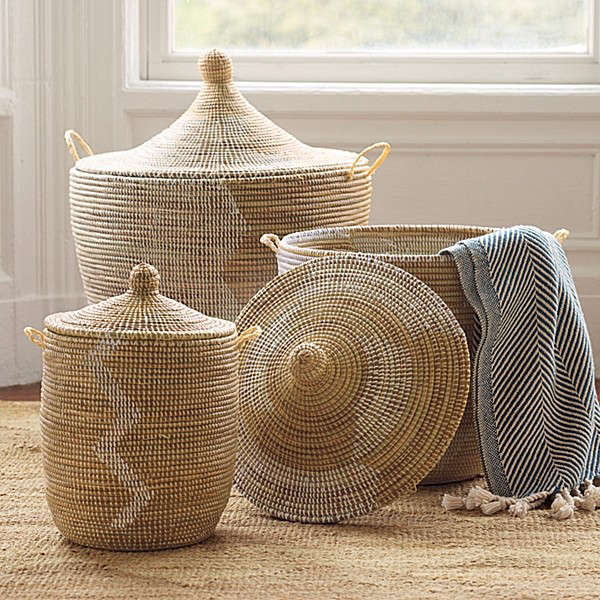
Some storage containers quietly disappear into a closet. Senegalese storage baskets do the opposite. They organize theI am also art.” With sculptural shapes, graphic patterns, sturdy construction, and unmistakable handwoven character, these baskets turn ordinary clutter control into part of a home’s design.
Authentic Senegalese baskets are closely associated with Wolof weaving communities in rural Senegal. Many contemporary pieces combine dried grass or cattail stalks with colorful plastic strips, creating a practical bridge between inherited craft techniques and modern materials. The results range from small tabletop containers to enormous lidded hampers capable of swallowing a week’s worth of towels, toys, or mysteriously migrating socks.
Research basis: Unison Home, Swahili Modern, African Modern, West Elm. er>
What Are Senegalese Storage Baskets?
Senegalese storage baskets are handwoven containers traditionally produced by skilled artisans in Senegal, a West African country whose cultural life includes strong traditions of textile work, pottery, leatherwork, metalwork, and basketry. The baskets commonly sold in the United States are often identified as Wolof baskets because many are woven by Wolof women working independently or through artisan associations.
Unlike flimsy decorative bins that begin collapsing after one encounter with an enthusiastic toddler, these baskets are usually formed around a firm coiled structure. Bundles of natural stalks create the foundation, while narrow plastic strips wrap and bind the coils together. The weaver gradually builds the basket outward and upward, controlling its shape, tension, pattern, and color placement by hand.
The technique produces baskets that are structured but not rigid, lightweight but surprisingly strong, and decorative without sacrificing usefulness. Slight variations in dimensions, symmetry, and pattern are normal. They are evidence that a human being made the object, not defects that escaped a factory inspector armed with a ruler.
Research basis: Swahili Wholesale, Unison Home, Artisan Variety, Cultural Interiors. ion>
A Craft Built Through Generations
Traditional Materials and Modern Adaptation
Earlier Wolof baskets were commonly made by binding a thick local grass with thin palm-frond strips. Contemporary weavers frequently substitute recycled or newly produced plastic for the palm material. Some plastic strips come from discarded or surplus prayer mats and factory offcuts, although sourcing practices vary among workshops and exporters.
This adaptation has practical advantages. Plastic binding offers bright, consistent colors and helps the basket tolerate occasional contact with moisture better than an entirely plant-based piece. It also allows artisans to create crisp zigzags, diamonds, bands, crosses, and abstract geometric arrangements that look equally comfortable in a traditional home, a modern apartment, or a living room that cannot decide whether it is minimalist or bohemian.
Research basis: Unison Home, Little Traveler, African Modern, Cultural Interiors. >Weaving as Skilled Economic Work
Basket weaving is not merely a charming pastime performed between household chores. It is skilled labor. A large, tightly woven hamper can require many hours or even days of work, depending on its size, pattern, material preparation, and the artisan’s schedule.
For women in rural communities, basket income may contribute to food, education, health expenses, household improvements, and greater financial independence. Fair-trade businesses emphasize long-term purchasing relationships, prompt payment, safe working conditions, environmental responsibility, and respect for artisans’ cultural knowledge. However, the global popularity of “Senegal-style” baskets has also encouraged imitation products, and a high retail price does not automatically guarantee that the original weaver received a fair share.
Research basis: Fair Trade Federation, AfricaNews, Associated Press. ion>
Why Senegalese Storage Baskets Stand Out
They Make Visible Storage Look Intentional
Most homes need storage in places where cabinets are unavailable or already occupied by appliances purchased with heroic optimism. Senegalese baskets solve this problem beautifully. Instead of hiding a plastic tote behind a curtain, homeowners can leave a woven hamper beside a sofa, under a console, near an entryway, or in an open shelving unit.
The surface pattern adds movement, while the natural stalks introduce warmth and texture. A black-and-white basket can sharpen a modern room. A multicolored piece can energize neutral furniture. Natural tan, cream, and muted gray patterns blend easily with coastal, organic-modern, farmhouse, global, or Scandinavian-inspired interiors.
Every Basket Is Slightly Different
Handmade variation gives each basket personality. Two items woven in the same pattern may have slightly different proportions, lids, handles, or color placement. One may stand perfectly upright while another leans with the relaxed confidence of someone who has stopped caring about posture.
These differences matter because they keep the object from feeling sterile. A handmade basket records decisions made by its weaver: how tightly to pull the binding, when to change colors, where to widen the wall, and how to finish the rim. That individual character is a major reason authentic Senegalese baskets feel more like functional craft than ordinary storage merchandise.
Research basis: African Modern and West Elm product information. >They Are Impressively Versatile
Large lidded baskets work as laundry hampers, blanket storage, toy containers, or spare-linen holders. Medium open baskets can organize pillows, magazines, knitting supplies, rolled towels, pet toys, or exercise equipment. Small baskets are useful for remotes, chargers, cosmetics, mail, craft materials, and all the tiny objects that otherwise form unauthorized colonies on countertops.
Home-organization experts regularly recommend baskets because they group loose items, simplify cleanup, and make open storage more attractive. The trick is assigning each basket a purpose. A beautiful container labeled mentally as “miscellaneous” will eventually become a woven archaeological site.
Research basis: Better Homes & Gardens, Apartment Therapy, Martha Stewart. ion>
Popular Shapes and the Best Uses for Each
Lidded Hamper Baskets
Tall Senegalese hampers are among the most recognizable designs. Their fitted lids conceal visual clutter, making them ideal for bedrooms, bathrooms, nurseries, and living rooms. Use one for dirty laundry, extra blankets, stuffed animals, seasonal pillows, or bulky winter accessories.
Before purchasing, check the opening width as well as the overall height. A dramatic narrow-necked basket may look magnificent but prove inconvenient when you are attempting to insert a comforter the size of a weather system.
Open Floor Baskets
Open baskets provide fast access and encourage quick cleanup. Place one beside a sofa for throws, near a fireplace for kindling kept safely away from sparks, or in a playroom for toys. Handles make moving the basket easier, but they should not be treated like industrial lifting equipment. Support the bottom when carrying a heavily loaded piece.
Low Bowls and Tabletop Baskets
Shallow baskets work well on coffee tables, entryway consoles, dressers, and kitchen counters. They can hold keys, wrapped snacks, fruit, cloth napkins, or decorative objects. When storing food, use a washable liner and avoid placing oily, wet, or strongly colored foods directly against the weave.
Nesting Basket Sets
Nesting sets offer several sizes in coordinated patterns. They are useful when a room needs visual consistency without using identical containers. The largest basket can hold blankets, the medium one can manage toys, and the smallest can collect remote controls before they disappear into the sofa’s secret underground network.
How to Style Senegalese Baskets at Home
Use One Large Basket as a Focal Point
A single oversized basket can anchor an empty corner more effectively than a cluster of small accessories. Choose a pattern that contrasts with the wall or nearby furniture. Beside a neutral sofa, a boldly patterned hamper adds height and energy without creating visual clutter.
Repeat Colors Already in the Room
Look for one or two colors in the basket that connect with existing textiles, artwork, rugs, or upholstery. The shades do not need to match perfectly. Repetition creates harmony, while slight differences keep the room from looking as though it was purchased as a single boxed set.
Mix the Basket With Simpler Materials
Because Senegalese baskets already contain strong pattern and texture, they pair well with quiet materials such as linen, solid-colored wool, pale wood, matte ceramics, leather, concrete, and simple metal finishes. In a highly patterned room, choose a basket with a restrained two-color design. In a minimalist space, a multicolored basket can provide the room’s main visual spark.
Create Practical Drop Zones
Place a medium basket near the front door for scarves, reusable bags, dog accessories, or children’s outdoor gear. Baskets also work well on open shelves, beneath benches, and under console tables. Measure the intended location before buying, especially when placing a basket inside a cubby. Handmade dimensions are approximate, and optimism is not a recognized unit of measurement.
Research basis: Better Homes & Gardens and Apartment Therapy. ion>
How to Choose an Authentic, Well-Made Basket
Read the Origin Information Carefully
A product described only as “African-inspired,” “global,” or “Senegal style” may not have been made in Senegal. Look for clear information about the country of origin, weaving community, artisan group, importer, materials, and production method. Specific descriptions are generally more useful than romantic phrases about “timeless tribal spirit” that somehow say everything and nothing.
Ask How the Artisans Are Paid
Responsible sellers should be able to explain their sourcing relationship. Useful signs include direct partnerships, ongoing orders, membership in a recognized fair-trade organization, transparent artisan stories, and acknowledgment of the actual weaving community. Be cautious when a retailer uses cultural imagery heavily but provides no information about who made the product.
Inspect Construction
The coils should feel firm, the rim should be securely finished, and the binding should not unravel under gentle handling. A lid should sit reasonably well, although perfect machine-like alignment is not expected. Check photographs for the weave density, base shape, handles, and interior finish.
Expect Handmade Variation
Measurements listed online are often approximate. Color may vary with lighting, available materials, and small production runs. That variation is part of the appeal, but buyers who need a basket to fit a specific shelf should allow extra clearance.
Research basis: African Modern, West Elm, Fair Trade Federation, AfricaNews. ion>
Cleaning and Caring for Senegalese Storage Baskets
Routine care is simple. Remove loose dust with a soft brush, dry microfiber cloth, or vacuum attachment set to low suction. Work gently around raised coils and decorative details.
For light dirt, dampen a cloth with a mild soap-and-water solution and wipe the affected area. Do not saturate the natural stalks. Excess water may soften the structure, encourage mildew, distort the shape, or create uneven drying. Allow the basket to air-dry completely in a well-ventilated area before replacing the lid or filling it.
A soft toothbrush can loosen debris trapped between coils. Avoid harsh bleach, aggressive scrubbing, soaking, dishwashers, and prolonged outdoor exposure. Although the plastic binding improves durability, the basket still contains natural plant material.
Keep the basket away from standing water and excessive humidity. Direct sunlight may gradually fade strong colors, so rotate the piece occasionally when it sits near a bright window. If the basket becomes misshapen during shipping, gentle reshaping by hand may help. Work slowly rather than attempting to wrestle it into submission like an uncooperative suitcase.
Research basis: Martha Stewart cleaning guidance and artisan retailer care information. ion>
Are Senegalese Storage Baskets Sustainable?
The answer depends on the specific basket and supply chain. The use of locally gathered grasses and recovered plastic can reduce demand for entirely new materials, while durable construction may allow a basket to serve a household for many years. A long-lasting item that replaces several disposable bins can be a sensible purchase.
However, words such as “recycled,” “artisan,” and “handmade” should not be treated as automatic proof of sustainability. Buyers should consider worker compensation, transport, material sourcing, product longevity, packaging, and whether the seller maintains a genuine relationship with the weaving community.
The most responsible purchase is usually a basket that is authentic, well constructed, appropriately sized, and likely to remain useful. A beautiful hamper that serves the family for a decade is more meaningful than five trend-driven containers purchased because an influencer’s pantry looked suspiciously calm.
Research basis: Fair Trade Federation, Goodee sustainability framework, Swahili Modern. ion>
Living With Senegalese Storage Baskets: A Practical Experience
The everyday appeal of a Senegalese storage basket usually becomes obvious during the first week. At first, the basket may be purchased as a decorative accent. It is positioned carefully beside a chair, photographed from several angles, and treated with the respect normally reserved for museum objects. Then real life arrives. A blanket lands inside. Next come two magazines, a charging cable, a child’s toy, and one sock that appears to belong to nobody.
That gradual transition from display piece to working household object is where the basket proves its value. A tall lidded hamper can make a bedroom feel calmer almost instantly because irregular piles disappear behind a patterned surface. Unlike a plastic laundry bin, it does not need to be hidden when visitors arrive. The room remains organized without looking overly managed.
Owners often notice that the basket’s light weight makes it easy to reposition. A floor basket can begin beside the sofa holding throws, move to the guest room when visitors arrive, and later become toy storage. Supporting the base is important when carrying heavy contents, but for ordinary linens and soft goods, the basket is easy to handle.
The lid can be both a gift and a minor daily comedy. It keeps clutter concealed, yet handmade lids may fit more naturally in one direction than another. After several uses, the household learns the correct angle. This tiny ritual becomes part of living with a handmade object. Instead of snapping into place with factory precision, the lid asks for half a second of cooperation.
Texture also changes the atmosphere of a room. In a space dominated by flat walls, smooth cabinets, screens, and rectangular furniture, the coiled surface introduces depth. Sunlight catches the raised weave during the day, while the pattern appears bolder in evening light. Even a neutral basket can make the room feel warmer and less generic.
Small baskets tend to become the most frequently used pieces. One near the front door collects keys and sunglasses. Another controls remote controls on the coffee table. A third holds charging cables that previously reproduced freely across the house. Organization becomes easier because cleanup no longer requires opening drawers, rearranging shelves, or making serious decisions. Items simply return to their assigned basket.
There are practical limitations. The woven surface is not suitable for leaking bottles, damp towels left for days, muddy shoes, or unlined plant pots. Tiny objects may work into wider gaps, and rough interior fibers can catch delicate fabrics. Using washable liners for produce, toiletries, or fragile textiles solves many of these problems.
Over time, small signs of use may appear. The base may relax slightly, a color may soften near a sunny window, or a coil may develop a subtle irregularity. These changes usually add character rather than ruining the basket. Regular dusting and careful handling preserve its shape, while the strong binding allows it to withstand ordinary family life.
The most satisfying experience comes from knowing that the basket combines utility with human skill. It is not merely a patterned container designed to survive one decorating season. Its form reflects practiced hands, inherited knowledge, material adaptation, and a long conversation between tradition and contemporary design.
That is why Senegalese storage baskets often outlast the decorating trend that introduced them. They are useful enough to remain in the home even when furniture changes, walls are repainted, or the once-perfect living room becomes a temporary fortress of moving boxes. A good basket keeps working. It holds the mess, improves the room, and asks for very little in return.
Conclusion
Senegalese storage baskets offer more than an attractive place to hide household clutter. Authentic pieces represent sophisticated weaving knowledge, creative use of materials, and the economic work of Senegalese artisans, particularly Wolof women. Their sculptural shapes and bold patterns make them natural focal points, while their practical construction allows them to organize nearly every room.
Choose a basket by considering its intended use, measurements, weave quality, materials, origin, and the seller’s sourcing practices. Care for it with gentle dusting, minimal moisture, and protection from prolonged dampness or harsh sunlight. Treated thoughtfully, a Senegalese basket can remain both useful and beautiful for yearsquietly proving that storage does not have to resemble something issued by a warehouse.












