
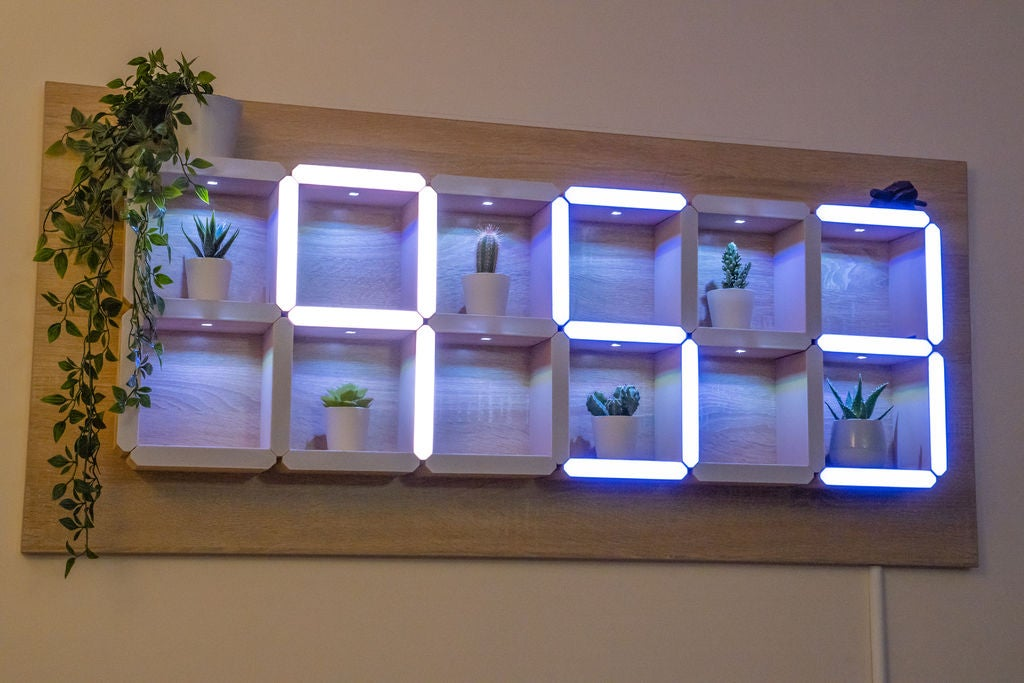
Some home projects politely sit in the corner and hold a few books. Others barge into the living room wearing LEDs, telling time, lighting up collectibles, and making guests say, “Wait… is your shelf also a clock?” Seven-segment shelves belong proudly in the second category.
The idea is wonderfully nerdy and surprisingly practical: build a geometric shelving unit whose edges form the familiar shapes of a digital seven-segment display. Add addressable LED strips, a microcontroller, a real-time clock module, ambient light sensing, and suddenly the shelf is not just storage. It is wall art. It is lighting. It is a giant digital clock. It is also a gentle reminder that “just one weekend project” can become a full-blown personality trait.
At its core, Seven-Segment Shelves Do Double Duty is about combining two worlds that usually live in separate aisles: electronics and interior design. On one side, you have the reliable logic of a seven-segment display, the same visual language used in digital clocks, calculators, meters, counters, and appliances. On the other side, you have wall-mounted shelving, a classic solution for small-space storage and decorative display. Put them together, and you get a maker-friendly furniture concept that is functional even when the clock is off.
What Are Seven-Segment Shelves?
Seven-segment shelves are a shelving system designed around the visual structure of a seven-segment display. A standard seven-segment digit uses seven bars, commonly labeled A through G, arranged so different combinations can form numbers from 0 to 9. Light up the top, upper right, lower right, bottom, lower left, upper left, and middle segments, and you can create almost every digit people recognize at a glance.
Now imagine those segments as shelf edges instead of tiny display bars. The frame becomes furniture. The LEDs become a readable clock face. The negative space becomes a place for books, plants, small sculptures, collectibles, or the mysterious object every home has but no one can identify.
The most famous inspiration for this concept is a maker-built hidden shelf-edge clock: a geometric wall shelf with LED strips tucked into its edges so the whole structure works as a giant digital display. It uses addressable LEDs, an Arduino-style controller, a real-time clock module, and a light sensor to keep the time accurate while adjusting brightness to the room. The result feels like something halfway between a smart home gadget and a modern art installation.
Why the Seven-Segment Display Still Works
There is a reason seven-segment displays have lasted for decades. They are simple, readable, and efficient. A person can recognize a digital “8” or “3” from across the room because the shape is already baked into our visual memory. Digital clocks, fuel pumps, kitchen timers, multimeters, thermostats, and calculators trained us all very well.
The design is also forgiving. Unlike a full pixel display, a seven-segment format does not need hundreds or thousands of points of light to communicate useful information. A few bold illuminated bars can do the job. That makes the format perfect for large-scale DIY projects where the goal is impact without unnecessary complexity.
Simple Visual Language
Seven bars can show ten digits. Add a colon between digit groups, and you have a clock. Add color control, and you have mood lighting. Add a temperature sensor, countdown mode, or calendar function, and suddenly your shelves have more features than some budget appliances.
Low Visual Clutter
Because the display is integrated into the shelf edges, the clock does not need a separate housing. There is no extra black rectangle on the wall, no bulky plastic case, and no “tech blob” competing with the room. The display hides in plain sight, which is the best kind of hiding unless you are looking for your TV remote.
How Seven-Segment Shelves Do Double Duty
The phrase “double duty” gets thrown around a lot in home design, usually when a bench has a secret compartment or a coffee table contains three blankets and one emotional-support charging cable. Seven-segment shelves take the idea further because they serve multiple roles at once.
1. They Store and Display Objects
First, they are shelves. That matters. A cool electronic project that cannot survive normal life becomes a novelty. A shelf that can hold books, models, photos, houseplants, or gaming collectibles has daily usefulness. The geometric compartments naturally create small display zones, making the unit feel curated even when your decorating strategy is “place thing where thing fits.”
2. They Tell Time
Second, the shelf acts as a clock. Using LED strips arranged in seven-segment patterns, the edges can illuminate to form hour and minute digits. A real-time clock module helps the system keep accurate time even if the controller restarts. That detail is important because a giant clock that confidently lies is not charming; it is just a wall-mounted gaslighter.
3. They Add Ambient Lighting
Third, the LEDs can provide accent lighting. Addressable strips such as WS2812B-style LEDs allow individual color control, which means the shelves can glow softly at night, highlight display items, or shift color depending on mood. Warm white can make the shelves feel cozy. Cool tones can make them feel futuristic. Rainbow mode can make the room look like a tiny disco got promoted to management.
4. They Become Conversation Pieces
Finally, they create a memorable design feature. People are used to shelves. They are used to clocks. They are less used to a shelf revealing itself as a huge digital clock after sunset. That surprise gives the project emotional value, and emotional value is what separates a custom build from a thing you bought because it was “fine.”
The Maker Electronics Behind the Magic
The electronics are approachable but not trivial. A typical seven-segment shelf clock uses several major components: a microcontroller, addressable LED strips, a real-time clock module, wiring, power supply, and brightness sensing. The exact parts can vary, but the design logic remains similar.
Microcontroller
An Arduino Nano or similar board is often enough for this type of project. The controller decides which LED segments should turn on for each digit. It reads the time, maps numbers to segments, and updates the display. In other words, it is the tiny brain inside the wall shelf, which is either inspiring or slightly unsettling depending on how many smart devices already live in your house.
Addressable LED Strips
Addressable LEDs make large displays much easier to control. Instead of running separate wires to every single segment, the LEDs can be daisy-chained and controlled with data signals. This reduces wiring complexity and allows color effects, brightness adjustment, animations, and custom modes.
Real-Time Clock Module
A real-time clock module, such as a DS3231-style module, helps the clock keep time accurately. Many modules include a small backup battery, so the clock can remember the time even if power is temporarily disconnected. That means your shelf does not wake up from a power outage thinking it is 12:00 forever, like a microwave with commitment issues.
Ambient Light Sensor
A photoresistor or light sensor lets the project respond to the room. During the day, the LEDs can shine brighter. At night, they can dim automatically so the shelf does not blast your living room with the intensity of a tiny airport runway.
Design Matters: Why This Project Looks Better Than a Plain Clock
The best version of seven-segment shelving does not scream “electronics project” from across the room. It looks intentional. The geometry, wood finish, light diffusion, wall placement, and object styling all matter.
Good interior design often rewards pieces that combine function with a clean visual identity. Modular shelving is popular because it can adapt to different spaces and lifestyles. Small-space design also favors vertical storage and multifunctional furniture. Seven-segment shelves fit that trend perfectly because they use wall space, add lighting, store objects, and avoid taking up floor area.
Use the Wall Like Real Estate
Floor space is expensive, whether you live in a compact apartment, a dorm room, a studio, or a house that somehow has closets full of everything except the thing you need. Wall-mounted shelves free up the floor and create a focal point. When the shelf also functions as a clock and light feature, the wall starts earning its keep.
Make the Geometry Feel Intentional
A seven-segment display has a naturally technical look. To make it feel at home in a living room, the materials should match the room. Plywood can feel warm and maker-friendly. Painted MDF can look clean and modern. Hardwood edges can make the piece feel more like furniture than gadgetry. Acrylic diffusers can soften the LEDs and prevent harsh hotspots.
Style the Shelves Carefully
The compartments should not be overloaded. Because the shelf already has strong geometry, a few well-chosen objects usually look better than a crowd of unrelated items. Books, small plants, ceramics, framed photos, miniatures, and collectibles all work well. The goal is “curated display,” not “garage sale trapped in a math problem.”
Practical Build Considerations
Seven-segment shelves are not impossible to build, but they do reward planning. This is the kind of project where measuring twice is good, measuring three times is better, and cutting once without checking is how you invent modern abstract sadness.
Power and Heat
Large LED installations need a proper power supply. The more LEDs used, the more current the system may draw at high brightness. Builders should calculate power needs conservatively, use wiring suitable for the current, and avoid enclosing electronics in a way that traps heat. LEDs are efficient, but “efficient” does not mean “ignore physics and hope.”
Diffusion
LED strips can show individual bright points if they are too close to the visible surface. Diffusers help blend the light into a smooth bar. Frosted acrylic, translucent plastic, or recessed channels can improve the appearance dramatically. Diffusion is the difference between “premium display” and “I taped lights to furniture at midnight.”
Maintenance Access
Any electronic furniture project should allow access to the controller, power connections, and LED segments. A removable back panel or service opening can save enormous frustration later. Future you deserves kindness. Future you also has a tiny screwdriver and limited patience.
Mounting Strength
Because the unit is both furniture and electronics, wall mounting must be secure. The shelf should be anchored into studs or installed with appropriate hardware for the wall type. The frame also needs to support the intended display objects. A clock that falls off the wall is technically still telling time, but mostly it is telling you that the mounting plan was bad.
Where Seven-Segment Shelves Work Best
This project works especially well above a sofa, desk, console table, gaming setup, workbench, or media unit. It can serve as a living room centerpiece, a maker studio statement piece, or a bedroom clock that refuses to be boring.
In a home office, it can display time while showing off small tools, books, or prototypes. In a gaming room, it can become a scoreboard-style clock with color effects. In a classroom or STEM space, it can demonstrate electronics, coding, digital logic, design thinking, and fabrication in one object. In a living room, it can quietly glow behind a plant and make everyone think you are much more organized than you actually are.
SEO-Friendly Takeaways for DIY Readers
For anyone searching for seven-segment shelves, DIY LED clock shelves, hidden shelf edge clock, or Arduino seven-segment display project, the appeal is the same: this build solves a real design problem while showing off technical creativity. It is not only a digital clock. It is not only a shelf. It is a hybrid project that makes wall space more useful and more interesting.
The best projects in this category balance three things: readability, durability, and style. The clock needs to be easy to read. The shelf needs to be strong enough to use. The design needs to look good when the LEDs are on and when they are off. If any one of those fails, the project becomes less satisfying. If all three work, the result feels like custom smart furniture.
Experience Notes: What It Feels Like to Live With Seven-Segment Shelves
The first thing you notice about seven-segment shelves is not the clock. It is the shape. Before the LEDs turn on, the unit reads like a geometric display shelf, the kind of piece that makes a blank wall look deliberate. It gives the room structure. Even empty, it has rhythm. Add a few objects, and the compartments start acting like little stages.
Then the lights come on, and the entire mood changes. The shelf stops being passive. It becomes alive in a subtle way. The illuminated edges create depth, and the clock function reveals itself without needing a separate device. That reveal is fun every time. Guests often stare for a moment before realizing the shelves are forming numbers. It is the furniture equivalent of a magician pulling a rabbit out of a perfectly reasonable storage solution.
In daily use, the most enjoyable part is how naturally the project blends into routine. You glance at it for the time while walking through the room. You use the shelves to hold items you actually like looking at. At night, the dimmed LEDs become soft accent lighting. The project earns its place because it does not demand attention every second; it simply rewards attention when you give it.
There are also practical lessons. Brightness control matters more than expected. A display that looks fantastic at noon may feel too intense at midnight. Automatic dimming is not just a technical flourish; it is a comfort feature. Diffusion also matters. Bare LED dots can look harsh, especially on a large display. A smooth glowing segment makes the whole build feel more polished.
Object placement becomes part of the experience too. Because the shelf edges are also display segments, large items can interfere with readability if placed carelessly. Smaller objects usually work best. Plants should be chosen thoughtfully because leaves can block light, and watering near electronics is a comedy routine best avoided. Books look excellent, but heavy stacks need proper support. Lightweight decor, small framed prints, models, and keepsakes are safer choices.
Another surprise is how much personality the color settings add. A neutral white clock feels clean and architectural. Amber feels warm and retro. Blue or green can feel futuristic. Seasonal colors can make the shelf part of holiday decor without needing to tape anything to the wall. Still, moderation wins. A constantly flashing rainbow effect is amusing for about thirty seconds, after which your living room may start resembling a very responsible nightclub.
The project also teaches patience. Every segment must align visually. Every wire needs a plan. Every measurement affects both furniture and display accuracy. When something goes wrong, it may look like a woodworking issue, an electronics issue, a coding issue, or all three wearing a trench coat. But that challenge is exactly what makes the finished piece satisfying. It is not a product pretending to be personal. It is personal because the builder had to solve real problems.
Living with seven-segment shelves proves that useful objects do not have to be boring. Storage can be expressive. A clock can be architectural. Lighting can be interactive without becoming obnoxious. The project is a reminder that the best DIY ideas often happen when two ordinary things are forced to share a job and somehow become better together.
Conclusion
Seven-Segment Shelves Do Double Duty is more than a clever maker headline. It is a strong example of modern DIY design: practical, programmable, space-saving, and genuinely fun. By turning shelf edges into illuminated display segments, the project transforms a blank wall into storage, lighting, decor, and a giant readable clock.
For makers, it is a satisfying blend of woodworking, LEDs, Arduino-style control, and smart-home thinking. For design lovers, it is proof that technology can be integrated into furniture without making a room feel cold or cluttered. For everyone else, it is simply a shelf that tells time, which is exactly the kind of unnecessary-but-wonderful invention that makes DIY culture so entertaining.
Note: This article is original editorial content synthesized from real maker electronics, seven-segment display, modular shelving, LED lighting, and multifunctional furniture references. Source links are intentionally not included, following the publishing brief.














