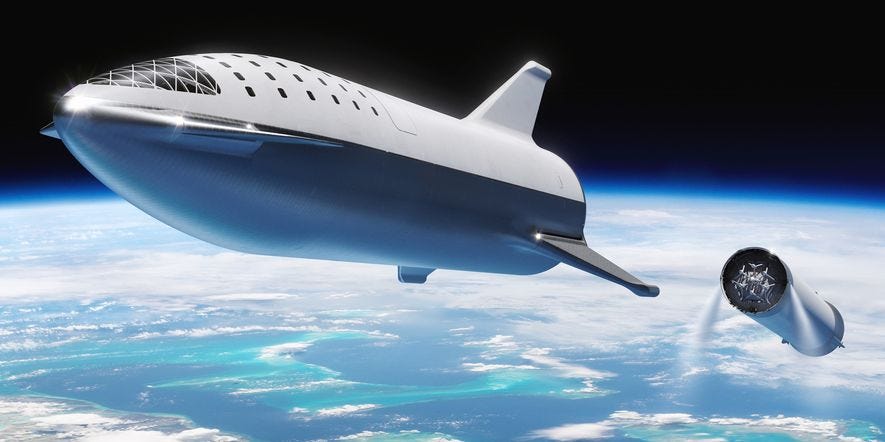
Sapo: SpaceX once looked at turning part of its workhorse Falcon 9 into a miniature testbed for the Big Falcon Rocket, the vehicle concept that later evolved into Starship. The idea sounded like something from a rocket engineer’s sketchbook: take a familiar upper stage, add lessons from a future Mars ship, and use orbital reentry to learn what no wind tunnel can fully teach.
Why a “Mini-BFR” Made So Much Sense
SpaceX has never been shy about building big dreams in small, testable chunks. Before Starship became the stainless-steel giant now associated with Starbase, Super Heavy, lunar landers, and Mars ambitions, the company explored a bridge between the Falcon era and the next-generation reusable spacecraft era: a modified Falcon 9 upper stage that would behave like a miniature Big Falcon Rocket ship.
At first glance, that sounds like putting a racing spoiler on a family sedan and calling it a Formula 1 car. But in aerospace, scaled-down testing is not a gimmick. It is survival with spreadsheets. The original idea, discussed publicly in 2018, was to upgrade the second stage of Falcon 9 so it could test technologies needed for SpaceX’s future reusable spacecraft. The key targets were an ultra-light heat shield and high-Mach control surfaces, both of which are hard to evaluate properly without sending hardware through the brutal reality show known as atmospheric reentry.
The Falcon 9 was the obvious laboratory. It was already SpaceX’s dependable launch vehicle, a reusable two-stage rocket designed to carry payloads and people to orbit. Its first stage had made booster landings feel almost routine, which is ridiculous when you remember that landing an orbital-class rocket used to sound like catching a falling skyscraper with chopsticks. But Falcon 9’s second stage remained expendable. Recovering or even deeply studying upper-stage reentry was a tougher challenge because that stage reaches orbital velocity and faces far harsher thermal conditions on the way home.
From Falcon 9 to Big Falcon Rocket: The Technical Bridge
The Big Falcon Rocket, or BFR, was SpaceX’s earlier name for the vehicle family that became Starship and Super Heavy. It was not just another bigger rocket. It represented a complete shift in philosophy: full reusability, large payload capacity, in-space refueling, deep-space travel, and a spacecraft that could enter atmospheres, maneuver, and land vertically.
The mini-BFR concept mattered because SpaceX needed data from the most unforgiving part of the mission profile: coming back from orbit. Launch is loud, dramatic, and full of fire, but reentry is where physics sends the invoice. A spacecraft returning from orbital speeds compresses the air in front of it, heating the surrounding flow and the vehicle’s surface. Heat shields, control flaps, body orientation, structural loads, and guidance software all have to work together. A computer model can predict a lot. A test stand can validate some pieces. But only actual flight can reveal the weird, rude details that show up when hypersonic air, vibration, plasma, and vehicle dynamics all arrive at the same party.
What the Modified Falcon 9 Upper Stage Would Have Tested
The modified upper stage was not meant to become a tiny passenger spaceship. It was better understood as a technology demonstrator. Its purpose would have been to expose Starship-like components to orbital reentry conditions. The most important areas included thermal protection, aerodynamic control, structural behavior, and flight-data collection.
An ultra-light heat shield was especially important. Starship needed a thermal protection system that could survive repeated high-energy entries without turning each flight into a refurbishment marathon. If reusability is the business model, then “replace half the vehicle after every mission” is not exactly a catchy slogan. SpaceX wanted hardware that could fly, return, get inspected, and fly again with minimal work.
High-Mach control surfaces were another critical piece. Starship’s belly-flop style reentry and controlled descent would eventually rely on body flaps that steer the vehicle through the atmosphere. The Falcon 9 upper-stage experiment could have helped engineers understand how movable surfaces behave at extreme speeds and temperatures, even if the shape and size were not identical to full-scale Starship.
Why Not Just Wait for the Full Big Falcon Rocket?
Because waiting is expensive, and rockets are impatient teachers. Developing a completely new launch system takes years of design, manufacturing, testing, failure analysis, redesign, and more testing. A smaller test article can accelerate learning before the full vehicle is ready. That is a classic SpaceX pattern: test early, test visibly, break things when necessary, and use the data to move faster.
The Falcon 9 had already served as SpaceX’s practical classroom for reusability. The company learned booster descent, landing burns, grid-fin control, drone-ship operations, refurbishment routines, and rapid launch cadence through Falcon 9. In that sense, turning a Falcon 9 upper stage into a mini-BFR would have extended the same learning culture upward, literally and technically.
There was also a business logic. SpaceX ultimately wanted Starship to replace Falcon 9 and Falcon Heavy for many missions. But replacing a proven rocket with a radically new system requires confidence, not just ambition. A mini-BFR could have provided intermediate proof that important Starship systems were moving from presentation slides into the real atmosphere.
The Twist: The Mini-BFR Idea Did Not Stay Mini for Long
Like many SpaceX ideas, the mini-BFR concept evolved quickly. Soon after the 2018 discussion, SpaceX’s development path shifted toward full-diameter Starship test articles rather than a small Falcon 9-derived reentry craft. That pivot was not a contradiction so much as a sign of the company’s rapid design cycle. SpaceX often treats plans like prototypes: useful until a better one appears.
The name changed, too. The Big Falcon Rocket became Starship, with the spacecraft and upper stage called Starship and the booster called Super Heavy. The branding became cleaner, the hardware became more stainless-steel and less carbon-composite, and the test program moved toward full-scale atmospheric hops and integrated flight tests.
This is one of the funniest things about following SpaceX. A plan can sound huge on Monday, become old news by Friday, and still be important historically. The mini-BFR plan may not have become the main road, but it showed what SpaceX was trying to learn: how to make orbital-class reentry reusable, controllable, and eventually routine.
How This Fits Into the Bigger Starship Story
Today, Starship is the centerpiece of SpaceX’s long-term space transportation strategy. The system is designed as a fully reusable super-heavy launch vehicle capable of carrying large payloads to orbit, supporting missions to the Moon, and eventually enabling Mars transportation. NASA also selected a lunar variant of Starship as part of the Artemis Human Landing System program, which gives the vehicle a role not only in SpaceX’s Mars dreams but also in America’s return-to-the-Moon architecture.
The roots of that future can be seen in the Falcon 9 mini-BFR concept. The question was never simply, “Can we make a small version of a big rocket?” The deeper question was, “Can we learn the hardest parts of a future vehicle using hardware we already understand?” That is a very SpaceX question. It combines engineering practicality with a level of ambition that makes normal project managers reach for antacid.
Falcon 9 as the Training Ground
Falcon 9 trained SpaceX in operational reusability. It proved that rockets do not have to be treated like disposable fireworks for billionaires. The booster landings created an experience base in guidance, propulsion, landing legs, turnaround inspection, and fleet management. Without Falcon 9, Starship would be a much steeper mountain.
The second-stage problem, however, remained different. A booster separates at lower speed and returns from a less punishing trajectory. An orbital upper stage has to handle far greater velocity, thermal load, and reentry energy. That is why the mini-BFR concept attracted attention: it pointed directly at the next frontier in reusability.
Why Heat Shields and Control Surfaces Are the Real Stars
Casual observers often focus on engines because engines are loud, shiny, and excellent at turning livestream chats into fireworks emojis. But for a reusable spacecraft, the quieter technologies can be just as important. Heat shield tiles, aerosurfaces, actuators, sensors, and flight software decide whether the vehicle survives the return trip.
A heat shield must protect the structure without becoming too heavy. Every extra pound of thermal protection is a pound that cannot be payload, propellant margin, or useful hardware. But make the shield too thin or fragile, and the vehicle gets a one-way ticket to becoming a meteor with branding.
Control surfaces are equally demanding. They must move precisely while facing intense heating, pressure changes, vibration, and aerodynamic forces. Starship’s flaps are not decorative fins; they are essential steering tools. Testing similar ideas at orbital speeds was the kind of knowledge SpaceX wanted from a mini-BFR-style experiment.
What the Mini-BFR Tells Us About SpaceX’s Engineering Culture
The miniature Big Falcon Rocket idea reveals three important things about SpaceX. First, the company prefers flight data over perfect paperwork. Simulations matter, but SpaceX likes hardware that leaves the ground and reports back, even if the report is occasionally delivered in smoke.
Second, SpaceX recycles lessons aggressively. Falcon 9 was not only a commercial rocket; it was a technology platform. Every landing attempt, every booster reuse, every engine upgrade, and every anomaly fed the company’s understanding of reusable launch systems.
Third, SpaceX is comfortable changing direction. Traditional aerospace programs often freeze designs early to reduce risk. SpaceX tends to freeze designs later, after testing exposes what should change. That approach can look chaotic from the outside, but it can also shorten the distance between theory and reality.
The SEO-Friendly Big Picture: Why This Moment Still Matters
The story of SpaceX fashioning a miniature Big Falcon Rocket out of a Falcon 9 remains relevant because it captures a transition point in modern spaceflight. It sits between the Falcon 9 era, where reusable boosters became normal, and the Starship era, where full-system reusability is the prize.
For space fans, it is a fascinating “what might have flown” moment. For engineers, it is a case study in test strategy. For business analysts, it shows how SpaceX tries to reduce risk while moving toward a vehicle intended to transform launch economics. And for everyone else, it is a reminder that the road to Mars may be paved with prototypes that look slightly ridiculous until history makes them look obvious.
The mini-BFR was not just a cute nickname. It represented a serious attempt to answer serious questions: How do you bring an orbital upper stage back? How do you validate a reusable heat shield? How do you control a large spacecraft at hypersonic speeds? How do you turn the most violent part of spaceflight into an operational routine?
Those questions did not disappear when the mini-BFR path changed. They became Starship questions. They became Artemis questions. They became the questions SpaceX continues to tackle with every test flight, every hardware revision, and every late-night update that sends space Twitter into a caffeine-powered spiral.
Experience Section: What It Feels Like to Follow the Mini-BFR Story
Following the “miniature Big Falcon Rocket out of a Falcon 9” story feels a bit like watching a brilliant mechanic rebuild a motorcycle while already talking about designing a bullet train. You are impressed, confused, excited, and slightly worried about the number of parts left on the floor. That is part of the SpaceX experience.
For readers who first encountered this idea in 2018, the mini-BFR sounded wonderfully strange. Falcon 9 was familiar. It had a clean white body, black landing legs, grid fins, and a growing reputation as the rocket that could go to space and come back like it had forgotten its wallet. The Big Falcon Rocket, on the other hand, felt almost mythical: huge, reusable, Mars-capable, passenger-carrying, and constantly changing shape in renderings. Connecting those two worlds through a modified upper stage made the future feel suddenly practical.
The experience also teaches patience. Spaceflight development is not a straight hallway; it is a maze where some doors are labeled “breakthrough,” some are labeled “budget meeting,” and one is always labeled “unexpected plumbing issue.” The mini-BFR concept came and went quickly, but it helped observers understand what SpaceX valued most: real flight data. The plan’s short lifespan does not make it meaningless. In fast-moving engineering, even abandoned ideas can leave fingerprints on the final machine.
There is also a useful lesson for innovators outside aerospace. Big goals become less intimidating when they are broken into testable pieces. SpaceX did not jump from Falcon 1 to Starship in one magical leap. It built, flew, failed, landed, reused, redesigned, and repeated. The mini-BFR concept was part of that mindset. It asked, “What can we learn now with what we already have?” That question applies to startups, software teams, classrooms, factories, and even personal projects.
Another experience tied to this topic is the thrill of watching language chase technology. BFR became Starship. BFS became part of a cleaner Starship/Super Heavy architecture. Carbon fiber gave way to stainless steel. Renderings gave way to welded rings, test tanks, hops, static fires, and integrated flight tests. If you stepped away from SpaceX news for a few months, you could return and feel as if someone had rearranged the furniture in the future.
Yet the central dream stayed surprisingly consistent: make space transportation reusable enough to change the economics of orbit and deep-space travel. Whether through a mini-BFR on Falcon 9 or a full-scale Starship in Texas, the goal was to stop treating spacecraft like single-use luxury appliances. The mini-BFR idea captured that dream in miniature. It was the pocket-sized version of a very large ambition.
In hindsight, the concept is valuable not because it became famous hardware, but because it shows the messy middle of innovation. Public attention often focuses on finished rockets, dramatic launches, and spectacular landings. But the real story lives in transitional ideas: the sketches, test articles, temporary plans, and engineering shortcuts that help teams move from “maybe” to “watch this.” The mini-BFR was one of those transitional sparks.
And frankly, that is what makes the story fun. SpaceX looked at Falcon 9, looked at its future Mars ship, and seemed to say, “What if we made this one teach us about that one?” It is a very rocket-science version of using a bicycle to prototype a motorcycle, except the bicycle goes orbital and returns through a firestorm. Subtle? Not exactly. Memorable? Absolutely.
Conclusion
SpaceX’s plan to fashion a miniature Big Falcon Rocket out of a Falcon 9 was more than a quirky headline. It was a snapshot of a company trying to connect proven hardware with an unproven future. By considering a modified Falcon 9 upper stage as a testbed for heat shields and high-Mach control surfaces, SpaceX highlighted the hardest part of full reusability: not just getting to space, but coming back in good enough shape to do it again.
The mini-BFR may have been overtaken by the full-scale Starship development path, but its logic remains central to SpaceX’s approach. Build fast. Test in the real world. Learn from the atmosphere, not just from equations. Change the plan when the data says to. That philosophy carried Falcon 9 from experimental landings to operational reuse, and it continues to shape Starship as SpaceX pushes toward the Moon, Mars, and a future where giant rockets may one day be treated less like rare monuments and more like working vehicles.