
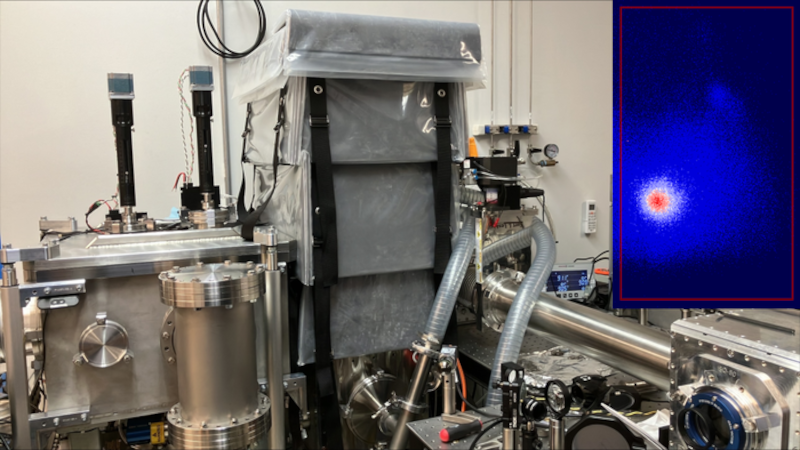
Imagine a machine so precise it can steer invisible particles at nearly the speed of light, so powerful it can help scientists peek inside matter, and so useful it shows up in hospitals, manufacturing plants, security systems, museums, and research labs. Now imagine calling that machine “my particle accelerator,” as if it were a slightly dramatic treadmill in the garage. Welcome in. Please keep your hands, snacks, and loose metaphors inside the beamline at all times.
A particle accelerator is not just a giant science ring built for people in white coats who casually say things like “quark-gluon plasma” before breakfast. At its heart, a particle accelerator is a tool for giving charged particlessuch as electrons, protons, or atomic nucleimore energy. It uses electric fields to speed them up and magnetic fields to guide, focus, or bend their path. Once those particles are moving, scientists can collide them with targets, send them around circular tracks, or use them to generate powerful beams of light. The result is a technology that turns motion into discovery.
The title “Step Into My Particle Accelerator” sounds like an invitation to a sci-fi nightclub, but the real world of accelerator science is even better. It is part physics lesson, part engineering miracle, part industrial workhorse, and part cosmic detective story. So let’s open the door, look down the tunnel, and follow the beam.
What Is a Particle Accelerator?
A particle accelerator is a machine that increases the energy of charged particles and shapes them into a controlled beam. The “charged” part matters because electric and magnetic fields can push and steer particles only when those particles carry electrical charge. Electrons are negatively charged, while protons and many atomic nuclei are positively charged. Neutral particles, unfortunately, do not take steering instructions very well. They are the cats of the subatomic world.
The basic idea is simple enough to fit on a napkin: push particles with electric fields, guide them with magnets, and keep them moving through a carefully designed path. The execution, however, is where things become beautifully complicated. Particle accelerators rely on vacuum systems, radio-frequency cavities, superconducting magnets, cryogenics, detectors, precision timing, shielding, and control systems that can make a high-end gaming computer feel like a potato with a password.
Electric Fields: The Engine
Electric fields do the accelerating. In many modern machines, particles pass through radio-frequency cavities where oscillating electromagnetic fields give them repeated energy boosts. Think of a surfer catching wave after wave, except the surfer is smaller than an atom and the wave is an engineered electromagnetic field. If the timing is right, the particle gains energy each time it passes through.
Magnetic Fields: The Steering Wheel
Magnetic fields bend and focus the particle beam. In circular accelerators, magnets keep particles traveling around a ring instead of flying into the wall and ending the experiment with a very expensive “oops.” Other magnets squeeze the beam so it stays narrow and stable. In accelerator language, focusing is not a motivational poster. It is beam survival.
The Main Types of Particle Accelerators
Particle accelerators come in different shapes and sizes, from compact medical systems to giant research facilities stretching for miles. The three types most people encounter in science articles are linear accelerators, cyclotrons, and synchrotrons.
Linear Accelerators: Straight to the Point
A linear accelerator, often called a linac, sends particles down a straight path. The particles gain energy as they pass through accelerating structures arranged along the line. Linacs are used in research, medicine, and industry. Medical linear accelerators, for example, are widely used in radiation therapy to treat cancer by delivering carefully shaped beams to tumors. That is accelerator science doing something deeply practical: turning high-energy physics into a tool for human health.
Large research linacs can also feed other machines or generate intense light. At SLAC National Accelerator Laboratory in California, electron beams are accelerated to extremely high energies and used to produce bright X-ray laser pulses. These X-rays allow researchers to capture snapshots of atoms and molecules in action, like a camera fast enough to catch chemistry in the act of making up its mind.
Cyclotrons: The Original Particle Merry-Go-Round
The cyclotron was invented by Ernest O. Lawrence at the University of California, Berkeley. It was one of those inventions that looked modest at first and then proceeded to change physics with the confidence of a marching band in a library. A cyclotron uses a magnetic field to guide particles in a spiral path while an electric field gives them repeated kicks of energy. As the particles gain speed, they spiral outward until they are extracted and sent toward a target.
Cyclotrons are still important today, especially in medicine. They can produce radioisotopes used in medical imaging and can support certain types of particle therapy. Their compact circular design makes them useful when a full-size research accelerator would be, shall we say, difficult to fit between the parking lot and the vending machines.
Synchrotrons: Rings With Serious Ambition
A synchrotron is a circular accelerator that carefully synchronizes the particle beam with changing electric and magnetic fields. As particles gain energy, the magnetic fields adjust to keep them on the right path. Synchrotrons can accelerate particles to enormous energies or generate intense synchrotron light, including powerful X-rays used to study materials, proteins, batteries, fossils, pollutants, and more.
Brookhaven National Laboratory’s Relativistic Heavy Ion Collider, known as RHIC, has used high-energy collisions to study nuclear matter and conditions similar to those that existed shortly after the Big Bang. Argonne National Laboratory’s Advanced Photon Source uses accelerator-generated X-rays to help researchers examine the structure of materials and biological systems. These machines are not just “big physics toys.” They are discovery engines with magnets.
What Happens Inside the Accelerator?
Stepping into the idea of a particle accelerator means following the journey of a beam. First, particles must be created. An electron source may release electrons, while an ion source can generate charged atoms or nuclei. Next, the particles are injected into the accelerator and shaped into bunches. These bunches are like microscopic train cars, except each one is packed with particles and traveling at speeds that would make a sports car feel emotionally inadequate.
The beam then moves through a vacuum pipe. The vacuum is essential because air molecules would interfere with the particles. If the beam kept bumping into stray gas atoms, it would scatter, lose quality, and generally behave like a shopping cart with one bad wheel. A strong vacuum gives the beam a clear path.
As the particles travel, radio-frequency cavities boost their energy. Magnets steer and focus them. Diagnostics monitor the beam’s position, size, intensity, and stability. At the end of the process, the beam may collide with another beam, strike a fixed target, generate X-rays, produce isotopes, or treat a medical condition. Every accelerator has a purpose, and every purpose shapes the machine.
Why Particle Accelerators Matter
Particle accelerators help answer some of the biggest questions humans can ask. What is matter made of? How did the universe behave in its earliest moments? Why do particles have mass? What forces hold atomic nuclei together? But the story does not stop at fundamental physics. In fact, most accelerators in the world are not giant research colliders. Many are smaller machines used for medicine, industry, environmental work, security, and materials science.
Medicine: From Imaging to Cancer Treatment
Accelerators play a major role in modern medicine. Medical linacs deliver radiation therapy to tumors with impressive precision. Cyclotrons can produce radioactive isotopes used in PET scans, helping doctors see biological processes inside the body. Proton therapy uses accelerated protons to target tumors while reducing radiation exposure to surrounding tissue in selected cases. The physics may be complex, but the goal is clear: use controlled energy to improve diagnosis and treatment.
Industry: Tiny Beams, Big Results
In manufacturing, particle beams can modify materials, sterilize medical equipment, inspect cargo, improve semiconductors, and treat surfaces. Ion implantation, for example, is essential in semiconductor manufacturing because it allows engineers to place atoms into silicon with remarkable precision. Your phone may not have a bumper sticker that says “powered by accelerator science,” but part of its technological family tree likely includes charged particles behaving very obediently in a factory.
Research: Seeing the Invisible
Accelerator-based light sources help scientists study structures that are too small or too fast for ordinary microscopes. Bright X-ray beams can reveal protein shapes, battery materials, chemical reactions, and hidden features inside ancient artifacts. A synchrotron can help a biologist, a chemist, an engineer, and an archaeologist all in the same week. That is the beauty of accelerator facilities: they are physics machines that lend superpowers to other sciences.
Famous Particle Accelerators and What They Do
When people hear “particle accelerator,” they often think of the Large Hadron Collider in Europe. It is the world’s largest and most famous collider, known for the discovery of the Higgs boson. But the United States has a rich accelerator landscape as well, with major facilities that support physics, chemistry, biology, materials science, energy research, and national needs.
Fermilab: Hunting the Deep Rules of Nature
Fermilab in Illinois is one of America’s premier particle physics laboratories. It has a long history of accelerator research, neutrino science, and high-energy experiments. Today, Fermilab continues to develop accelerator technologies and supports major projects that explore the nature of matter, energy, space, and time. It is the kind of place where “What is the universe made of?” counts as a normal work question.
SLAC: The Straight-Line Legend
SLAC National Accelerator Laboratory is famous for its long linear accelerator and its modern X-ray laser facilities. Its Linac Coherent Light Source uses high-energy electrons to generate extremely bright X-ray pulses. These pulses let scientists observe atoms and molecules at work, revealing details in materials, chemistry, and biology that would otherwise remain hidden. If regular X-rays are a flashlight, SLAC’s X-ray laser is a lightning bolt with a PhD.
Brookhaven: Colliding Heavy Ions
Brookhaven National Laboratory in New York operates RHIC, a major collider used to explore nuclear matter. By colliding heavy ions at high energies, researchers study quark-gluon plasma, a hot, dense state of matter believed to have existed shortly after the Big Bang. This work helps scientists understand how the strong force behaves under extreme conditions. In plain English: Brookhaven recreates tiny flashes of early-universe weirdness, then studies the leftovers.
Argonne and Berkeley Lab: Light Sources and Accelerator Innovation
Argonne’s Advanced Photon Source and Berkeley Lab’s accelerator legacy show how accelerator science extends far beyond particle collisions. Argonne’s synchrotron X-rays support thousands of researchers studying materials, biological molecules, and energy systems. Berkeley Lab traces its accelerator roots to Ernest Lawrence’s cyclotron and continues to contribute to accelerator technology, applied physics, and scientific user facilities. These institutions prove that accelerators are not one-trick machines. They are entire toolboxes built out of precision physics.
The Science Is Big, But the Concept Is Human
The wonderful thing about particle accelerators is that they take a human habitthrowing things at other things to see what happensand elevate it into a masterpiece of measurement. Children drop rocks into puddles. Engineers test crash dummies. Physicists collide particles. The difference is mostly scale, budget, and the number of people wearing access badges.
When accelerated particles hit a target or collide with other particles, detectors capture the aftermath. The products of those collisions can reveal hidden structures, new particles, or important interactions. Sometimes the discovery is dramatic, like evidence for a fundamental particle. Other times it is practical, like a better understanding of a catalyst, battery material, or protein. Either way, the accelerator makes the invisible speak.
Common Myths About Particle Accelerators
Myth 1: Particle Accelerators Are Dangerous Doomsday Machines
Real particle accelerators are carefully designed, shielded, regulated, and monitored. They are not casual basement appliances. Radiation safety, interlock systems, access controls, and operating procedures are built into accelerator facilities. The dramatic movie version may involve glowing tunnels and someone shouting “shut it down,” but the real version involves trained teams, safety reviews, and paperwork that could stun a rhinoceros.
Myth 2: Accelerators Are Only for Particle Physicists
Particle physics is an important use, but it is not the only one. Accelerators support cancer treatment, medical imaging, chip manufacturing, food safety research, environmental analysis, cultural heritage studies, and materials development. They are scientific Swiss Army knives, except heavier and less likely to fit in your pocket.
Myth 3: Bigger Always Means Better
Large accelerators can reach extraordinary energies, but smaller accelerators are often better suited for practical applications. A hospital does not need a giant collider to provide radiation therapy. A manufacturing plant does not need a miles-long ring to modify materials. The best accelerator is the one designed for the job.
How Particle Accelerators Shape the Future
The future of accelerator science is focused on making machines more powerful, compact, efficient, and accessible. Researchers are exploring superconducting technologies, advanced magnets, plasma wakefield acceleration, improved beam control, machine learning, and energy-saving designs. The dream is not just to build bigger machines. It is to build smarter ones.
Compact accelerators could expand access to advanced medical treatments and research tools. Brighter light sources could reveal faster chemical reactions and more detailed biological processes. Better accelerator control systems could improve beam stability while reducing energy use. New designs may help scientists push beyond today’s limits without needing facilities the size of small counties.
In other words, the particle accelerator is not stuck in the past as a monument to twentieth-century physics. It is evolving. It is becoming more precise, more useful, and more connected to everyday life. The future may bring accelerators that are smaller, greener, and more commonnot in every kitchen, thankfully, but in more hospitals, labs, and industries.
Step Into My Particle Accelerator: A Personal-Style Experience
If you have ever toured a major research facility, you know the feeling: the hallway looks ordinary, the doors look ordinary, and then someone points to a thick concrete wall and says, “Behind that is the beamline.” Suddenly, the building stops feeling like a building and starts feeling like a secret handshake with the universe.
Stepping into the world of a particle accelerator is not like walking into a shiny spaceship. It is often more practical than glamorous. There are signs, pipes, cables, racks of electronics, warning lights, control rooms, and enough labeled equipment to make a label maker proud of its life choices. But once you understand what the pieces do, the place becomes thrilling. A vacuum pipe is no longer just a pipe. It is a protected highway for particles. A magnet is no longer just a heavy metal block. It is a steering system for matter moving at breathtaking speed. A control screen is no longer just a graph. It is a live conversation with a beam you cannot see.
The most memorable part is the contrast. Particle accelerators are designed to study the smallest pieces of nature, yet the machines themselves can be enormous. They investigate events that happen in fractions of a second, yet they require years of planning, construction, calibration, and teamwork. They depend on abstract physics, but they also depend on electricians, machinists, computer scientists, cryogenic experts, safety teams, engineers, technicians, and researchers who know exactly which valve should never be opened at the wrong time.
There is also something charming about the language. Accelerator people talk about beams, bunches, cavities, dumps, kicks, magnets, targets, and luminosity. To outsiders, it can sound like a bowling alley designed by NASA. But the vocabulary reflects a practical culture. Every word points to a real function. The beam has to be born, shaped, accelerated, guided, measured, used, and safely stopped. Nothing is accidental. Even the “beam dump” is not an insult; it is the carefully designed place where the beam goes when its useful work is done.
The experience also changes how you see ordinary technology. After learning about accelerators, a hospital cancer-treatment room feels connected to high-energy physics. A smartphone chip feels connected to ion beams and materials engineering. A museum artifact scanned with advanced X-rays feels connected to the same core idea: use controlled particles or radiation to reveal what the eye cannot see. Suddenly, accelerator science is not remote. It is quietly woven into modern life.
And then there is the wonder. A particle accelerator reminds us that humans are strange in the best possible way. We built machines to speed up particles we cannot see, inside pipes emptier than outer space, guided by magnets stronger than anything on the family refrigerator, all so we can ask nature better questions. That is not just technology. That is curiosity with a power supply.
So when I say, “Step into my particle accelerator,” I do not mean sneak past the safety gate. Please do not do that. I mean step into the idea. Step into a world where electricity becomes motion, motion becomes evidence, and evidence becomes understanding. Step into the tunnel where engineering meets imagination. Step into the beamline of human curiosity, where the universe is not simply observed from a distanceit is gently, carefully, scientifically asked to explain itself.
Conclusion
A particle accelerator is one of humanity’s most impressive scientific tools. It can accelerate charged particles, reveal hidden structures, support medical treatments, improve materials, produce powerful X-rays, and help answer fundamental questions about the universe. From cyclotrons and linacs to synchrotrons and colliders, accelerator technology has grown from early nuclear physics experiments into a global engine of discovery and practical innovation.
The next time someone mentions a particle accelerator, do not picture only a giant underground ring or a mysterious machine from a sci-fi movie. Picture a tool that connects hospitals, laboratories, factories, and cosmic questions. Picture a machine that turns tiny particles into big answers. And, most importantly, picture science doing what it does best: taking something invisible and making it impossible to ignore.
Note: This article synthesizes real information from reputable U.S. science, national laboratory, government, and educational sources, including accelerator research and public science explainers.














