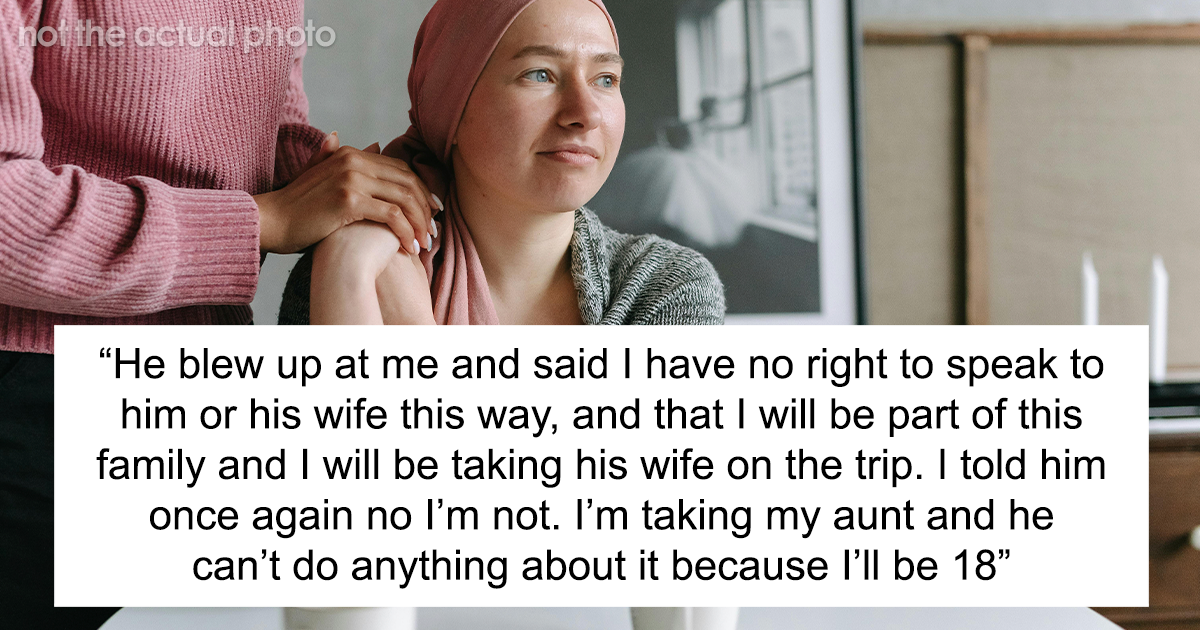
Losing a parent as a teenager is hard enough without someone barging into your grief and trying to reorganize it like an overstuffed kitchen cabinet. Yet that was essentially what happened in a viral family conflict involving a 17-year-old girl, her late mother’s sister, her father, and the woman he married shortly after her mother died.
The teenager had planned a meaningful trip with her mother before cancer took her life. Knowing she might not live long enough to travel, the mother arranged for her sisterthe teen’s auntto accompany the girl instead. It was supposed to be a memorial journey, a final gift, and an opportunity for the teen to feel connected to the mother she had recently lost.
Then her father’s new wife announced that she should take over the trip, replace the aunt, and bring her young son along for some convenient “family bonding.” The teenager did not respond with a polite calendar invitation. She exploded.
Although some of her words were understandably criticized, the deeper issue was not teenage attitude. It was a grieving young woman trying to defend one of the few remaining experiences that still felt connected to her mother.
A Memorial Trip Becomes a Family Battlefield
According to the teenager’s online account, her mother had battled cancer for approximately three years and died when the girl was 16. Her parents had also been moving toward divorce, although the teen initially did not know what had caused their marriage to collapse.
Within months of the mother’s death, the father moved another woman and her five-year-old son into the family home. He soon married the woman, who reportedly began pushing for the late mother’s belongings to be removed. For the teenager, those clothes, photographs, and personal objects were not clutter. They were physical reminders of someone whose absence was still painfully new.
While reviewing her mother’s possessions, the teen said she discovered evidence that her mother had hired a private investigator. The documents allegedly showed that her father had been involved with his new wife for several years while his first wife was sick. The young boy living in the home was reportedly not merely the woman’s child but also the father’s biological son.
That revelation transformed an already uncomfortable remarriage into something emotionally explosive. The new wife was not simply “Dad’s next chapter.” In the teenager’s mind, she represented betrayal, secrecy, and the humiliation her mother had experienced during a terminal illness.
Why the Trip Meant More Than a Vacation
To an outsider, changing a travel companion might sound like an ordinary scheduling disagreement. It was not. This trip carried emotional meaning that could not be transferred with the airline reservation.
The girl and her mother had discussed traveling together before the teen went to college. When the mother realized she might not be able to fulfill that plan, she entrusted it to her sister. The aunt was not a random substitute selected because she owned a dependable suitcase. She was part of the mother’s family, knew her stories, understood her wishes, and could help preserve her presence throughout the journey.
Grieving children and teenagers often maintain what specialists call a continuing bond with someone who has died. They may tell stories, visit meaningful places, keep treasured objects, prepare favorite foods, or complete plans the person left behind. These actions do not necessarily indicate that a young person is “stuck.” They can help integrate the loss into a life that must continue.
The trip therefore belonged to the teenager’s relationship with her mother. Turning it into a blended-family vacation would have changed its purpose completely. A reflective memorial journey with an aunt is one experience. Traveling with a self-appointed replacement mom and a five-year-old is anotherespecially when the latter may require regular negotiations about snacks, bathroom stops, and why hotel elevators are not amusement-park rides.
Where the New Wife Crossed a Serious Boundary
She declared herself the teen’s new mother
The new wife reportedly argued that she should accompany the teenager because she was her “mom now.” That phrase may have been intended as an invitation to closeness, but it landed like an attempted hostile takeover.
Marriage can make someone a legal or social stepparent. It does not automatically create a parent-child bond, erase the deceased parent, or give the new spouse ownership of emotionally significant traditions. A teenager who remembers and deeply loves her mother is especially unlikely to welcome anyone announcing that the position has been refilled.
She tried to replace the aunt instead of building something new
Healthy stepparent relationships usually develop gradually through reliability, respect, shared experiences, and realistic expectations. They are not produced by removing an existing trusted adult from a meaningful plan.
The new wife could have suggested a separate afternoon together, a casual meal, or a future family outing. Instead, she targeted the most emotionally loaded event available and tried to place herself at its center. That is not bonding. It is emotional photobombing.
She added her son to a deeply personal journey
The child was innocent and did not cause the affair or the adults’ choices. However, the teenager was not obligated to turn a memorial trip into sibling-bonding camp. Relationships between half-siblings and stepsiblings cannot be forced by placing everyone in the same hotel room and hoping continental breakfast performs a miracle.
The teen’s indifference toward the boy may be painful, but emotional closeness is not an enforceable household chore. Adults can require basic kindness and respectful behavior. They cannot command affection.
The Teen’s Anger Made Sense, but Her Words Still Had Consequences
During the confrontation, the teenager reportedly said she wanted nothing to do with the new wife or her “affair baby.” Her anger was understandable. The label directed at the child, however, was unfair.
A five-year-old does not choose how he is conceived, what secrets adults keep, or which home he enters. He should not be made responsible for decisions his parents made. The teenager later clarified that she did not hate or mistreat him and understood that he was innocent. She simply did not want to be forced into a close sibling relationship.
That distinction matters. She had every right to reject the adults’ attempt to take over the trip. She could also refuse to treat the new wife as her mother. But the strongest boundary would have focused on the responsible adults: “This trip was arranged by my mother and aunt. It is not a family vacation, and the plans will not be changed.”
Teenagers are not always known for delivering carefully edited statements during emotional ambushes. Expecting perfect language from a grieving 17-year-old while the adults behave like contestants on a low-budget reality show would be unrealistic. Still, pain explains harmful wording; it does not make every word harmless.
The Father’s Response Made the Conflict Worse
The father reportedly demanded that his daughter accept his wife as family and take her on the trip. He also suggested that the teen could not understand how difficult it had been to be married to someone with cancer.
Caregiver strain is real. Supporting a seriously ill partner can be exhausting, frightening, and isolating. None of that excuses deception, infidelity, or demanding sympathy from a teenager who watched her mother suffer and then lost her.
Instead of defending the trip his late wife had arranged, the father centered his new marriage. Instead of acknowledging his daughter’s grief, he framed her refusal as disobedience. Instead of protecting her relationship with her maternal aunt, he supported an attempt to replace that aunt with his wife.
A better response would have begun with accountability: “I understand why this trip matters. Your aunt will go with you as your mother intended. My wife will not interfere.” He could then have addressed respectful language separately without pretending that the underlying boundary was unreasonable.
What Healthy Stepfamily Integration Actually Looks Like
Blended families are common, but common does not mean effortless. Teenagers are already seeking greater independence, establishing identities, and testing adult relationships. A new stepparent who arrives with immediate expectations of authority may encounter resistance even under peaceful circumstances.
When remarriage follows death, the process can be even more delicate. A teen may fear that accepting a stepparent is disloyal to the deceased parent. Attempts to remove photographs, discard belongings, rename relationships, or replace traditions can intensify that fear.
Successful stepfamilies generally allow relationships to develop at their own speed. The biological parent remains primarily responsible for discipline during the early stages. The stepparent concentrates on being dependable, interested, and respectful. Family members are permitted to hold different levels of closeness without being treated as defective pieces in a matching furniture set.
Most importantly, a deceased parent should not be erased to make a new spouse feel secure. A confident stepparent can say, “I know your mother will always be your mother. I am not here to replace her.” That sentence creates more trust than a hundred mandatory bonding exercises.
How the Adults Could Repair the Damage
Protect the original travel plan
The trip should remain between the teenager and her aunt. Its purpose was established before the mother’s death, and honoring that arrangement demonstrates respect for both the teen and her late mother.
Secure the mother’s belongings
The teen was wise to consider moving sentimental possessions to a safe location with her aunt. Grief experts generally caution against rushing major decisions about a deceased person’s property. What looks unnecessary to one person may carry enormous emotional value for another.
Important documents, photographs, jewelry, letters, digital files, and irreplaceable keepsakes should be inventoried and protected. The goal is not to preserve every grocery receipt forever. It is to prevent irreversible decisions while grief remains raw.
Stop forcing family labels
The father and his wife should allow the teenager to decide what she calls the new wife and what kind of relationship she is willing to build. Civility can be expected. Maternal devotion cannot.
Offer individual and family support
A grief counselor could help the teen process several overlapping injuries: her mother’s illness, her death, the alleged affair, the newly discovered half-sibling, the rapid remarriage, and fear that her mother is being erased. Family therapy could be useful only if the adults enter it to listen and take responsibilitynot to hire a professional referee who will order the teenager to “move on.”
What the Online Reaction Got Rightand What It Missed
Many commenters supported the teenager’s decision to travel with her aunt. They also encouraged her to secure her mother’s belongings, passport, personal documents, and financial information before leaving.
That practical concern was understandable given the reported pressure to remove the mother’s possessions. However, internet discussions often sprint from “protect your keepsakes” to “assume everyone is planning an elaborate felony” with impressive athleticism. Advice should remain proportionate and involve a trusted adult, particularly when the person seeking help is still a minor.
The strongest part of the public response was its recognition that grief has boundaries. The teen was not required to surrender a memorial experience to prove she accepted her father’s new family. The weakest part was the tendency to treat every character as either a perfect victim or cartoon villain.
The young boy, in particular, deserved compassion. He may eventually discover that his family’s history contains secrets and conflict he never created. Protecting the teen’s autonomy does not require turning another child into collateral damage.
Related Experiences: When Memorial Plans Become Power Struggles
The following illustrative experiences show how similar conflicts can unfold in families dealing with grief and remarriage. The details are composites rather than claims about specific identifiable people.
The graduation trip that suddenly needed “more family”
Imagine a high school senior whose father died when she was 15. Before his death, they had planned to visit several national parks after graduation. Her uncle later offered to take her, following the route her father had saved on his laptop.
Two months before departure, her mother’s boyfriend suggested converting the trip into a vacation for all six members of their newly combined household. He proposed replacing long hikes with amusement parks because his younger children would be bored. He also wanted to change the destination because the original route seemed “too sad.”
The teen refused and was accused of excluding the new family. What the adults missed was that exclusion was not the purpose. The original journey was a personal ritual tied to the father’s memory. A separate family vacation could have been planned without dismantling it.
Once the mother understood that distinction, the conflict eased. The teen traveled with her uncle, brought her father’s camera, and recreated several photographs he had taken years earlier. Later that summer, she joined the blended household for a beach weekend. Preserving one exclusive connection made her morenot lesswilling to participate in something new.
The recipe book no one was ready to share
In another common situation, a teenager inherits a handwritten recipe book from her late mother. Her stepmother enjoys cooking and asks to use it for family dinners. When the teen hesitates, the father says the recipes should belong to everyone now because “we are one family.”
To the adults, the book is a useful household object. To the teen, every stain and scribbled note is part of her mother’s voice. The pressure to share feels like another person reaching into a private conversation.
A respectful compromise might involve scanning selected recipes while allowing the original book to remain with the teenager. The stepmother could also create a new family cookbook rather than taking ownership of the old one. New traditions are more likely to succeed when they are planted beside old roots instead of directly on top of them.
The annual memorial dinner that became mandatory bonding
Consider siblings who mark their late mother’s birthday by visiting her favorite restaurant with their maternal grandmother. After their father remarries, his wife asks to attend. One sibling agrees, while the other wants the tradition to remain unchanged.
The father could force the issue and create resentment before the appetizers arrive. A healthier approach would respect the disagreement. The stepmother might attend a different remembrance event or help the children prepare flowers without joining the private dinner.
Over time, the reluctant sibling might invite her voluntarily. That invitation would carry real emotional value because it arose from trust. Forced attendance, by contrast, might achieve physical proximity while everyone studies the menu with the enthusiasm of people reviewing tax forms.
The lesson shared by all three experiences
Grieving teenagers often need some experiences that remain specifically connected to the person who died. Protecting those experiences is not necessarily a rejection of the surviving family. It can be the emotional stability that eventually allows new relationships to grow.
Adults sometimes attempt to accelerate family closeness because uncertainty makes them uncomfortable. They want new labels, shared holidays, matching photographs, and proof that the household has successfully blended. But emotional bonds are not instant mashed potatoes. Adding pressure and stirring aggressively does not make them ready faster.
Patience works better. Respecting a teen’s “no” today may make an authentic “yes” possible later.
Conclusion: The Trip Should Remain With the Aunt
The teenager’s choice was reasonable. The trip had been planned with her mother and entrusted to her aunt. Her father’s new wife had no ethical claim to replace the aunt, redefine the journey, or turn it into a family-bonding project.
The teen should avoid directing cruel labels at an innocent child, but that mistake does not invalidate her boundary. The adults held the greater responsibility to behave calmly, protect her grief, and recognize that a new marriage does not overwrite the family history that came before it.
A stepparent earns trust by respecting the deceased parent’s placenot by competing for it. The new wife’s best opportunity to build a relationship was to support the original trip and say, “I hope it helps you feel close to your mom.” Instead, she tried to take control of it and demonstrated exactly why the teenager did not trust her.
The aunt should pack her bags. The teen should take the journey her mother imagined. And the other adults should stay home, reflect on their choices, and perhaps plan a separate vacation after everyone learns the important difference between joining a family and invading a memory.
Note: This article discusses an online first-person account whose private details have not been independently verified. The broader analysis is informed by established guidance on adolescent grief, bereavement, boundaries, and stepfamily adjustment.