Buying a student microscope sounds easy until you discover there are compound microscopes, stereo microscopes, pocket microscopes, USB microscopes, digital microscopes, and a mysterious species known as “very cheap microscopes that promise 2000x magnification but show you mostly blur and regret.” The good news? A great microscope for students does not need to cost as much as a semester of biology lab fees. The best student microscopes of 2024 balance clear optics, durable construction, useful magnification, simple controls, and enough accessories to make science feel exciting instead of intimidating.
This guide focuses on microscopes for students in elementary school, middle school, high school, homeschool science, beginner biology, and early college lab work. Some picks are serious compound microscopes for slides and cells. Others are digital or pocket-friendly tools for leaves, coins, insects, fabric fibers, and the strange crumb that has been living under a keyboard since 2021. Each recommendation is chosen for a specific type of learner, so the “best” microscope depends on the student, the subject, and how much patience everyone in the house has for tiny glass slides.
Quick Comparison: Best Student Microscopes of 2024
| Rank | Microscope | Best For | Typical Magnification |
|---|---|---|---|
| 1 | AmScope M150C-I Compound Microscope Kit | Best overall student microscope | 40x to 1000x |
| 2 | Plugable USB Digital Microscope | Best budget digital microscope | 60x to 250x |
| 3 | OMAX MD82ES10 Binocular Compound Lab Microscope | Best advanced microscope | 40x to 2000x |
| 4 | AmScope All-Metal Compound Microscope | Best basic durable microscope | 40x to 1000x |
| 5 | Emarth Compound Microscope | Best beginner microscope kit | 40x to 1000x |
| 6 | AmScope Digital Compound Monocular Microscope | Best microscope for screen viewing | 40x to 1000x |
| 7 | Carson Pocket Microscope | Best portable field microscope | 20x to 40x or 60x to 120x, depending on model |
What Makes a Microscope Good for Students?
The best microscopes for students are not always the ones with the biggest number printed on the box. Magnification matters, but only when the optics, lighting, focus controls, and slide stage can actually support it. A blurry 2000x image is less useful than a crisp 400x view of onion cells, pond water organisms, or cheek cells.
For most school science projects, a compound microscope with 40x, 100x, 400x, and possibly 1000x magnification is enough. Compound microscopes are designed for thin, transparent specimens on slides, such as plant cells, prepared tissue samples, algae, or microorganisms in pond water. Stereo microscopes use lower magnification and are better for rocks, insects, leaves, coins, shells, and other objects that do not let light pass through easily. Digital microscopes are excellent when students need to capture images, share results, or view specimens on a laptop instead of squinting into an eyepiece like a tiny laboratory pirate.
The 7 Best Microscopes for Students in 2024
1. AmScope M150C-I Compound Microscope Kit – Best Overall
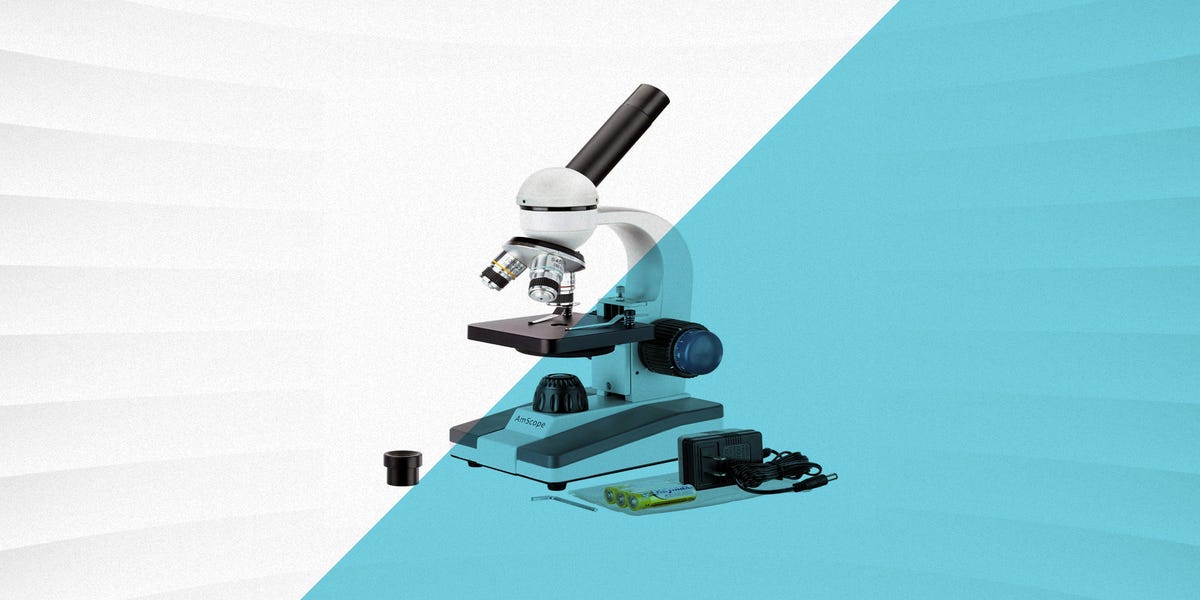
The AmScope M150C-I earns the top spot because it feels like a real school microscope without being overly complicated. It typically offers 40x to 1000x magnification, optical glass lenses, LED illumination, coarse and fine focusing, and a solid metal frame. That combination makes it a strong choice for middle school, high school, homeschool biology, and curious beginners who are ready to move beyond toy-level science kits.
Its 360-degree rotatable monocular head is useful when more than one student is viewing the same slide. Instead of dragging the microscope around the table, students can rotate the head and keep the slide in place. The dual power option, usually plug-in or battery operation, also makes it more flexible for classrooms, kitchen-table experiments, and science fair practice sessions.
Best for: Students who want a reliable first compound microscope for real biology lessons.
Why it stands out: It has the right mix of durability, magnification, optical quality, and student-friendly controls.
Watch out for: It is still a monocular microscope, so long viewing sessions may be less comfortable than using a binocular model.
2. Plugable USB Digital Microscope – Best Budget Digital Microscope
The Plugable USB Digital Microscope is not a traditional lab microscope, and that is exactly why many students like it. Instead of looking through an eyepiece, students connect it to a computer and view the image on screen. It is commonly used for classroom exploration, coins, stamps, leaves, circuit boards, fabric, insects, handwriting, and other surface details.
With a typical magnification range around 60x to 250x, it is not the tool for serious cell biology. However, it is fantastic for making observation feel immediate. Students can capture images, compare textures, and include real photos in lab reports. The adjustable LED ring light helps control glare, which is useful when looking at shiny objects like coins or electronics.
Best for: Students who want a simple, affordable digital microscope for everyday exploration.
Why it stands out: Screen viewing makes it easy for groups, younger learners, and students who struggle with eyepieces.
Watch out for: It is not ideal for transparent slides, blood cells, or high-magnification biology.
3. OMAX MD82ES10 Binocular Compound Lab Microscope – Best Advanced Pick
The OMAX MD82ES10 is a stronger choice for advanced high school students, college beginners, and serious homeschool labs. It is a binocular compound microscope, meaning students look through two eyepieces rather than one. That can reduce eye strain and create a more comfortable viewing experience during longer lab sessions.
This model is often listed with magnification up to 2000x or higher depending on the eyepiece and objective combination. More importantly, it includes features that matter in real lab use: a mechanical stage, Abbe condenser, iris diaphragm, variable LED illumination, coaxial coarse and fine focus, and a built-in digital camera on some packages. Translation: it is built for students who are ready to stop saying “I think I see something” and start saying “I can identify that structure.”
Best for: AP Biology, college biology, serious hobbyists, and students who need more precise slide control.
Why it stands out: The binocular head, mechanical stage, and stronger optical system make it feel more like a lab instrument.
Watch out for: It may be more microscope than a younger student needs, and it costs more than beginner models.
4. AmScope All-Metal Compound Microscope – Best Basic Durable Microscope
Students are wonderful, curious, energetic humans. They are also fully capable of treating lab equipment as if it were built for a minor earthquake. That is why an all-metal microscope can be a smart buy. AmScope’s all-metal compound models usually focus on the essentials: optical glass lenses, LED illumination, magnification up to 1000x, coarse and fine focusing, and a sturdy frame.
This is the kind of microscope that works well when you do not need a giant accessory kit. If the student already has slides, stains, coverslips, and a science curriculum, a basic durable microscope may be better than a flashy bundle with plastic extras. It is especially useful for families or classrooms that want fewer gimmicks and more reliability.
Best for: Students who need a sturdy microscope for repeated use.
Why it stands out: The build quality is the main attraction, especially for classrooms and shared learning spaces.
Watch out for: Some basic models do not include many accessories, so you may need to buy slides and tools separately.
5. Emarth Compound Microscope – Best Beginner Kit
The Emarth Compound Microscope is a popular beginner-friendly option because it usually includes a broad magnification range, dual LED lighting, color filters, slides, small tools, and enough accessories to make a student feel like a real scientist on day one. It is a practical choice for younger learners who need immediate activities rather than a bare microscope and a parent saying, “Now what?”
Dual lighting is especially useful because it lets students view both transparent slides from below and some opaque objects from above. That flexibility matters when a child wants to look at a prepared plant stem slide one minute and a mysterious backyard leaf the next. The plastic-heavy construction is not as rugged as an all-metal microscope, but the lower price and friendly setup make it appealing for beginners.
Best for: Elementary and middle school students starting microscope activities at home.
Why it stands out: Accessories, color filters, and dual lighting make the learning curve less intimidating.
Watch out for: The build may not feel as durable as heavier metal microscopes.
6. AmScope Digital Compound Monocular Microscope – Best for Screen Viewing
A digital compound microscope is a great middle ground between a traditional microscope and a classroom-friendly imaging tool. AmScope digital compound monocular models commonly combine 40x to 1000x optical magnification with a USB camera that displays images on a computer or projector. That makes it easier for students to document specimens, create lab reports, and share discoveries without forcing everyone to take turns at the eyepiece.
This is especially helpful for group learning. When a teacher or parent wants to explain what students are seeing, a screen view prevents the classic microscope problem: one student sees a perfect image, the next sees darkness, and the third somehow sees their own eyelashes. Digital viewing keeps everyone on the same page.
Best for: Homeschool labs, group projects, digital lab reports, and students who want to save specimen images.
Why it stands out: It combines real compound microscopy with practical digital capture.
Watch out for: Built-in cameras on budget microscopes are convenient, but they may not match the quality of dedicated microscope cameras.
7. Carson Pocket Microscope – Best Portable Field Microscope
The Carson Pocket Microscope is the fun pick. It is small, lightweight, affordable, and built for curiosity outside the lab. Depending on the model, Carson pocket microscopes may offer magnification such as 20x to 40x or 60x to 120x with built-in LED lighting. That makes them great for field trips, hikes, backyard science, camping, or quick inspection of leaves, sand, fabric, rocks, and insects.
No, it will not replace a compound microscope for biology class. But it can do something just as valuable: make students want to look closer. A pocket microscope turns everyday objects into mini science lessons. A leaf becomes a landscape. A feather becomes architecture. A grain of salt looks surprisingly dramatic, like it has been waiting for its close-up.
Best for: Outdoor exploration, younger students, nature walks, and quick observation.
Why it stands out: It is portable, inexpensive, and genuinely fun.
Watch out for: It is not designed for prepared slides or detailed cell study.
Compound vs. Stereo vs. Digital: Which Microscope Should a Student Buy?
Choose a compound microscope for biology
If the student is studying cells, pond water, algae, prepared tissue slides, or microorganisms, choose a compound microscope. This is the classic school microscope with objective lenses, an eyepiece, a stage, and light shining from below. For most students, 40x to 400x will handle many classroom tasks, while 1000x is useful for more advanced slide work when the optics and focusing system are good enough.
Choose a stereo microscope for solid objects
A stereo microscope is better for objects you can hold in your hand: rocks, insects, plant parts, jewelry, coins, fossils, and electronics. It uses lower magnification but gives a more three-dimensional view. Younger students often enjoy stereo microscopes because they do not require slide preparation.
Choose a digital microscope for sharing and documenting
A digital microscope is ideal when students need photos, videos, or screen viewing. It may not always provide the same optical experience as a good compound microscope, but it can be more engaging for group learning. For lab reports, a digital microscope can save time because students can capture what they see instead of drawing a “cell” that looks like a potato wearing a belt.
Important Features to Check Before Buying
Magnification that is useful, not just impressive
Many student microscopes advertise high magnification, but magnification without resolution is not helpful. Look for optical glass lenses, stable focusing, good lighting, and a stage that holds slides securely. For most schoolwork, a sharp image at 400x is more valuable than a blurry image at 2000x.
Coarse and fine focus controls
Fine focus matters at higher magnification. Without it, students may struggle to get a clear view. A microscope with both coarse and fine focusing gives learners more control and less frustration.
LED illumination
Modern LED lighting is bright, cool, and reliable. Adjustable brightness is even better because different specimens require different light levels. Too much light can wash out transparent samples, while too little makes the image dim and difficult to interpret.
Mechanical stage
A mechanical stage lets students move slides smoothly in small increments. This is especially helpful for advanced learners scanning prepared slides or tracking tiny organisms in pond water. Beginner microscopes may use simple clips, which are fine for casual use but less precise.
Accessories that actually help
Prepared slides, blank slides, coverslips, forceps, droppers, and a dust cover are useful. Random plastic tools that break after two uses are less exciting. A microscope kit should support real observation, not just make the product photo look like a tiny science carnival.
Best Microscope by Student Level
Elementary school
Choose a beginner kit or pocket microscope. Younger students benefit from quick success, simple controls, and durable accessories. The Emarth beginner kit or Carson Pocket Microscope can make science feel playful and approachable.
Middle school
A compound microscope such as the AmScope M150C-I is a smart step up. Students can begin learning slide preparation, magnification changes, focusing technique, and basic cell observation.
High school
High school students should look for better optics, fine focus, 400x to 1000x magnification, and a stable build. The AmScope all-metal models or digital AmScope compound microscopes are strong options.
Advanced high school and college
For AP Biology, college labs, or serious home study, consider a binocular compound microscope such as the OMAX MD82ES10. Comfort, precision, and mechanical slide control become more important as lab sessions get longer and specimens become more demanding.
Student Microscope Experiences: What Actually Matters After the Box Is Opened
The first real lesson students learn from a microscope is not about cells. It is about patience. The second lesson is that dust exists everywhere and apparently has a thriving social life. A student can unbox a microscope with the confidence of a Nobel Prize winner, place a slide on the stage, crank the magnification to maximum, and see absolutely nothing. This is normal. In fact, it is practically a rite of passage.
The best experience starts at the lowest magnification. Students should begin with the 4x objective, center the specimen, adjust the light, and focus slowly. Once the image is clear, then they can move to 10x or 40x objectives. Skipping straight to the highest power is like trying to find your house on a map while your nose is touching the paper. Technically possible? Maybe. Enjoyable? Not really.
Prepared slides are the easiest way to build confidence. Onion root tips, plant stems, insect wings, and cheek cell slides help students understand what a properly mounted specimen should look like. Once they know what “clear” looks like, they can experiment with homemade slides. A drop of pond water can be thrilling because it may contain tiny moving organisms. A thin onion skin sample is a classic because it reveals cell walls beautifully. A hair sample is simple, safe, and surprisingly interesting under magnification.
Lighting also changes everything. Beginners often use too much light and wash out the specimen. Transparent samples usually need careful brightness adjustment and sometimes a diaphragm or filter to improve contrast. With digital microscopes, glare can become a problem on shiny objects. Adjusting the LED intensity or changing the angle of the object often improves the image quickly.
One of the most satisfying student experiences is capturing an image for a lab report. Digital microscopes make this easy, but even traditional microscopes can sometimes be paired with a smartphone adapter. Students love comparing their own images with textbook diagrams because real specimens are messier, weirder, and more memorable. Textbook cells look like they had professional headshots. Real cells look like nature made them during a busy week, which is part of the fun.
Maintenance is another quiet but important part of ownership. A dust cover, lens paper, careful slide handling, and gentle focusing habits can keep a microscope useful for years. Students should never force the focus knobs, touch lenses with fingers, or leave slides on the stage after use. A good microscope is not fragile like a soap bubble, but it is still an optical instrument, not a lunchbox.
The biggest takeaway from using student microscopes is simple: the best microscope is the one that gets used often. A basic, clear, easy-to-focus microscope will teach more than an expensive model that intimidates the student into leaving it on a shelf. Start with simple specimens, celebrate imperfect discoveries, and let curiosity lead. Once students realize that a drop of water, a leaf, or a strand of hair can open an entire hidden world, science stops feeling like homework and starts feeling like a secret door.
Final Verdict
The best microscope for students in 2024 is the AmScope M150C-I Compound Microscope Kit for most learners because it offers a strong balance of price, durability, magnification, and real educational value. The Plugable USB Digital Microscope is the easiest budget-friendly digital option, while the OMAX MD82ES10 is the better choice for advanced biology students who need more precision and comfort. Younger learners may prefer the Emarth Compound Microscope or Carson Pocket Microscope, especially if the goal is to spark curiosity before diving into serious slide work.
Choose based on what the student wants to observe. Cells and prepared slides need a compound microscope. Rocks, bugs, and leaves are better with a stereo or pocket microscope. Screen sharing and lab reports are easier with digital models. The right microscope does not just magnify objects; it magnifies curiosity. And honestly, curiosity looks pretty great at 400x.