
Local SEO is the art of helping nearby customers find your business before they find your competitor, your cousin’s “marketing guy,” or that one national chain with a billboard budget large enough to need its own zip code. And that is exactly why a good local SEO cheat sheet matters. It turns a messy pile of tasksGoogle Business Profile updates, reviews, citations, landing pages, schema, photos, local links, and reportinginto a clear checklist you can actually follow.
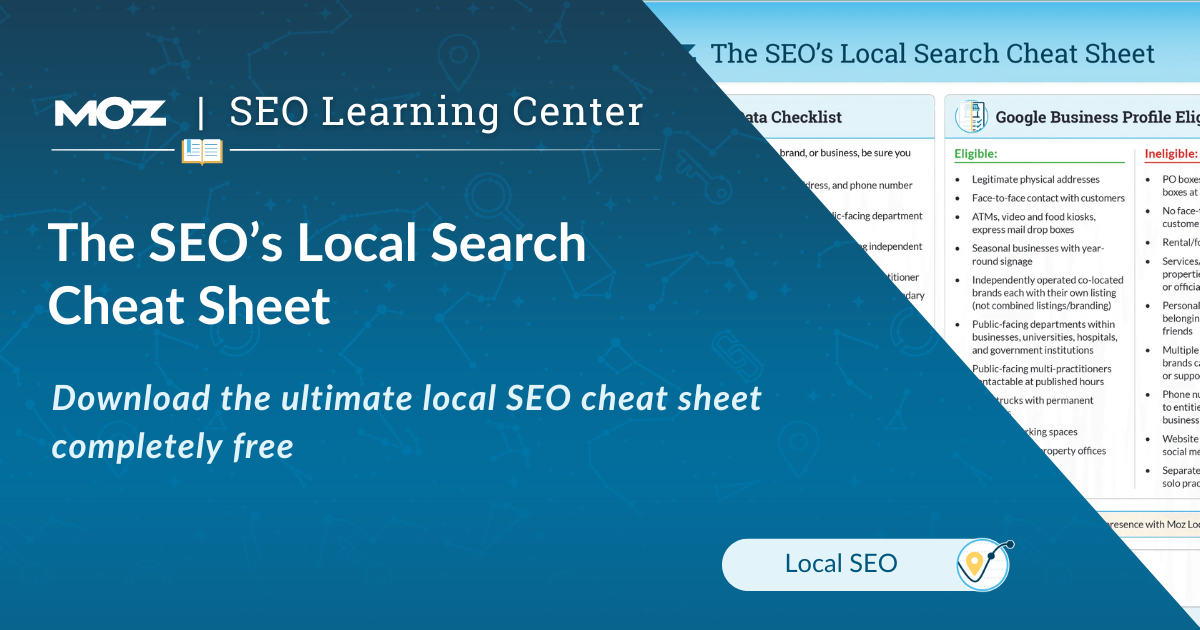
The idea behind The Local SEO Cheat Sheet [Free PDF Download] – Moz is simple: local search success rarely comes from one magical trick. It comes from doing the right small things consistently. Think of it as brushing your teeth, but for your online visibility. Skip it for a week, and things can get unpleasant fast.
This guide breaks down the practical local SEO fundamentals every small business, franchise, service-area business, and local marketer should understand. Whether you run a dental office in Phoenix, a bakery in Austin, a law firm in Chicago, or a plumbing company serving three counties, the same foundation applies: make your business easy to understand, easy to trust, and easy to choose.
What Is a Local SEO Cheat Sheet?
A local SEO cheat sheet is a simplified checklist for improving visibility in local search results, especially Google Search, Google Maps, Bing, Apple Maps, Yelp, and other platforms where customers look for nearby businesses. It does not replace a full SEO strategy, but it keeps your most important tasks in one place so you do not forget the basics while chasing shiny new trends.
Local SEO has two main battlegrounds. The first is the local pack, the map-based section that often appears when someone searches for phrases like “best dentist near me,” “emergency plumber,” or “coffee shop open now.” The second is the traditional organic search result, where your website pages compete for local keywords, service searches, and informational queries.
The best businesses optimize for both. Your Google Business Profile can bring calls and direction requests, while your website can rank for service pages, neighborhood pages, blog posts, FAQs, and comparison searches. When both work together, local SEO becomes less like throwing spaghetti at the wall and more like building a customer acquisition machine with fewer sauce stains.
Why Local SEO Still Matters
Local SEO matters because people search with intent. Someone typing “roof repair near me” is not casually admiring shingles. They probably have a problem, a budget, and a strong desire for rain to stay outside the house. Local searches often happen close to the buying moment, which makes visibility extremely valuable.
For small businesses, local SEO can level the playing field. You may not outrank a national brand for a broad keyword like “insurance,” but you can compete for “independent insurance agent in Denver” or “home insurance broker near Cherry Creek.” Local relevance gives smaller businesses a real chance to show up where it counts.
Search engines want to recommend businesses that are relevant, nearby, and trustworthy. That means your job is not to “trick” Google. Your job is to clearly prove what your business does, where it operates, why customers trust it, and how people can contact you. In other words, local SEO rewards clarity. Confusion is expensive.
The Local SEO Cheat Sheet: Core Tasks
1. Optimize Your Google Business Profile
Your Google Business Profile is often the front door to your local presence. Before a customer visits your website, they may see your business name, rating, photos, hours, services, address, phone number, and reviews directly in Search or Maps. If that information is incomplete or outdated, you may lose the customer before they even meet your homepage.
Start with the basics: business name, address, phone number, website URL, hours, service area, business category, services, products, photos, and attributes. Choose the most accurate primary category because it heavily influences what searches your profile can appear for. A family law attorney should not choose “law firm” if “family law attorney” is more specific and accurate.
Keep your hours updated, especially during holidays. Nothing annoys customers faster than driving across town to find a locked door and a paper sign that says, “Closed today.” Google may forgive you eventually. The customer may not.
2. Keep NAP Information Consistent
NAP stands for name, address, and phone number. These details should be consistent across your website, Google Business Profile, Bing Places, Apple Maps, Yelp, Facebook, industry directories, chamber of commerce listings, and other citation sources.
Consistency helps search engines connect all mentions of your business to the same real-world entity. Small differences are not always catastrophic, but messy information creates friction. If one directory lists “Suite 200,” another says “Ste 2,” and a third has an old phone number from 2017, you are making search engines work too hard. Search engines are smart, but they are not your unpaid administrative assistant.
3. Build and Clean Up Local Citations
Local citations are mentions of your business information on third-party websites. These can appear on structured directories like Yelp, Yellow Pages, BBB, Healthgrades, Avvo, TripAdvisor, Angi, and industry-specific platforms. They can also appear in unstructured places like local news articles, sponsor pages, event listings, and community blogs.
The goal is not to submit your business to every directory in the known universe. Quality beats quantity. Start with major platforms, then add niche directories that matter in your industry. A restaurant should care about Yelp, TripAdvisor, Google, Apple Maps, and food-related platforms. A medical practice may focus on healthcare directories. A home services company may prioritize local service directories and trade associations.
4. Create Local Landing Pages
Your website should clearly explain where you serve customers. For a single-location business, that may mean optimizing your homepage and service pages for your city. For a multi-location company, each location should usually have its own unique page with local details.
A strong local landing page includes the location name, service details, address if applicable, phone number, business hours, embedded map, testimonials, FAQs, driving directions, nearby landmarks, staff information, and original photos. Avoid creating thin, copy-paste city pages where only the city name changes. Google has seen that trick. So have users. Nobody is impressed.
For example, a pest control company serving Tampa, St. Petersburg, and Clearwater should not publish three identical pages with swapped city names. Each page should describe local pest issues, neighborhoods served, real customer examples, and location-specific service details.
5. Use Local Keywords Naturally
Local keyword research helps you understand how customers search. Common patterns include “service + city,” “service near me,” “best service in city,” “emergency service,” “open now,” and “cost of service in city.”
Use local keywords in page titles, headings, meta descriptions, body copy, image alt text, internal links, and FAQs. But keep it natural. A sentence like “Our Denver dentist in Denver provides Denver dental services for Denver patients” is not SEO. It is a cry for help.
Good local SEO writing sounds like a helpful business owner explaining services clearly. Mention the city, neighborhoods, service areas, and customer needs where they make sense. Relevance should feel useful, not stuffed into the page like extra socks in an overpacked suitcase.
6. Earn More Reviewsand Respond to Them
Reviews influence trust, clicks, conversions, and local visibility. A business with recent, detailed, authentic reviews often looks more active and reliable than one with a dusty five-star rating from three years ago. Customers want proof that real people had real experiences.
Ask satisfied customers for reviews after a successful service, purchase, appointment, or project. Make the process simple by sending a direct review link where allowed. Do not buy fake reviews, offer forbidden incentives, or pressure customers to say only positive things. Fake review schemes are like glitter: messy, hard to remove, and eventually obvious to everyone.
Respond to positive and negative reviews professionally. Thank happy customers. For negative reviews, stay calm, acknowledge the concern, and invite the customer to continue the conversation offline. Your response is not only for the reviewer; it is for every future customer reading silently in detective mode.
7. Add LocalBusiness Schema
Structured data helps search engines understand your business details. LocalBusiness schema can identify your business name, address, phone number, opening hours, logo, website, services, and other important information.
Schema is not a magic ranking button. You cannot sprinkle JSON-LD on a weak website and suddenly outrank everyone. But it can help search engines interpret your business entity more confidently. For local SEO, clarity is always a win.
Use schema that matches your visible page content. If your page says you are open Monday through Friday, your schema should not claim 24/7 availability unless your team has discovered time travel.
8. Improve Website Quality and Technical SEO
Your local SEO strategy needs a healthy website. That means fast loading pages, mobile-friendly design, clear navigation, secure HTTPS, crawlable content, optimized images, working forms, and no broken contact links. Many local customers search on mobile, so your site should make calling, booking, or getting directions effortless.
Technical SEO does not have to be scary. Start with practical checks. Does the site load quickly? Can a customer tap the phone number? Is the address visible? Do forms work? Are pages indexed? Are title tags unique? Is the content actually useful? If the answer is no, fix those issues before arguing about advanced algorithm theories on social media.
9. Build Local Links
Local links help show that your business is part of the community. Great link opportunities can come from local sponsorships, nonprofits, schools, events, business associations, local news, partner companies, neighborhood guides, and industry organizations.
For example, a bakery could sponsor a school fundraiser and earn a link from the event page. A law firm could publish a local legal resource and earn mentions from community organizations. A gym could collaborate with a local nutritionist, physical therapist, or wellness event.
The best local links usually come from real relationships, not spammy outreach templates that begin with “Dear Sir/Madam, I loved your insightful article.” Nobody believes you, robot friend.
10. Track Local SEO Performance
Local SEO should be measured by business outcomes, not just rankings. Track phone calls, form submissions, direction requests, website clicks, bookings, revenue, local keyword positions, review growth, profile views, and conversions by location.
Use Google Business Profile performance data, Google Search Console, analytics software, call tracking when implemented correctly, and local rank tracking tools. The goal is to learn what drives customers, not to stare lovingly at a ranking chart while sales stay flat.
Common Local SEO Mistakes to Avoid
Keyword Stuffing the Business Name
Adding extra keywords to your Google Business Profile name may look tempting, but it can violate platform guidelines and create trust problems. Use your real-world business name. “Joe’s Plumbing” is fine. “Joe’s Plumbing Best Emergency Water Heater Repair Cheap Plumber Dallas 24/7” is not a business name; it is a panic attack wearing a nametag.
Ignoring Bing and Apple Maps
Google is the biggest player, but it is not the only place customers search. Bing powers search experiences across Microsoft products, and Apple Maps matters for iPhone users. Claiming and maintaining these listings can improve visibility beyond Google and help keep your business data consistent across the local ecosystem.
Using Duplicate Location Pages
Many businesses create dozens of near-identical pages for every city they want to target. This usually creates low-quality content. Instead, build fewer, stronger pages with real local relevance, unique examples, specific service details, and helpful FAQs.
Forgetting Photos
Photos help customers understand what to expect. Add real images of your storefront, team, products, vehicles, office, projects, menu items, or completed work. Stock photos can help a website look polished, but local SEO benefits from authenticity. Customers can smell generic stock photography through the screen.
Not Asking for Reviews
Happy customers are busy. They may love your service and still forget to leave a review. Build review requests into your normal workflow. Train staff to ask politely, send follow-up messages, and make the process easy. Consistency wins.
A Practical Local SEO Checklist
- Claim and verify your Google Business Profile.
- Select the most accurate primary business category.
- Complete all profile fields, including services, hours, attributes, and photos.
- Keep your name, address, and phone number consistent everywhere.
- Claim Bing Places, Apple Maps, Yelp, and key industry directories.
- Create strong service and location pages on your website.
- Add LocalBusiness schema where appropriate.
- Request authentic customer reviews regularly.
- Respond to reviews with professionalism and personality.
- Publish locally useful content, not generic filler.
- Earn links from local organizations, partners, and community websites.
- Make your website fast, mobile-friendly, and easy to contact.
- Track calls, forms, bookings, direction requests, and revenue.
- Audit listings quarterly to catch outdated information.
How to Use This Moz-Inspired Local SEO Cheat Sheet
The best way to use a local SEO cheat sheet is to turn it into a repeatable workflow. Do not try to fix everything in one heroic weekend fueled by coffee and regret. Instead, break the work into phases.
In week one, audit your Google Business Profile and website basics. In week two, clean up citations and claim missing listings. In week three, improve service pages and local landing pages. In week four, build a review request process and start tracking results. After that, repeat the cycle monthly.
Local SEO is not a one-time project. Businesses change hours, add services, move locations, hire new staff, collect reviews, publish content, and face new competitors. Search results change too. Treat local SEO like maintenance, not decoration.
Experience Notes: What Actually Works in Local SEO
After working through many local SEO campaigns, one lesson becomes obvious: the businesses that win are usually not the ones looking for shortcuts. They are the ones that execute boring fundamentals with impressive discipline. Boring is underrated. Boring pays invoices.
The first experience worth sharing is that Google Business Profile optimization often creates the fastest visible improvement. When a profile has the wrong category, missing services, weak photos, old hours, and no review responses, simply cleaning it up can improve customer actions. For example, a home repair company that adds accurate service categories, project photos, service descriptions, and fresh posts may start receiving better-qualified calls because searchers finally understand what the company does.
The second lesson is that reviews need a system. Businesses often say, “Our customers love us, but they do not leave reviews.” That is usually because nobody asks at the right moment. The best time to request a review is shortly after a successful experience, while the customer still remembers the details. A simple message works best: thank them, mention the service, and provide the review link. Keep it polite. Do not write a novel. Customers are not applying to graduate school.
The third lesson is that local pages must be genuinely local. A page targeting “emergency HVAC repair in Nashville” should not sound like it could apply to Miami, Seattle, or the moon. Mention real neighborhoods, seasonal concerns, service expectations, and practical questions customers ask. Local specificity builds trust with users and gives search engines stronger context.
The fourth lesson is that photos are conversion tools. Many businesses underestimate them. A restaurant with bright menu photos, a dental office with team pictures, a contractor with before-and-after project images, and a fitness studio with real class photos all communicate credibility. People want to know what they are walking into. Real photos reduce uncertainty.
The fifth lesson is that local link building works best when it stops pretending to be “link building.” Sponsor a community event because it supports the community. Join the chamber of commerce because it creates relationships. Collaborate with nearby businesses because it helps customers. The links are a byproduct of real-world activity. Search engines are getting better at recognizing genuine local authority, and customers already recognize it.
The sixth lesson is that tracking must connect to revenue. Ranking number one feels great, but if the phone does not ring, the celebration should be brief. Local SEO reports should show calls, leads, booked appointments, visits, and sales whenever possible. This keeps the strategy focused on business growth rather than vanity metrics.
Finally, patience matters. Local SEO can produce quick wins, but durable visibility usually grows through consistency: updated listings, better pages, more reviews, stronger photos, useful content, and local relationships. The cheat sheet is not a magic wand. It is a map. But for most local businesses, a good map is exactly what they need.
Conclusion
The Local SEO Cheat Sheet [Free PDF Download] – Moz represents a practical way to organize the moving parts of local search. Instead of treating SEO like a mysterious fog machine, it breaks the work into visible, manageable tasks: optimize your profile, clean up business data, build trust with reviews, strengthen your website, add structured data, earn local links, and measure what matters.
Local SEO is not about gaming the system. It is about becoming the clearest, most trustworthy answer for nearby customers. When your business information is accurate, your website is useful, your reviews are active, and your local presence is consistent, search engines have more reasons to show youand customers have more reasons to choose you.
Print the checklist, save it, turn it into a monthly workflow, or tape it to the office coffee machine if that helps. Just do not let it sit untouched in a downloads folder named “SEO stuff.” Local visibility rewards action.














