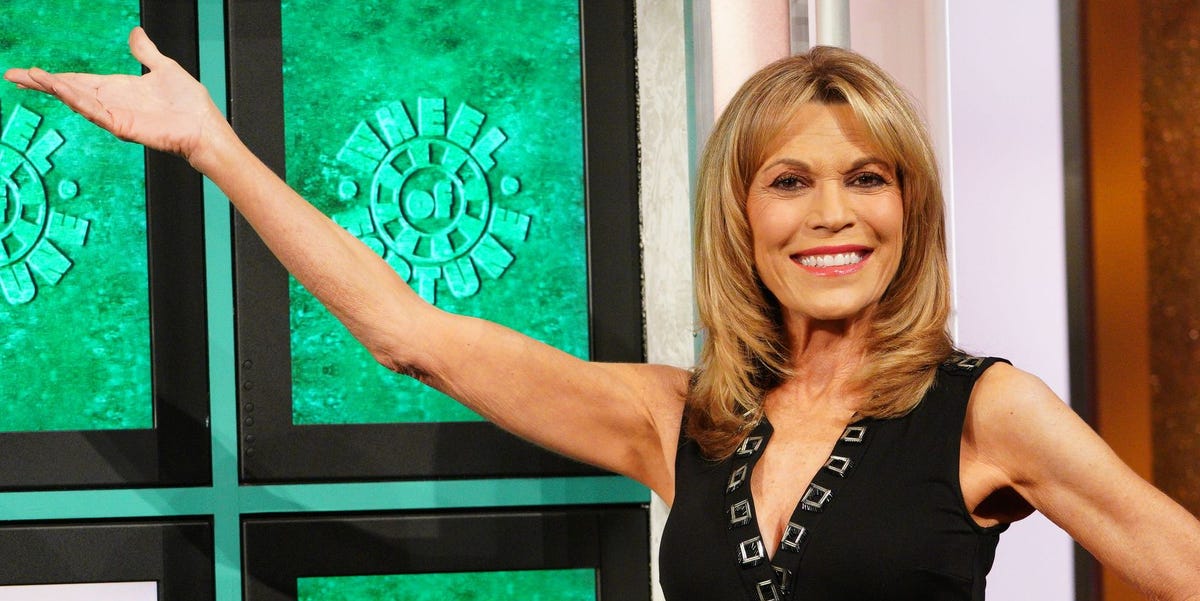
For decades, millions of viewers have welcomed Vanna White into their homes five nights a week. She appears beside the puzzle board in a fresh outfit, flashes her famously encouraging smile, and makes every correctly guessed consonant feel like a national achievement.
That nightly familiarity created one perfectly reasonable assumption: White must spend most of the year reporting to the Wheel of Fortune studio. During a March 4, 2025 appearance on Elvis Duran and the Morning Show, however, the television icon revealed a production secret that left the hostsand plenty of fansstaring as though somebody had solved the Bonus Round without requesting R, S, T, L, N or E.
Vanna White said she films Wheel of Fortune for only about 34 days each year.
Before anyone updates a résumé and applies for “professional letter revealer,” there is an important catch: the production tapes six episodes in a single day. The surprisingly compressed schedule explains how one of America’s most familiar television programs can appear nightly even though its stars are not walking onto the set every afternoon.
What Was the Major “Wheel of Fortune” Secret?
During her conversation with Elvis Duran and his morning-show team, White was asked about the program’s production routine. She casually answered that she films approximately 34 days per year. When that number generated an understandably dramatic response, she added that the cast and crew record six shows during each taping day.
Her playful message was essentially: yes, the number of workdays sounds wonderful, but those days are hardly leisurely. Six complete episodes require six groups of puzzles, multiple contestants, studio audiences, introductions, prize segments and, in White’s case, repeated wardrobe changes.
If every one of those 34 days includes six programs, that schedule can produce roughly 204 episodes. That is enough original material to supply most of a traditional weekday television season, with reruns, holidays and special programming filling out the calendar.
The Illusion of a Daily Broadcast
The revelation surprised people because Wheel of Fortune feels unusually immediate. Contestants react spontaneously, the wheel behaves unpredictably and the hosts speak directly to the home audience. Yet, like many syndicated game shows, it is recorded in batches rather than produced live every weekday.
The episodes are later scheduled for broadcast across local stations. A Monday episode might have been recorded on the same afternoon as the programs viewers see Tuesday, Wednesday, Thursday, Friday and possibly the following Monday. Television time is apparently more flexible than the Bankrupt wedge.
How Six Episodes Are Filmed in One Day
A six-show taping schedule depends on efficiency. The basic set remains in place, the technical crew knows the format down to the second and much of the production follows a carefully rehearsed rhythm. New contestants rotate onto the stage, puzzles are prepared in advance and the team resets the game between episodes.
The finished broadcast may feel relaxed, but a production day requires precise coordination among camera operators, audio technicians, stage managers, puzzle coordinators, prize departments, contestant producers, wardrobe specialists and editors. One delayed element can affect everything that follows.
Each Episode Still Has to Feel Fresh
Batch production creates an unusual performance challenge. The hosts may be recording their fifth or sixth episode of the day, but viewers must feel as though everyone just arrived.
White cannot stroll toward the puzzle board looking as if she has already applauded several hundred consonants. Ryan Seacrest cannot greet a new group of contestants with the energy of someone wondering whether the studio has a spare pillow. Each program needs its own opening-night excitement.
That ability to reset emotionally is one reason veteran television professionals make demanding work look simple. The job involves more than remembering where to stand. It requires consistent timing, concentration and warmth, even when the day has become a marathon conducted beneath hot studio lights.
Vanna White’s Wardrobe Makes the Schedule More Complicated
White’s clothes have become almost as recognizable as the wheel itself. She appears in a different dress for each episode, meaning a six-show day also involves six separate looks.
Over more than four decades, she has worn more than 8,000 gowns and outfits on the program. The clothes are generally borrowed from designers and returned after filming rather than carried home to a closet the size of a regional shopping mall.
Wardrobe planning begins before taping. White has previously described trying on dozens of dresses during fittings so the team can choose outfits that look appropriate on camera and allow her to walk comfortably across the stage. Between episodes, she may have only a short break to change her dress, shoes and accessories before returning to the board.
Why the Outfits Matter
The gowns do not influence the game, but they help give each episode a separate visual identity. A viewer watching on Thursday should not immediately realize that Thursday’s show was filmed shortly after Wednesday’s.
Changing White’s wardrobe supports that illusion of a new day. It also protects the program’s familiar sense of occasion. Contestants have often waited years for their chance to spin the wheel, so the set cannot feel like a production line even when the schedule operates with impressive factory-like precision.
White joked during the interview that people could feel sorry for her because she must change six times. The hosts were not entirely moved. It is difficult to generate sympathy while describing a 34-day filming calendar, although performing gracefully in six different pairs of shoes deserves at least a respectful nod.
The Puzzle Board Is More Advanced Than It Looks
The filming secret was not the only behind-the-scenes detail White discussed. Her role at the puzzle board has evolved dramatically since she joined the show in 1982.
Early versions of the board used physical panels that had to be turned manually. In 1997, the program introduced a computerized board made of individual touch-activated screens. White no longer had to rotate mechanical pieces; she touched the appropriate spaces to reveal letters.
The system changed again in 2022. The separate screens were replaced by one large LED display supported by motion-sensing technology. White can now activate letters by moving her hand near the correct area instead of physically pressing the board.
That technology makes the reveal smoother and helps production move quickly. It also creates a slightly amusing modern reality: one of television’s most famous “letter turners” has not literally turned a letter in years.
More Secrets From Vanna White’s Podcast Appearance
The interview offered more than a surprising calendar calculation. White appeared with her son, Nikko Santo Pietro, and reflected on her long history with the program, her original audition and her relationship with former host Pat Sajak.
White explained that she remains in contact with Sajak following his departure from the syndicated edition. Their professional partnership lasted more than four decades and produced thousands of episodes. Off camera, they developed the comfortable familiarity of two people who have collectively witnessed nearly every possible way to mispronounce a puzzle.
From Pat Sajak to Ryan Seacrest
Sajak’s final regular episode aired in June 2024, ending one of television’s longest-running hosting tenures. Ryan Seacrest began hosting the syndicated program in September 2024, with White remaining as the essential link between eras.
The transition placed White in a unique position. She understood the show’s timing, traditions and audience expectations better than almost anyone, while Seacrest brought a different hosting style and fresh energy.
Rather than transforming the program beyond recognition, the new team preserved its central formula: spin the wheel, choose a letter, solve the puzzle and try not to lose a vacation package to a small cardboard wedge labeled “Bankrupt.”
Why the 34-Day Work Year Went Viral
People are fascinated by celebrity work schedules, especially when those schedules challenge ordinary ideas about employment. Hearing that a famous television personality films only 34 days per year naturally attracts attention from anyone who has answered an email during lunch, attended a meeting about another meeting or stared at a calendar containing significantly more than 34 occupied squares.
However, the viral reaction also reveals how little viewers know about syndicated television production. A program can air almost every weekday without being recorded every weekday. The efficient schedule is possible because the format, crew and set are built for batch production.
Fewer Days Do Not Mean No Preparation
The number also represents taping days, not necessarily every hour White devotes to the job. Wardrobe fittings, promotional appearances, rehearsals, interviews, photography, contract discussions and special events may happen outside those 34 studio days.
Her value to the show cannot be measured only by the number of mornings she drives onto the Sony Pictures lot. White has spent decades building a recognizable public persona based on consistency, friendliness and visual elegance. That familiarity is part of the program’s commercial value.
In other words, she is not simply being paid to wave at illuminated vowels. She is being paid to remain Vanna Whitean occupation for which the applicant pool is currently very small.
How Vanna White Became Essential to “Wheel of Fortune”
White became the show’s regular co-host in December 1982 after auditioning to replace Susan Stafford. The syndicated version of Wheel of Fortune launched the following year and rapidly became a major part of American television culture.
Her job initially appeared straightforward: reveal letters, applaud contestants and model elegant clothes. Over time, however, her calm presence became central to the show’s identity. She represented continuity as sets, puzzle boards, prize values, hosts and television technology changed around her.
White has also stepped beyond her usual position. In 2019, she temporarily hosted the game after Sajak underwent emergency surgery. The assignment required her to manage gameplay, speak with contestants and control the pace from the opposite side of the stage.
The experience demonstrated that her familiar walk beside the board was not the limit of her ability. It also reminded viewers how much specialized knowledge is hidden inside a program designed to look effortless.
Extended Experience: What a “Wheel of Fortune” Taping Day Really Feels Like
The 34-day revelation becomes more meaningful when the schedule is considered from the perspectives of the audience, contestants, crew and hosts. A taping day is not simply six casual games placed back to back. It is a controlled live-event experience repeated several times before the participants go home.
The Studio Audience Experience
For audience members, attending a taping can feel like stepping inside a familiar living-room television set. The wheel looks larger, the puzzle board appears brighter and the studio may feel colder than expected because strong lighting and production equipment generate considerable heat.
Audience coordinators explain rules, encourage applause and maintain energy during pauses. Viewers may see production conversations, camera adjustments and resets that never appear in the edited broadcast. Then the music starts, the hosts enter and the set suddenly becomes the polished world seen on television.
Watching several episodes in sequence also reveals the importance of repetition. Introductions must be delivered cleanly. Contestants must stand on their marks. Applause needs to sound enthusiastic even after the audience has already celebrated multiple vacations, cars and impressive puzzle solutions.
The Contestant Experience
Contestants face a different challenge. They may have practiced for months, studied common letter patterns and imagined the moment they would finally touch the wheel. Once the cameras roll, however, preparation collides with nerves.
The wheel is heavy. The studio is distracting. The puzzle timer feels faster than it does from the couch. A simple phrase that would normally be obvious can disappear from the brain when money, cameras and a smiling television legend are only a few feet away.
Contestant coordinators provide instructions and practice before filming, but no rehearsal can fully reproduce the emotional pressure of the real game. That tension is what keeps the program engaging. The format is predictable, while the human reactions are not.
Vanna White’s Experience
For White, the challenge is consistency across an unusually compressed schedule. She must track the board, respond to each contestant and remain camera-ready while changing outfits between programs. One episode may include a dramatic comeback, while the next begins minutes later with an entirely new group of people who deserve the same attention.
That emotional reset is a professional skill. White cannot allow fatigue from an earlier taping to reduce the excitement of a contestant appearing in a later episode. To every player, this is not the fifth show of a long day. It is a once-in-a-lifetime event.
Her movements also require precision. Although the modern board uses sensors, she still has to approach the correct letters, stay within camera framing and move without obstructing the puzzle. A mistake could interrupt the game or require an edit.
The Crew’s Experience
Behind the cameras, the crew operates like a well-rehearsed orchestra. Puzzles, prizes, contestant positions, audio cues, graphics and wheel results must all be monitored. After one episode ends, the team prepares for another while wardrobe and makeup departments work on the hosts.
Efficiency cannot come at the expense of fairness. Contestants need clear instructions, puzzles must be correct and the physical wheel must function consistently. Game shows are entertainment, but they are also competitions involving real money and prizes.
The Viewer’s Experience
Home viewers receive the final illusion: one fresh, effortless episode each evening. They do not see the wardrobe sprint, the contestant briefing or the technical reset. They see a self-contained half hour that feels as dependable as dinner.
That is the real significance of White’s secret. The schedule does not make the show less authentic. Instead, it reveals how much planning is required to create something that appears spontaneous. Television magic is often less about mystery than about excellent organizationand a truly heroic number of garment bags.
Conclusion: The Secret Makes Vanna White’s Career More Impressive
Vanna White’s revelation that Wheel of Fortune films for approximately 34 days a year generated laughs, envy and plenty of surprised reactions. Yet the complete picture is more interesting than the headline alone.
Those 34 days contain six-show production marathons, rapid wardrobe changes, technical cues and the responsibility of making every new contestant feel important. Combined with fittings, promotion and more than four decades of maintaining a beloved television persona, the schedule reflects efficiency rather than idleness.
The secret also helps explain the durability of Wheel of Fortune. Its producers have refined a system capable of creating an entire season during a relatively small number of carefully organized taping sessions. Meanwhile, White delivers the same warmth and polish whether the cameras are recording the first episode of the morning or the final puzzle of the day.
So yes, 34 filming days is an enviable arrangement. But after more than 8,000 outfits, countless miles walked beside the puzzle board and several million supportive claps, White has probably earned the right to enjoy a few days away from the wheel.