
Note: This article is original, rewritten for SEO publication, and inspired by real empty-city photography, local illustration projects, mixed-media art, and the way public art can turn silent urban spaces into stories worth staring at twice.
When the City Went Quiet, Artists Heard Something Else
An empty city is a strange thing. Streets that usually cough up traffic, footsteps, scooters, delivery bikes, and that one mysterious person yelling into a phone suddenly become still. Storefronts stare back. Crosswalks wait politely for nobody. Benches look like they have been abandoned mid-thought. For photographers, that silence can feel cinematic. For illustrators, it feels like an invitation.
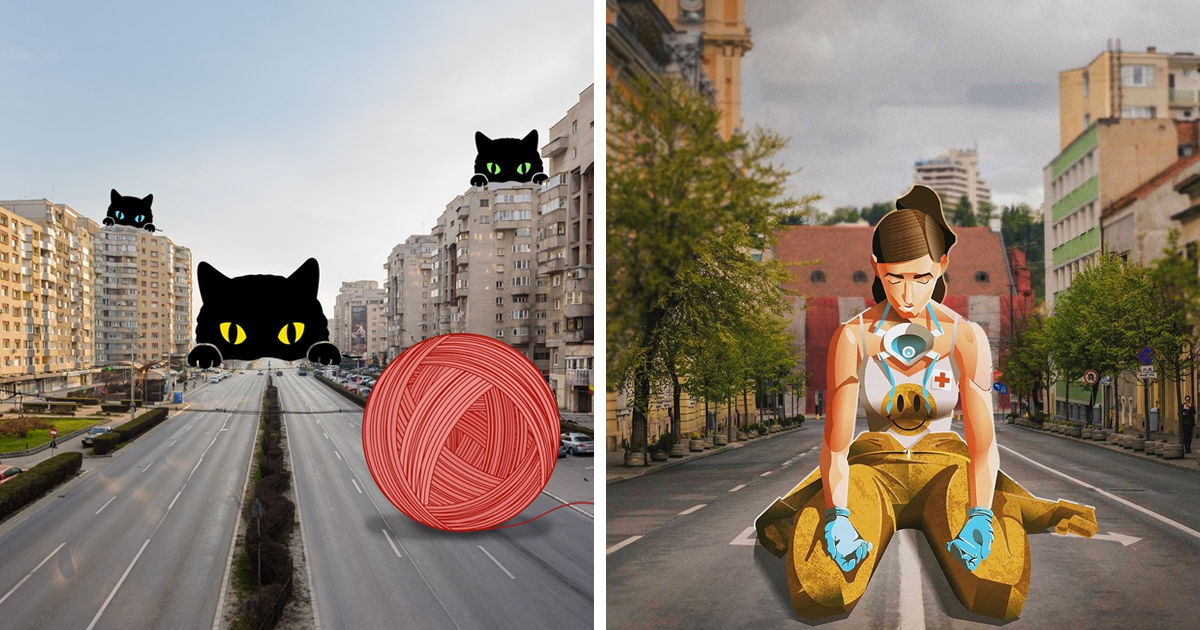
That is the heart of this creative project: we gave local illustrators our pictures of the empty city and asked them to add their own touch. The result is a playful collection of 24 pictures where real streets, walls, windows, and corners become stages for tiny monsters, daydreaming characters, oversized cats, floating creatures, surreal jokes, and sweet little visual surprises. It is part urban photography, part digital illustration, part “wait, did that traffic pole just become a wizard?”
The idea works because empty city photography already carries a strong emotional charge. A vacant square can look peaceful, lonely, eerie, beautiful, or all four before breakfast. But when an illustrator enters the scene, the mood changes. A silent alley becomes a comic strip. A blank wall becomes a conversation. A deserted sidewalk becomes a runway for imagination. The city is no longer empty. It is simply waiting for someone with a pen, a tablet, and a slightly suspicious amount of creative energy.
Why Empty City Photos Make Such Powerful Blank Canvases
Empty streets have always fascinated artists and photographers because they reveal the city’s bones. Without crowds, signs become louder. Shadows become characters. Architecture stops being background noise and starts demanding attention like a theater actor who has finally received a solo scene.
During lockdown periods around the world, many people saw familiar places in unfamiliar ways. Normally crowded landmarks, downtown roads, cafés, transportation hubs, and public squares suddenly looked like movie sets after the cast had gone home. Photographers captured the stillness, but the images often felt unfinished, as if the city had paused in the middle of a sentence.
That unfinished feeling is exactly what makes these photos ideal for illustration. A puddle can become a portal. A traffic light can become a tiny robot with authority issues. A balcony can host a dragon that pays rent in smoke. When a city is busy, every inch is already occupied by movement. When it is empty, imagination gets more legroom than a first-class passenger.
The Magic of Mixing Photography and Illustration
Combining photography with illustration is not a gimmick; it is a long-loved visual language. Mixed-media artists have used collage, drawing, photomontage, and digital manipulation for decades to challenge what a picture can do. A photograph says, “This happened here.” An illustration replies, “Yes, but what if a giant octopus was also waiting for the bus?” Together, they create a third thing: a believable impossible world.
In this project, the photographic base gives each artwork a sense of place. Viewers can recognize streets, doors, fences, stairs, shops, and corners. The illustration adds personality, humor, fantasy, and emotional color. That balance is important. If the drawing completely covers the photo, the city disappears. If the drawing is too timid, the image feels like a polite doodle in the margin of a notebook. The best pieces make the real and imaginary shake hands like old friends.
1. The City Becomes a Playground
One of the most charming effects of the series is how it turns public space into a playground. A boring patch of pavement can become a landing zone. A plain wall can become a monster’s hiding place. A window can become a sleepy face. Viewers are invited to look again at the ordinary objects they usually ignore.
2. Humor Softens the Silence
Empty streets can feel heavy. Add a cartoon creature peeking from behind a lamppost, and suddenly the sadness has a mustache. Humor does not erase the strange mood of the empty city; it gives people a way to approach it without feeling overwhelmed. A good visual joke can turn loneliness into connection.
3. Local Artists Add Local Personality
Local illustrators understand the rhythm of their city. They know which corners feel cozy, which alleys look mysterious, which buildings have attitude, and which street signs are secretly begging to be turned into characters. Their additions do not feel random; they feel rooted in the personality of the place.
What Makes These 24 Pics So Shareable?
There is a reason projects like this travel quickly online. They are easy to enjoy at first glance but rewarding when you look closer. The viewer sees the photo, notices the illustration, smiles, then zooms in to find small details. It is a visual treasure hunt, and the prize is usually something delightfully odd.
Shareable art often has three ingredients: a simple concept, a strong emotional hook, and a surprise. This project has all three. The concept is clear: empty city photos transformed by illustrators. The emotion is universal: we all know the feeling of seeing a familiar place suddenly quiet. The surprise comes from each artist’s unique touch. One illustrator might add gentle poetry. Another might add chaos with legs. Both are valid. Chaos with legs deserves representation.
The Emotional Side of an Empty City
An empty city is not just a visual subject; it is a feeling. It can represent isolation, calm, loss, safety, memory, or renewal. People often attach their routines to specific places: the café where they meet friends, the bus stop where they check messages, the bookstore they enter “just to browse” before accidentally adopting three novels. When those places appear empty, the viewer feels the missing human layer.
Illustration can bring that missing layer back in symbolic form. Instead of drawing realistic crowds, artists can add dream creatures, exaggerated figures, strange companions, or little narrative moments. In doing so, they do not simply refill the city with people. They refill it with feeling.
How Public Art Changes the Way We See Urban Space
This project also connects to a bigger conversation about public art and creative placemaking. Public art has the power to make streets feel less anonymous. Murals, installations, illustrations, and community art projects help people see their neighborhoods as living places rather than just routes between errands.
Even though these 24 pictures exist as digital artworks, they function like tiny pieces of public art. They reimagine walls, sidewalks, roads, and buildings as sites of possibility. The viewer might return to the real location later and remember the illustrated version. Suddenly, an ordinary corner is not just an ordinary corner anymore. It is the place where, in one artist’s universe, a giant sleepy cat might have stretched across the street like it owned the neighborhood. To be fair, most cats already believe they own the neighborhood.
What the Illustrators Teach Us About Looking
The best lesson from the project is simple: artists see invitations where others see emptiness. A photographer captures the scene. An illustrator asks what else the scene could become. That question is powerful because it changes the viewer’s habit of looking.
After seeing pictures like these, you may walk through your own city differently. A cracked wall might look like a mountain range for ants. A storm drain might look like a tiny theater entrance. A row of parked bicycles might look like mechanical horses waiting for their medieval quest. The world becomes more interesting when your imagination refuses to clock out.
Behind the Creative Process
A project like this may look effortless, but good visual collaboration takes careful choices. First, the photographers need images with enough space for illustration. Too much clutter can make the final artwork feel crowded. Empty streets, blank walls, open skies, simple shadows, and strong architectural lines all create room for drawn elements.
Next, the illustrators need to respond to the photo rather than fight it. The most successful pieces usually respect perspective, lighting, scale, and composition. If a drawn character stands on a sidewalk, it should feel like it belongs there. If a creature wraps around a building, the drawing should understand the building’s shape. Fantasy works best when it knows the rules before breaking them.
Finally, each artwork needs a mood. Some pieces may be funny. Others may be tender, strange, dreamy, or slightly spooky. A strong mood helps the image feel complete instead of decorative. The goal is not to draw on top of a photo. The goal is to reveal the invisible story hiding inside it.
Specific Examples of What Works in This Style
Imagine a deserted street with a long shadow across the pavement. One illustrator might turn the shadow into a sleeping whale, making the road feel like an ocean. Another might add tiny people climbing the shadow like a hill. A third might draw a lonely character sitting at the edge of it, as if waiting for the city to wake up.
Or picture an empty intersection. Without cars, it feels oddly ceremonial, like the city is holding its breath. An artist could add a parade of invisible musicians, shown only through floating instruments. Another could draw a giant hand moving the crosswalk stripes like piano keys. Suddenly, the intersection has rhythm again.
A blank wall is another perfect canvas. It can hold a mural, a monster, a memory, a fake doorway, or a character trying to escape the frame. Walls are especially useful because they give illustrators a flat surface while still keeping the realism of the street. In visual storytelling terms, a blank wall is basically a microphone waiting for someone dramatic.
Why Local Creativity Matters
There is something special about asking local illustrators to reimagine local photos. It keeps the work intimate. Instead of creating generic fantasy scenes, the artists are responding to streets they may have walked, buildings they may have passed, and small details they may recognize. That familiarity gives the drawings warmth.
Local creative projects also help communities document their own emotional history. A city is not only its architecture; it is also the way people remember it. These illustrated empty-city pictures capture a moment when familiar spaces felt unfamiliar. They preserve that feeling but refuse to leave it bleak. They add color, wit, tenderness, and a little absurdity, which is often exactly what human beings need.
What Brands, Publishers, and Creators Can Learn From This Project
For publishers, this format is a reminder that strong visual storytelling does not always require a complicated concept. A simple collaboration can become memorable when the execution is thoughtful. Photography plus illustration is accessible, flexible, and highly engaging for digital audiences.
For brands, the lesson is even clearer: people respond to creativity that feels human. Instead of polished perfection, they often enjoy work that feels playful, local, and emotionally honest. A city does not need to be turned into a glossy postcard. Sometimes it just needs a small illustrated creature sitting on a rooftop, looking confused but optimistic.
For artists, the project is a nudge to collaborate more. Photographers and illustrators often work in separate lanes, but when they merge their skills, they create something neither could produce alone. The photographer offers reality. The illustrator offers possibility. Together, they make reality slightly less boring, which is a public service.
Experiences Related to the Topic: Seeing the City With New Eyes
There is a very specific feeling that comes from walking through a quiet city. You notice sounds that are usually buried: a loose sign tapping in the wind, the buzz of a streetlight, the squeak of your own shoes, the dramatic inner monologue you apparently carry around like a backpack. Empty streets make you aware of your presence. They also make you aware of absence.
Looking at illustrated empty-city pictures can recreate that experience in a softer, more imaginative way. The photo reminds you of the silence. The drawing offers companionship. It is like walking alone and suddenly finding a friendly little monster beside you, one who does not ask awkward questions and probably knows where the best snacks are hidden.
Many people discovered during quiet urban moments that their cities were more detailed than they had realized. A doorway had decorative carvings. A street corner had beautiful old tiles. A building’s shadow changed shape at sunset. A faded sign had more personality than half the people on reality television. When illustrators add their own touch to these photos, they amplify those overlooked details. They say, “Look here. This spot has a story.”
That is why this type of project feels comforting. It does not pretend the empty city is normal. It acknowledges the strangeness, then responds with creativity. The illustrations act like emotional repairs. They stitch humor onto silence, color onto grayness, and motion onto stillness. They give viewers a way to revisit a difficult visual memory without being swallowed by it.
There is also a personal lesson in the process. We all carry empty spaces in our lives: paused plans, unfinished ideas, quiet seasons, blank pages, awkward calendar gaps, and that one drawer full of cables nobody can identify. The illustrators’ approach suggests that emptiness does not have to be the end of the story. It can be the beginning of a new layer.
In daily life, this might mean taking a photo walk through your neighborhood and looking for “blank canvases.” Maybe you photograph a quiet staircase, a lonely mailbox, a cracked sidewalk, or a shop window after closing time. Then you sketch what could live there: a tiny astronaut, a sleepy fox, a plant with opinions, a cloud taking a coffee break. You do not need to be a professional illustrator to enjoy the exercise. You only need curiosity and the willingness to let ordinary places misbehave a little.
Projects like this also remind us that creativity is often a conversation. The city speaks first through its shapes, light, and silence. The photographer answers by framing it. The illustrator answers again by adding imagination. Then the viewer joins the conversation by interpreting the result. A single image becomes a shared experience, which is exactly what good art does.
Perhaps the most memorable part of these 24 pictures is not the technical skill, though that matters. It is the generosity of the idea. The artists are not mocking the empty city or covering it up. They are keeping it company. They are saying that even when streets are quiet, imagination can still walk around with its hands in its pockets, whistling badly but confidently.
Conclusion: The Empty City Was Never Really Empty
“We Gave Local Illustrators Our Pictures Of The Empty City And Asked Them To Add Their Own Touch (24 Pics)” is more than a fun art experiment. It is a reminder that cities are built from more than concrete, glass, traffic lights, and suspiciously expensive coffee. They are built from memory, humor, imagination, and the people who keep looking closely when everyone else looks away.
By blending urban photography with illustration, the project transforms silence into story. It turns deserted streets into imaginative scenes and ordinary backgrounds into emotional playgrounds. Most importantly, it proves that an empty city is never truly empty when artists are nearby. It is full of hidden creatures, secret jokes, possible worlds, and visual punchlines waiting for the right person to draw them into existence.














