
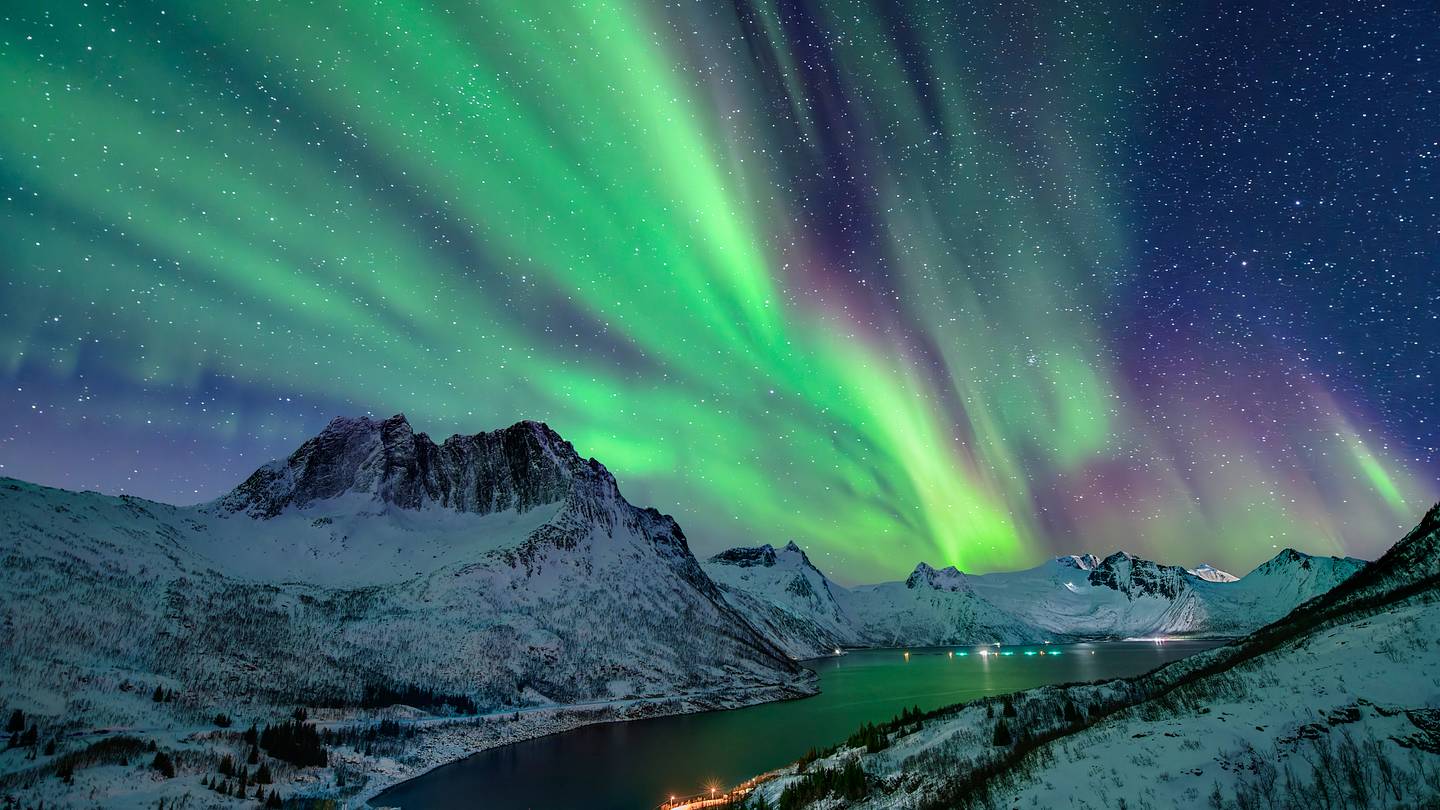
The northern lights are one of those rare natural wonders that make adults point at the sky like excited toddlers who just discovered the moon. One minute the night is quiet and cold; the next, ribbons of green, red, violet, and sometimes pink seem to ripple across the darkness like the universe forgot to close its curtains.
Scientifically, the northern lights are called the aurora borealis. They are colorful displays of light that happen when energetic particles from the Sun interact with Earth’s magnetic field and upper atmosphere. In simpler terms: the Sun throws tiny charged particles into space, Earth’s magnetic field catches many of them, and the atmosphere turns the whole thing into a glowing sky show. It is physics, chemistry, and dramabasically a cosmic Broadway performance with better lighting.
The northern lights are most often seen near the Arctic region, including Alaska, northern Canada, Greenland, Iceland, Norway, Sweden, and Finland. But during strong geomagnetic storms, auroras can appear much farther south, surprising people in places where the biggest nighttime event is usually a porch light turning on.
What Causes the Northern Lights?
To understand what causes the northern lights, we need to start with the Sun. The Sun is not just a warm yellow ball politely lighting our afternoons. It is a giant, energetic star constantly releasing a stream of charged particles called the solar wind. These particles travel through space at incredible speeds and eventually reach Earth.
Earth is protected by a magnetic field, often called the magnetosphere. Think of it as the planet’s invisible superhero shield. Most solar particles are deflected away, which is good news for life on Earth and bad news for anyone hoping to casually high-five a proton from space.
However, some particles become trapped and guided along magnetic field lines toward the polar regions. When these particles enter Earth’s upper atmosphere, they collide with gases such as oxygen and nitrogen. These collisions give atoms and molecules extra energy. When the gases release that energy, they emit light. That light is the aurora.
The Simple Version
The northern lights happen because:
- The Sun sends charged particles into space.
- Earth’s magnetic field guides some particles toward the poles.
- The particles collide with oxygen and nitrogen in the upper atmosphere.
- Those gases glow, creating colorful aurora displays.
So, when someone asks, “What are the northern lights?” the short answer is: they are glowing atmospheric lights caused by solar particles interacting with Earth’s magnetic field and air. The longer answer is what makes them so fascinating.
Why Are the Northern Lights Different Colors?
The color of the aurora depends mainly on which atmospheric gas is involved and how high the collision happens. Oxygen and nitrogen produce different shades, and altitude plays a big role in the final color palette.
Green Northern Lights
Green is the most common aurora color. It usually comes from oxygen atoms roughly 60 to 150 miles above Earth’s surface. This familiar green glow is what many people imagine when they picture the aurora borealis. It can look like a soft mist, a glowing curtain, or a giant cosmic highlighter mark across the sky.
Red Northern Lights
Red auroras are usually produced by oxygen at higher altitudes. Because the air is thinner up there, the light can appear softer, fainter, and more mysterious. Red auroras are less common than green ones, but during strong geomagnetic storms they can become visible across a wide area.
Blue and Purple Northern Lights
Blue, violet, and purple tones often involve nitrogen. These colors can appear along the lower edges of auroral curtains or during more active displays. They are sometimes easier for cameras to capture than for human eyes to see clearly, which explains why your phone may return from an aurora trip looking like it had a more exciting night than you did.
Where Can You See the Northern Lights?
The best places to see the northern lights are usually within or near the auroral oval, a ring-shaped zone around Earth’s magnetic poles where auroras happen most often. In the Northern Hemisphere, this includes high-latitude regions such as Alaska, northern Canada, Iceland, Greenland, northern Scandinavia, and parts of Russia.
In the United States, Alaska is the superstar. Fairbanks, Denali National Park, and other dark-sky areas in the state are well-known for aurora viewing. Farther south, states such as Minnesota, Michigan, North Dakota, Montana, Maine, and Washington may occasionally see the northern lights during stronger geomagnetic activity.
Still, seeing the aurora is never guaranteed. The northern lights are not a scheduled fireworks show with a snack stand and a punctual start time. They depend on solar activity, geomagnetic conditions, cloud cover, darkness, and your willingness to stand outside in cold air pretending you are “totally fine” while your toes file a formal complaint.
When Is the Best Time to See the Northern Lights?
The best time to see the northern lights is usually during dark, clear nights in high-latitude regions. In many northern locations, aurora viewing is best from late fall through early spring because nights are longer and skies become dark enough for the lights to stand out.
Winter is popular for aurora travel because the long nights create more viewing opportunities. However, colder weather also means you need serious preparation. A beautiful aurora is harder to appreciate if you are underdressed and slowly turning into a human popsicle.
The hours around local midnight are often favorable, although auroras can appear earlier or later depending on conditions. Many experienced aurora watchers check forecasts, then prepare to wait. Patience is not optional. The aurora likes suspense.
Do Solar Cycles Matter?
Yes. The Sun follows an approximately 11-year activity cycle. During periods of higher solar activity, solar flares, coronal mass ejections, and stronger solar wind streams can increase the chances of geomagnetic storms. These storms can make the aurora brighter and push visibility farther from the poles.
That does not mean auroras disappear during quieter solar periods. They can still happen, especially in high-latitude regions. But strong, widespread displays are more likely when the Sun is active.
How Do Aurora Forecasts Work?
Aurora forecasts use space weather data to estimate where and how strongly auroras may appear. Scientists monitor the solar wind, magnetic fields, and geomagnetic activity to predict whether Earth’s upper atmosphere may light up.
One common measurement is the Kp index, which describes global geomagnetic activity on a scale from 0 to 9. A low Kp value means auroras are generally limited to far northern regions. A higher Kp value suggests stronger activity and a better chance of seeing the northern lights farther south.
Forecast tools can be very helpful, but they are not magic crystal balls. Space weather changes quickly. A promising forecast can fade, and a quiet forecast can suddenly become interesting. In other words, aurora hunting is part science, part timing, and part standing outside whispering, “Come on, sky, do the thing.”
Are the Northern Lights Dangerous?
The northern lights themselves are not dangerous to people watching from the ground. You can safely enjoy them with your eyes, camera, binoculars, or a thermos of hot chocolate held with heroic determination.
However, the space weather that creates auroras can affect technology. Strong geomagnetic storms may interfere with satellites, radio communication, GPS signals, and power systems. This is why agencies monitor space weather carefully. The same solar energy that paints the sky can also make engineers pay very close attention to their dashboards.
For ordinary viewers, the biggest risks are much more practical: cold temperatures, icy roads, poor visibility, wildlife, and wandering too far from safe areas in the dark. The aurora is beautiful, but it is not worth getting lost in the woods because you were chasing a green glow with the confidence of a movie character who definitely ignores warning signs.
How to Watch the Northern Lights
If you want to see the northern lights, preparation makes a huge difference. The aurora may be natural, but a good viewing experience rarely happens by accident.
Find a Dark Location
Light pollution can wash out faint auroras. For the best view, get away from city lights and look for open areas with a clear view of the northern horizon. National parks, rural lakeshores, mountain viewpoints, and remote fields can all work well if they are safe and legally accessible.
Check the Weather
Clouds are the enemy of aurora watching. The northern lights could be dancing above you like a laser show, but if the sky is covered, you will see exactly one thing: clouds being rude. Always check local cloud cover before heading out.
Watch the Moon
A bright full moon can make faint auroras harder to see, although strong displays can still shine through moonlight. For the darkest skies, plan around a new moon or nights when the moon rises late or sets early.
Give Your Eyes Time to Adjust
Your eyes need time to adapt to darkness. Avoid bright white lights, phone screens, and car headlights when possible. Red lights are better for preserving night vision. After 20 to 30 minutes in darkness, you may notice faint auroral features that were invisible at first.
Dress Like You Mean It
Aurora watching often means standing still outdoors at night. That is colder than simply walking from a parking lot to a building. Wear insulated layers, warm socks, gloves, a hat, and proper footwear. Bring hand warmers if needed. Fashion can take the evening off; survival gets the headline.
How to Photograph the Northern Lights
Photographing the northern lights can be easier than seeing all their colors with the naked eye because cameras collect light over time. A long exposure can reveal greens, reds, and purples that appear faint or grayish to human vision.
For best results, use a tripod or stable surface. Set your camera or phone to night mode, long exposure, or manual settings if available. A wide aperture, higher ISO, and exposure time of several seconds can help capture the glow. The exact settings depend on how bright the aurora is and how dark the sky is.
Try not to spend the entire night staring at your screen. Take photos, yes, but also look up. Your camera may capture the colors, but your memory captures the moment when the sky itself seems alive.
Why Do the Northern Lights Look Like Curtains?
Auroras often look like curtains, arcs, rays, spirals, or waves because charged particles follow Earth’s magnetic field lines. These field lines shape where particles enter the atmosphere and how the resulting light appears from the ground.
When the aurora is quiet, it may look like a pale band or gentle glow. During more active periods, it can ripple, pulse, brighten, split into rays, or sweep across the sky. The movement is caused by changes in magnetic energy and particle flow high above Earth.
This is why aurora displays can feel almost alive. They are not fixed objects like stars. They shift and shimmer. One minute they look like a faint cloud; the next they flare into a glowing curtain that makes everyone nearby suddenly forget how sentences work.
Northern Lights vs. Southern Lights
The northern lights are the aurora borealis. The southern lights are the aurora australis. Both are caused by the same basic process: energetic particles interacting with Earth’s magnetic field and atmosphere.
The main difference is location. Aurora borealis appears in the Northern Hemisphere, while aurora australis appears in the Southern Hemisphere near Antarctica, southern Australia, New Zealand, and parts of southern South America during strong activity.
Because fewer people live close to the southern auroral zone, the southern lights are less commonly seen by large populations. The northern lights get more attention, not because they are better, but because they have better marketing and more land-based viewing spots.
Common Myths About the Northern Lights
For centuries, people have told stories about the northern lights. Some cultures saw them as spirits, omens, messages, or celestial fires. These stories reflect how powerful the aurora can feel when seen without modern scientific explanation.
Today, science explains the physical cause of auroras, but that does not make them less magical. In fact, knowing that the lights are connected to solar wind, magnetic fields, and glowing atmospheric gases can make them even more impressive. The aurora is not magic instead of science. It is science that behaves like magic.
Can You Hear the Northern Lights?
Some people have reported hearing faint sounds during aurora displays, such as crackling or rustling. The topic is debated and complex. Most auroras occur far too high in the atmosphere for sound to travel directly to the ground in real time. However, researchers have explored possible local electrical effects near the surface during certain conditions.
For most viewers, the northern lights are a silent show. And honestly, they do not need a soundtrack. The sky already has the lead role.
Why the Northern Lights Matter
The northern lights are beautiful, but they are also scientifically important. They help researchers understand space weather, Earth’s magnetic field, and how solar activity affects our planet. Studying auroras can improve forecasting for geomagnetic storms, which matters for satellites, astronauts, aviation, navigation, radio communication, and electrical grids.
In other words, auroras are not just pretty lights. They are visible evidence that Earth is connected to the Sun in a dynamic and powerful way. Every aurora display is a reminder that our planet is not floating in empty space like a lonely marble. It is part of an active solar system where energy, particles, and magnetic fields are constantly interacting.
Personal Experiences: What It Feels Like to See the Northern Lights
Reading about the northern lights is useful, but seeing them in person is a completely different experience. The first surprise is often how quiet everything feels. You may be standing in a snowy field, beside a frozen lake, or on a dark overlook with your breath floating in front of you. The world feels still. Then someone says, “Is that a cloud?” and suddenly everyone is staring north like the sky just sent a secret text message.
At first, the aurora can appear faint. Many first-time viewers expect neon lights immediately, but the display may begin as a pale gray-green band near the horizon. It can look almost like a strange cloud, except it does not move like one. Then the glow strengthens. A curtain forms. The edges sharpen. Rays stretch upward. The green becomes clearer. If the aurora grows more active, it may ripple across the sky with a motion that feels too graceful to be weather and too wild to be artificial.
One of the most memorable parts of aurora watching is the waiting. People often imagine the northern lights as a single dramatic moment, but the experience is usually slower and more suspenseful. You check the forecast. You drive away from town. You turn off the headlights. You step into the cold and immediately question several life choices. Then you wait. Five minutes. Ten minutes. Maybe an hour. Someone opens a snack. Someone else says the forecast app looks promising. Everyone becomes an amateur space weather analyst.
Then, if you are lucky, the sky rewards you. The aurora may brighten so quickly that the whole group reacts at once. Cameras click. People laugh. Nobody sounds cool. That is part of the charm. The northern lights have a way of removing everyone’s polished personality and replacing it with pure wonder. Even people who normally speak in calm, professional voices start saying things like, “Whoa, whoa, whoa, look at that!”
The colors can vary depending on the display and your eyes. Sometimes the camera shows more color than you see in person. This does not mean the experience is disappointing. The human eye is watching motion, scale, and atmosphere in real time. A photograph may capture brighter greens and purples, but it cannot fully recreate the feeling of standing under a sky that appears to breathe.
A strong aurora can change the mood of a place. A dark landscape suddenly has depth. Snow reflects a faint green glow. Trees become silhouettes. Lakes mirror the movement above. The entire scene feels larger than ordinary night. It is easy to understand why ancient cultures created powerful stories around these lights. Even with modern science, the emotional effect remains enormous.
The best aurora experiences also teach patience and humility. You cannot order the northern lights to appear. You cannot rush them, bargain with them, or refresh them into existence. Nature is not a streaming service. Sometimes you go out and see nothing but stars. Sometimes clouds win. Sometimes the aurora appears five minutes after you almost gave up. That uncertainty makes the successful nights feel even more special.
For many travelers, seeing the northern lights becomes less about checking an item off a bucket list and more about remembering a feeling: cold air, dark sky, quiet people, and a sudden green fire moving above the Earth. It is science, yes. But it is also one of the rare experiences that makes the planet feel both protected and exposed, familiar and mysterious, small and unbelievably grand.
If you ever get the chance to see the aurora borealis, take it. Bring warm clothes, check the forecast, find dark skies, and prepare to wait. And when the lights finally appear, remember to lower the camera for a moment. Let your eyes adjust. Let your brain struggle to process what is happening. The northern lights are not just something to photograph. They are something to witness.
Conclusion
So, what are the northern lights? They are natural light displays caused by energetic particles from the Sun colliding with gases in Earth’s upper atmosphere. They are shaped by Earth’s magnetic field, powered by space weather, and colored by oxygen and nitrogen. But that definition only explains the mechanics. It does not fully capture why people travel thousands of miles, stay up past midnight, and stand in freezing weather just to see them.
The aurora borealis is a reminder that science can be breathtaking. It shows us that Earth is protected by an invisible magnetic shield, connected to the activity of the Sun, and surrounded by an atmosphere capable of turning invisible particles into glowing ribbons of light. The northern lights are not just a sky show. They are one of the most beautiful conversations between the Sun and Earth.












