
A good year in the stock market feels a little like finding a $20 bill in an old jacketdelightful, slightly suspicious, and instantly followed by the question, “Can this happen again?” After stocks deliver a strong run, investors often become amateur meteorologists, scanning every cloud for signs of the next storm. Was the rally healthy? Are valuations too high? Should you sell everything and move to a cabin with canned beans and a battery-powered radio?
The honest answer is less dramatic and much more useful: after a good year in the stock market, many things can happen. Stocks can keep rising. They can stall. They can fall sharply and still end the year positive. They can rotate from one sector to another. The next year is not determined by last year’s return alone. It is shaped by earnings, interest rates, inflation, valuations, investor sentiment, economic growth, corporate profits, policy risk, and, occasionally, the market’s strange habit of behaving like a caffeinated squirrel.
Historically, the U.S. stock market has rewarded patient investors over long periods, but it has rarely done so in a straight line. Strong years are common. Pullbacks inside strong years are also common. The key is not to predict every twist after a big rally, but to understand the patterns, risks, and practical moves that can help investors stay disciplined when optimism gets loud.
Why a Good Stock Market Year Feels So Powerful
A strong year in the stock market does more than increase account balances. It changes emotions. Investors who felt cautious in January may feel brilliant by December. Media headlines become more cheerful. Friends who ignored investing suddenly discuss index funds at dinner. Even people who used to say “the market is rigged” start wondering whether they should buy semiconductor stocks before breakfast.
This emotional shift matters because confidence often rises after prices have already moved higher. That does not mean stocks must immediately fall. It simply means expectations can become inflated. When the S&P 500 gains 20% or more in a year, investors often assume the next chapter must be either a crash or another rocket launch. History suggests the reality is usually more balanced.
Research on long-term market returns shows that positive years occur more often than negative years, and strong years do not automatically “use up” future gains. The U.S. stock market has compounded near double-digit annual returns over very long periods, but those returns arrive unevenly. Some years deliver far more than average. Others deliver losses. Many years include scary declines even when the calendar-year result ends positive.
Does a Strong Year Mean Stocks Are Due for a Bad Year?
Not necessarily. One of the biggest myths in investing is that the market must “give back” gains simply because it had a good year. Markets are not moral accountants. They do not look at a 25% rally and say, “Well, that was too generous. Time for punishment.”
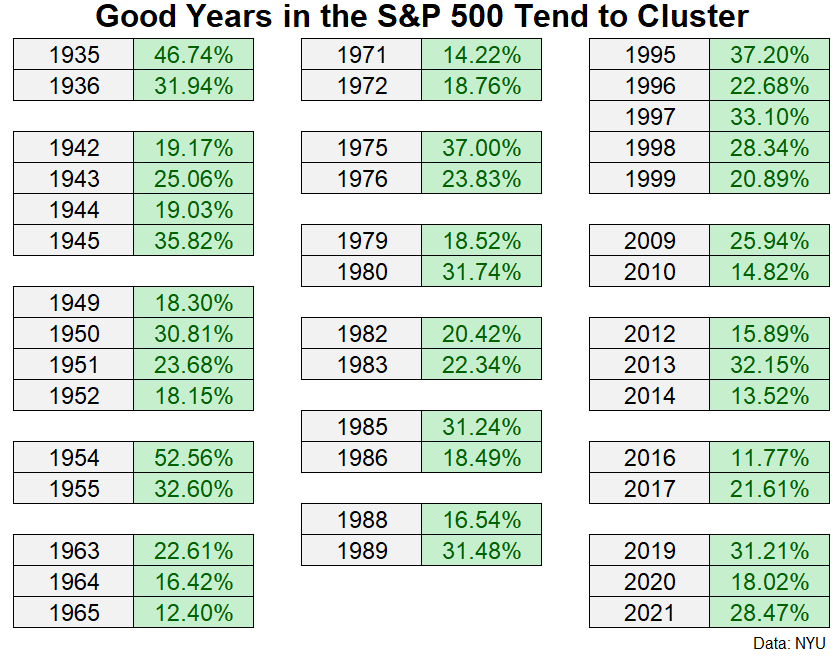
Historical studies of the S&P 500 show that after years when stocks rise more than 20%, the following year has often been positive. In some datasets, average returns after strong years have been close to or even above normal long-term averages. That surprises many investors because human intuition expects balance: big gain, then big pain. But markets are driven by changing fundamentals and expectations, not a neat calendar-based refund policy.
However, “not automatically bad” does not mean “risk-free.” After a strong year, stocks may trade at higher valuations. Investor positioning may become crowded. A small disappointment in earnings, inflation, or Federal Reserve policy can cause a sharp pullback. The market may still have a good long-term outlook while becoming more sensitive to bad news in the short term.
What Usually Comes After a Good Year?
There are several common outcomes after a strong stock market year. None is guaranteed, but each has appeared often enough to deserve attention.
1. Another Positive Year
Momentum can persist. Bull markets often last longer than nervous investors expect. When corporate earnings are growing, consumers are spending, credit markets are functioning, and inflation is manageable, stocks can continue rising even after a big year. This is especially true when the previous rally was supported by real profit growth rather than pure speculation.
For example, the 1990s included multiple strong years as productivity growth, technology adoption, and expanding corporate profits pushed stocks higher. More recently, the market has seen powerful rallies driven by earnings resilience, artificial intelligence investment, and large technology companies producing enormous cash flow. A good year can be the middle of a bull market, not necessarily the end of one.
2. A Choppy Year With Big Pullbacks
Another common outcome is volatility. Stocks may rise over the full year but take investors on a rough ride along the way. This is the market’s version of saying, “You may arrive at the destination, but I will make you question your life choices during the trip.”
Historically, the S&P 500 has experienced average intra-year declines in the low-to-mid teens, even though many of those years still ended positive. That means a 10% correction after a strong year is not unusual. It can feel alarming in real time, especially when headlines use words like “rout,” “turmoil,” and “plunge,” but corrections are part of normal market behavior.
3. Sector Rotation
After a good year, leadership often changes. The stocks that drove the last rally may not lead the next one. Investors may rotate from expensive growth stocks into value stocks, from technology into financials, from large-cap names into small-cap stocks, or from U.S. equities into international markets.
This is important because a headline index can look calm while the market underneath is changing rapidly. An investor concentrated in last year’s hottest winners may feel pain even if the broader market is stable. Diversification helps because it reduces dependence on one theme, one sector, or one heroic company wearing a cape made of quarterly earnings reports.
4. Lower Future Returns Because Valuations Are Higher
When stock prices rise faster than earnings, valuations expand. A higher price-to-earnings ratio does not guarantee a crash, but it can reduce the margin of safety. Investors are paying more for each dollar of corporate profits, which means future returns may depend heavily on continued earnings growth.
This is why analysts often become more cautious after a major rally. They are not always predicting disaster. They are saying the easy money may be gone. If the market already reflects a lot of optimism, companies must deliver strong results to justify those prices. When expectations are high, “pretty good” earnings can sometimes be treated like bad news.
5. A Bear Market, Though Not Simply Because the Prior Year Was Good
Sometimes a strong year is followed by a painful decline. Bear markets can happen after optimism becomes excessive, inflation accelerates, interest rates rise, credit conditions tighten, or the economy moves toward recession. But the cause is usually not the previous year’s gain by itself. The cause is a change in fundamentals, liquidity, earnings, or investor confidence.
For long-term investors, the lesson is clear: do not ignore risk after a good year, but do not assume risk means immediate doom. The market can be expensive and still rise. It can look attractive and still fall. Investing would be much easier if valuation alone rang a little bell. Sadly, the bell is usually on vacation.
Key Factors to Watch After a Strong Stock Market Year
Instead of asking, “Was last year too good?” investors may get better answers by asking what is changing now. The following factors often matter most after a strong rally.
Corporate Earnings
Stock prices ultimately need earnings support. If companies are growing revenue, expanding margins, and issuing confident guidance, the market can absorb higher valuations more easily. If earnings growth slows while prices remain high, stocks become more vulnerable.
After a good year, pay attention to whether earnings growth is broadening or narrowing. A rally led by many sectors is usually healthier than one carried by a handful of mega-cap stocks. Narrow leadership can continue for a while, but it increases concentration risk.
Interest Rates
Interest rates matter because they influence borrowing costs, consumer spending, business investment, and how investors value future profits. Growth stocks are especially sensitive to interest rates because much of their expected value comes from earnings far in the future.
If rates fall because inflation is cooling and the economy remains stable, stocks may benefit. If rates rise because inflation is sticky or bond investors demand higher yields, valuations can come under pressure. After a strong market year, interest-rate surprises can create sudden volatility.
Inflation
Moderate inflation can be manageable for stocks, especially when companies have pricing power. But persistent inflation can squeeze consumers, pressure profit margins, and keep central banks cautious. Investors should watch whether inflation is falling, stuck, or reaccelerating.
The market does not need perfect inflation data, but it does need confidence that inflation will not force a major policy shock. After a rally, even a small inflation scare can make investors rethink optimistic assumptions.
Market Concentration
Recent U.S. market performance has often been heavily influenced by a small group of very large technology and artificial intelligence-related companies. These businesses may be excellent, profitable, and innovative. But when a few names dominate index returns, the market becomes more dependent on their continued success.
Concentration is not automatically bad. The largest companies can remain large for good reasons. Still, investors should know what they own. A broad index fund may feel diversified, but if the top holdings represent a large share of the portfolio, performance can be more concentrated than expected.
Investor Sentiment
Sentiment often swings from fear to greed after a good year. This does not mean investors should sell every time optimism rises. Bullish sentiment can stay elevated during long bull markets. But extreme confidence can make markets fragile. When everyone expects perfection, disappointment does not need to be huge to hurt prices.
A practical test is simple: if your investment plan suddenly depends on everything going right, your plan may need a seatbelt.
What Smart Investors Often Do After a Good Year
A strong market year is a useful time to review your portfolio, not panic-sell it. The goal is not to predict next year perfectly. The goal is to make sure your investments still match your time horizon, risk tolerance, and financial needs.
Rebalance the Portfolio
After stocks rise sharply, they may become a larger percentage of your portfolio than intended. For example, a 70% stock and 30% bond allocation might drift toward 78% stocks after a big rally. That may be fine if your risk tolerance has increased, but dangerous if it happened accidentally.
Rebalancing means bringing the portfolio back toward its target allocation. This may involve trimming assets that have grown too large and adding to areas that lagged. It is not glamorous. Nobody makes action movies about rebalancing. But it is one of the most practical risk-management tools investors have.
Review Cash Needs
If you need money in the next one to three years, it probably should not depend heavily on stocks. A good year is an opportunity to raise cash for near-term goals, such as tuition, a home purchase, taxes, emergency savings, or retirement withdrawals.
This is not market timing. It is matching assets to time horizon. Money needed soon deserves stability. Money invested for decades can tolerate more volatility.
Check for Overconcentration
Strong years can create accidental concentration. One stock, sector, or theme may become too large simply because it performed well. This is especially common with employer stock, technology stocks, or hot thematic funds.
Ask yourself: if this one holding fell 30%, would my financial plan still be okay? If the answer is “I would need to lie down on the kitchen floor,” the position may be too large.
Avoid Performance Chasing
One of the most tempting mistakes after a good year is buying whatever just performed best. Investors often chase last year’s winners right when expectations are already high. This can lead to buying expensive assets and selling boring ones just before leadership changes.
Past performance can be useful context, but it is not a treasure map. A fund, stock, or sector that had a great year may continue winningor it may spend the next year reminding investors that gravity remains undefeated.
Keep Investing If the Plan Still Makes Sense
Long-term investors do not need to stop investing just because the market rose. Dollar-cost averaging through retirement plans, index funds, and diversified portfolios can still make sense after a strong year. Waiting for the “perfect pullback” can sound smart, but markets often move higher while investors sit in cash rehearsing their dramatic comeback speech.
The better question is not “Is the market high?” but “Am I investing according to a plan I can stick with in both good and bad markets?”
Examples of What Can Happen After a Great Year
Consider two simplified examples.
Investor A sees a 25% market gain and decides stocks are too expensive. They sell everything and wait for a crash. The market dips 7%, then rises another 15%. Investor A now faces the painful choice of buying back at higher prices or staying out longer. Their decision was based on fear, not a plan.
Investor B also sees the 25% gain. They rebalance, refill their emergency fund, trim an oversized tech position, and continue monthly contributions. If stocks rise, they participate. If stocks fall, they have dry powder and emotional stability. Investor B does not need to be a fortune teller. They only need to be organized.
The difference is not intelligence. It is process. After a good year, process beats prediction.
Common Mistakes Investors Make After a Good Year
The first mistake is assuming the next year must be bad. This can lead to sitting in cash too long. The second mistake is assuming the next year must be just as good. This can lead to excessive risk. The third mistake is confusing a strong market with personal genius. A rising market can make almost everyone feel like Warren Buffett with better Wi-Fi.
Another mistake is ignoring taxes. Selling winners in taxable accounts can create capital gains. Sometimes trimming risk is worth the tax cost, but investors should think carefully before making large taxable moves. Tax-loss harvesting, charitable giving, and asset location may all matter depending on the situation.
Finally, investors often forget that volatility is normal. A good year does not cancel future pullbacks. A pullback does not cancel long-term growth. Both can be true at the same time.
So, What Comes Next?
After a good year in the stock market, what comes next is usually a test of discipline. The market may reward patience with more gains. It may test patience with corrections. It may rotate away from the stocks everyone loves. It may move sideways long enough to bore investors into making unnecessary trades.
The most reasonable expectation is not a specific forecast, but a range of possibilities. Stocks have historically produced attractive long-term returns, but those returns come with uncertainty. After a strong year, the wise move is to respect both sides of that truth: stay invested enough to benefit from long-term growth, but diversified enough to survive disappointment.
Investors do not need to know whether next year will be wonderful, weird, or mildly rude. They need a plan that works under more than one scenario.
Additional Experiences and Practical Lessons After a Good Market Year
One of the most useful experiences investors have after a strong market year is learning how success changes behavior. When a portfolio rises quickly, people often become less careful. They check account balances more often, talk more confidently, and begin to believe they have discovered a special talent. The market has a way of encouraging this. It hands out gains first and teaches humility later.
A common real-world experience is the “I should have invested more” feeling. After a big year, investors look backward and imagine the larger profits they could have earned. This regret can push them to take bigger risks at exactly the wrong time. Someone who invested $5,000 and made a strong return may suddenly want to invest $50,000 into the same hot area. The problem is that the original opportunity may no longer offer the same risk-reward balance.
Another familiar experience is family-and-friend market excitement. In good years, investing becomes a social topic. People share screenshots, debate stock picks, and talk about companies they barely understood six months earlier. This can be fun, but it can also be dangerous. Social enthusiasm often peaks after prices have already risen. If your investment thesis begins with “Everyone online says,” it may be time to slow down and drink water.
Investors also experience the challenge of doing nothing. After a strong year, doing nothing can feel irresponsible. Surely, one must sell, buy, hedge, rotate, optimize, upgrade, downgrade, or at least open a spreadsheet with dramatic colors. Yet many long-term investors benefit from thoughtful inactivity. If the portfolio is diversified, costs are low, and the allocation still fits the plan, the best move may be minor maintenance rather than major surgery.
Retirees and near-retirees often face a different experience. A strong year can create relief, especially after a previous downturn. But it can also create temptation to increase spending too quickly. For retirees, a good market year is an excellent time to review withdrawal rates, refill cash reserves, and reduce sequence-of-returns risk. The goal is not to celebrate by pretending future bear markets have been outlawed. They have not. They are merely waiting somewhere offstage, probably wearing sunglasses.
Younger investors have another lesson: a good year is evidence that staying invested can work, but it is not proof that investing is easy. The early years of investing are about building habits. Automated contributions, diversified funds, and emotional control matter more than guessing next quarter’s winners. A young investor who learns discipline during good times may be better prepared when the market eventually turns difficult.
Business owners and high-income professionals may experience portfolio drift after a rally. Their taxable accounts may become heavily weighted toward equities, while their human capitaltheir career or business incomeis also tied to the economy. After a strong market year, they may need to consider whether their total financial life has become too dependent on continued growth. This is where cash management, insurance, debt reduction, and diversification outside a single business or sector become important.
Perhaps the most valuable experience is realizing that confidence should come from preparation, not prediction. Investors who prepare for multiple outcomes feel less pressure to know the future. They can say, “If stocks rise, I participate. If stocks fall, I rebalance. If my goals change, I adjust.” That mindset is far stronger than trying to guess whether the next year will be green or red.
A good year in the stock market is a gift, but it is also a mirror. It shows whether your plan is real or whether your risk tolerance only exists when prices go up. The best investors use strong years to strengthen their foundation. They review, rebalance, diversify, and keep perspective. They enjoy the gains without assuming the market owes them more. That may not sound exciting, but in investing, boring habits often beat exciting mistakes.
Conclusion
What comes after a good year in the stock market? Sometimes more gains. Sometimes volatility. Sometimes a correction. Sometimes a leadership change that makes last year’s winners look tired and last year’s laggards look surprisingly awake. The future is uncertain, but uncertainty is not a reason to abandon a sound investment plan.
The most important lesson is that a strong year should trigger review, not panic. Rebalance if your allocation drifted. Reduce concentration if one position became too large. Keep cash for short-term needs. Continue investing for long-term goals. Avoid chasing whatever already went up the most. And remember that the market’s job is not to make investors comfortable; it is to reward patience unevenly over time.
Note: This article is for educational purposes only and should not be considered personalized financial advice. Investors should consider their own goals, risk tolerance, time horizon, and tax situation before making investment decisions.












