
You open an inherited drawer and discover a silver claw with a spring-loaded handle. You walk along a beach and spot a smooth piece of bone punctured by neat little holes. You look up from your hospital parking space and notice a shower standing outdoors for no apparent reason. Naturally, three explanations enter your mind: forgotten kitchen utensil, ancient ritual device, or alien technology with disappointing battery life.
Fortunately, mysterious objects no longer have to remain mysterious. Online object-identification communities bring together archaeologists, engineers, mechanics, collectors, historians, farmers, technicians, and enthusiastic people who have apparently memorized every page of every instruction manual ever printed. Communities devoted to identifying strange objects encourage clear photographs, measurements, useful context, civil discussion, and a final “Solved!” when the answer is confirmed.
The best explanations do more than attach a name to an unfamiliar item. They reveal how people cooked, worked, traveled, communicated, cleaned, harvested food, practiced traditions, and solved everyday problems before our current collection of apps began demanding software updates.
Why Unidentified Objects Fascinate Us
A mysterious object creates a compact detective story. The physical evidence is already present, but the instructions have vanished. A curved edge suggests leverage. Repeated scratches indicate motion. Grease may point toward machinery, while soot suggests heat. Tiny holes might have held bristles, drained liquid, admitted air, or accommodated fasteners.
Museum professionals use many of the same clues as internet detectives. They examine materials, dimensions, wear patterns, decorations, maker’s marks, patent numbers, labels, moving parts, and the location where an artifact was found. Historical photographs, collection databases, catalogs, patents, and family records may then confirm the hypothesis.
Crowdsourcing works because knowledge is scattered. One person recognizes an agricultural tool from a grandparent’s barn. Another has serviced the same industrial component for 30 years. A third remembers seeing it in a museum. National institutions use similar public participation to improve descriptions, tags, transcriptions, and access to archival collections.
50 Mysterious Objects the Internet Identified
Forgotten Household and Kitchen Objects
- A bone strip covered with small holes: It was part of a Victorian toothbrush. The holes once held bundles of natural bristles, turning a beach find into a reminder that dental care used to look considerably more adventurous.
- A ceramic dish with three upright tubes: Rather than an unusually complicated ashtray, it was an ikebana container designed to support flowers in a Japanese-style arrangement.
- Tongs with a wire basket attached: This was a handheld colander used to lift fried food from hot oil while allowing the excess oil to drain away.
- A tiny blunt metal axe in a candy package: It was a confectionery hammer for breaking peppermint bark, toffee, or another sweet determined to fight back.
- A heavy clear slab shaped like a flattened dome: It was a page magnifier. Placed directly over a book, it enlarges several lines without requiring the reader to hold a traditional magnifying glass.
- A white plastic wand with little hands at both ends: This cheerful object was a cocktail swizzle stick or muddler, not an exercise bar for a very small ghost.
- A short wire with loops at both ends: It was a simple cheese-cutting wire. Pulling the wire through soft cheese produces cleaner slices than attacking it with a butter knife.
- A side table with a large hollow compartment: It was a telephone table. The cavity stored the phone book, an enormous paper ancestor of the contacts app.
- A recessed cubby built into a mid-century kitchen wall: This was a telephone niche, positioned so the household phone had a permanent and highly visible headquarters.
- Decorative glass bars found at a yard sale: They were knife rests, placed beneath used table knives to keep blades and food residue off the tablecloth.
These examples show why context matters. A mystery object found near a dining room, stove, sewing cabinet, or old telephone outlet provides a much stronger clue than a tightly cropped photograph floating in a context-free void.
Tools, Fittings, and Industrial Contraptions
- A silver hook with an ornate handle: It was a boot button hook. The hook pulled tiny buttons through tightly fitted buttonholes on fashionable boots and gloves.
- Small spring-loaded silver pincers: These were sugar-cube tongs, designed for serving individual cubes without encouraging every guest to rummage through the sugar bowl.
- A geared machine mounted beside a fireplace: It was a clockwork spit turner that rotated roasting meat automatically in front of the fire.
- A round metal device discovered in a commercial kitchen: It was a hamburger press, used to form patties with consistent thickness and shape.
- A deep wall-mounted sink positioned unusually low: This was a butler’s or cleaner’s sink, useful for filling buckets and disposing of dirty cleaning water.
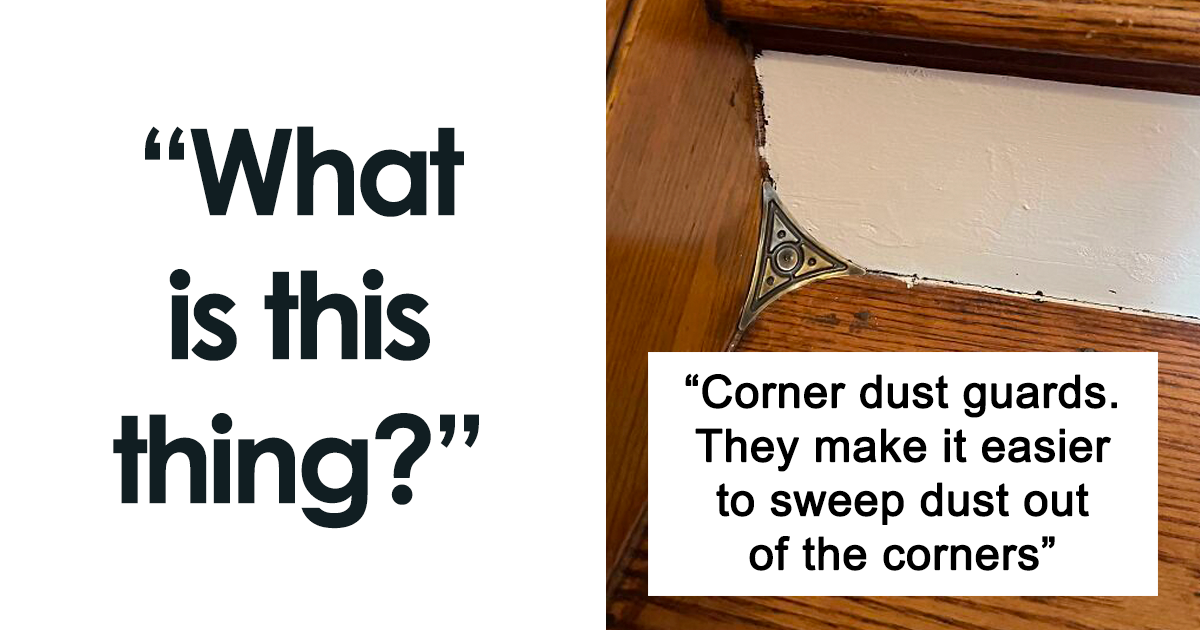
- Metal triangles fitted into stair corners: They were dust guards. Their curved surfaces made it easier to sweep debris out of corners where a broom would otherwise surrender.
- A long wooden fork with several prongs: It was a wash stick or laundry fork, used to lift, stir, or remove clothing from hot wash water.
- Heavy pincers with broad gripping jaws: They were clinker tongs, intended for removing fused ash and unwanted debris from a coal-burning stove or furnace.
- A circular dial marked with commands such as “Slow” and “Full”: It was an engine order telegraph. Ship officers used it to communicate desired engine settings to the engine room.
- A metal fitting filled with glass spheres: It was an early reflector. The glass elements returned light toward its source, improving the nighttime visibility of signs, vehicles, or railway equipment.
Historical tools frequently become unrecognizable after the activity they supported disappears. Smithsonian collections include specialized domestic tools, laundry equipment, heating implements, personal-care kits, and trade tools that can look wonderfully absurd without their original setting.
Outdoor Finds and Natural Oddities
- A dark triangular fragment found on a South Carolina beach: It was a broken megalodon tooth. Even an incomplete specimen can retain the fossil shark tooth’s recognizable shape and cutting edge.
- A branching pattern inside a rock: It was a fossilized plant or tree impression rather than a modern root somehow trapped inside solid stone.
- Delicate ribbons of ice growing from a plant stem: These were frost flowers, created when moisture moves through plant tissue and freezes into thin curling sheets.
- White fuzzy shapes covering spiders in a basement: The spiders had been colonized by fungus. This is one discovery best admired from several respectful steps away.
- Small islands of dry sand floating on calm water: Surface tension temporarily supported the grains after a rising tide reached very dry shoreline sand.
- A block filled with narrow tubes attached to a fence: It was a nesting house for solitary bees, often called a mason bee house or insect hotel.
- Large nets rolled beneath hillside trees: They were harvesting nets. Workers spread them under olive or fruit trees to catch produce efficiently.
- A dark leathery pouch with hornlike corners found near the ocean: It was likely a skate or shark egg case, popularly nicknamed a mermaid’s purse.
- A fenced metal structure standing alone in the mountains: It was a precipitation gauge, protected from animals and interference while recording rain or snow.
- A gigantic terraced hole with a spiral track: It was an open-pit mine. The apparent spiral was a haul road allowing heavy trucks to travel between the bottom and the surface.
Photographs can narrow possibilities, but they are not always enough for reliable geological or biological identification. The U.S. Geological Survey notes that many rocks and minerals require examination from several angles and may need physical tests. NOAA similarly recommends clear photographs, measurements, location details, and caution when documenting unfamiliar marine debris.
Architecture, Technology, and Public-Safety Equipment
- A freestanding outdoor shower at a hospital or laboratory: It was an emergency drench shower for rapidly washing corrosive or hazardous material from a person’s body.
- A tiny USB adapter that seems to do nothing: It was a USB data blocker. It connects the charging pins while preventing data transfer through an unfamiliar port.
- A labeled blue disk discovered inside packaged food: It was a test piece used to verify that a factory’s metal-detection equipment could detect ferrous contamination.
- A small white robot sitting in a classroom: It was a telepresence device allowing a student with a long-term illness to participate remotely in lessons and social activities.
- Rubbery tape that refuses to stick to anything: It was self-fusing silicone tape. It bonds to itself when stretched and wrapped, forming a sealed layer around hoses, cables, or electrical connections.
- A truck covered with an array of antennas: It was likely radio-direction-finding equipment used to estimate the direction from which a radio signal originates.
- A metal box and lever hidden inside a sewing cabinet: It was a knee-operated speed control for a sewing machine, allowing the operator to regulate power without a floor pedal.
- A huge composite cylinder washed ashore: Investigators identified it as a separated rocket-stage component by comparing its construction, attachment points, and cable-routing features.
- A gate secured by a chain of interconnected padlocks: The arrangement allowed several authorized users to open the gate with different keys. Any one lock could release the chain without everyone sharing a single key.
- A sealed glass container filled with liquid in an old barn: It was an antique fire extinguisher or “fire grenade,” intended to be thrown or broken near a fire.
Unknown equipment should be photographed before it is operated, opened, plugged in, shaken, or enthusiastically struck with a hammer. Model numbers, serial numbers, manufacturer labels, patent markings, and date codes can be checked against patent records and product-recall databases.
Cultural Objects and Delightfully Specific Gadgets
- A pocket watch with a strange dial and lever: It was a concealed pocket roulette wheel, disguised to resemble a timepiece when not in use.
- Two chiming metal balls carried together: They were Baoding balls, rotated in one hand for coordination, relaxation, or meditative exercise.
- A small plastic elephant filled with water: It was a reusable ice cube that had melted. Once frozen, it cooled drinks without diluting them.
- A tiny handmade figure kept near a bed: It was a worry doll, associated with the tradition of telling the doll one’s worries before placing it beneath a pillow.
- A small heavy metal figure found in Europe: It was identified as a medieval pilgrim badge, a souvenir or devotional object associated with a pilgrimage site.
- A miniature vessel with a perforated removable top: It represented a hookah or narghile, although its size and construction suggested decoration rather than practical use.
- A long pipe with an unfamiliar bowl: It was an opium pipe. Its specialized form differed from pipes designed for ordinary tobacco.
- A weighted office object with a narrow opening: It was a paperclip dispenser, proving that office supplies once received the kind of engineering now reserved for spacecraft.
- A flat wooden or metal disk covered with rotating numbers: It was a perpetual calendar, mechanically aligned to display dates for different months and years.
- A pen containing loose numbered balls: It was a lottery-selection pen. Shaking and tilting it moved random balls into viewing windows, producing a set of numbers.
The charming lesson is that “weird” often means “specialized.” An object can appear nonsensical when separated from its profession, ceremony, technology, or era. Once the missing context returns, its design frequently becomes remarkably logical.
How to Get an Accurate Object Identification Online
Photograph More Than the Interesting Side
Provide sharp images of the front, back, sides, underside, openings, joints, labels, and damaged areas. Place a ruler or familiar object beside the mystery item for scale. A coin can help, although international audiences may then begin a second investigation titled “What currency is this?”
Describe Materials and Movement
Say whether the object is magnetic, flexible, hollow, sharp, heavy, transparent, ceramic, wooden, rubbery, or metallic. Explain which parts rotate, slide, compress, lock, or detach. Do not force a stuck mechanism merely to make the post more exciting.
Record Every Marking
Search manufacturer names, patent numbers, logos, dates, model codes, military markings, and abbreviations exactly as written. Even a partial number may lead to an old catalog, patent drawing, archived advertisement, or museum record.
Include the Discovery Context
Where was it found? An attic, hospital, ship, farm, beach, laboratory, theater, workshop, or kitchen can eliminate hundreds of bad guesses. Note nearby equipment and the approximate age of the building.
Verify the Winning Answer
A confident comment is not automatically a correct comment. Compare the proposed identification with museum records, manuals, patents, historical photographs, manufacturer documentation, and multiple independent examples. The satisfying answer is not merely plausible; it explains the object’s shape, materials, wear, location, and mechanism.
Safety Comes Before Curiosity
Do not touch, taste, sniff, open, burn, plug in, dismantle, or transport an unknown item that could contain chemicals, medication, biological material, pressurized gas, electricity, radiation, ammunition, or explosives. Unknown containers should remain undisturbed, while suspected military munitions should be treated according to the “recognize, retreat, report” principle. Suspicious packages should not be moved or handled.
Beach debris may be sharp, contaminated, entangled, or hazardous. Unidentified fumes can also cause irritation, dizziness, breathing difficulty, or more severe symptoms. Curiosity is admirable; inhaling mystery vapor from Grandpa’s shed is not the recommended research method.
The Experience of Solving a Mystery Object
A typical mystery-object experience begins with complete confidence in an incorrect answer. Imagine finding a palm-sized brass tool in a kitchen drawer. It has a narrow hook at one end, a decorative handle, and enough tarnish to qualify for its own historical documentary. Someone declares that it is a miniature fireplace poker. Another person suggests a medical instrument, because every unknown metal object apparently looks medical when photographed under bad lighting.
The first useful step is resisting the urge to polish it. Dirt, residue, scratches, and discoloration may show how the object was used. Cleaning can erase maker’s marks or remove material that helps establish age. Instead, the finder photographs the tool from several angles, adds a ruler, and records the exact location: a drawer containing sewing supplies, old buttons, and glove fasteners.
That context changes everything. The object is no longer merely “a brass hook.” It belongs to a cluster of clothing-related items. Once the photographs are posted, the early guesses arrive quickly. A crochet tool? A shoehorn for mice? A device for removing hot stove lids? The jokes are entertaining, but the strongest response comes from someone who recognizes a Victorian button hook.
The suggested answer fits the evidence. The hook is narrow enough to pass through a buttonhole. Its curve can catch a button shank. The handle provides leverage when pulling the button through stiff leather. Comparable examples appear in museum collections, antique catalogs, and historical photographs. What initially resembled an impractical ornament suddenly becomes elegant engineering.
This moment is the real reward of object identification. The item has not physically changed, yet the viewer sees it differently. Its odd shape becomes purposeful. Wear on the handle indicates repeated gripping. Tiny scratches near the hook reveal contact with buttons and leather. The drawer where it was found stops being random storage and becomes supporting evidence.
The experience can also recover family history. A specialized tool may indicate that someone sewed professionally, maintained machinery, served aboard a ship, worked on a railway, practiced a craft, or followed a cultural tradition. Asking older relatives about the object may produce stories that no database contains. The final identification can therefore be both technical and personal.
There is also pleasure in watching strangers collaborate without demanding a grand reward. One person notices a logo. Another translates an inscription. Someone locates a patent diagram, while another uploads a photograph of the same device still installed in a working building. The answer emerges from many small observations rather than a single dramatic revelation.
Occasionally, the crowd gets it wrong. A piece of industrial slag becomes a “meteorite.” A decorative replica becomes a “medieval weapon.” A natural formation becomes evidence of a lost civilization with suspiciously modern drilling equipment. Good solvers welcome correction. They distinguish between “solved,” “likely solved,” and “this is an exciting guess delivered with theatrical confidence.”
After confirmation, the best finders preserve the result. They label the object, save the supporting information, and leave the original discussion available for future searchers. Years later, another person may discover an identical tool and find the archived explanation in seconds. One solved mystery becomes part of a growing public reference library.
That is why these stories remain compelling. They transform confusion into knowledge without removing the sense of wonder. The internet may reveal that the strange brass claw is only a button hook, but “only” is the wrong word. It is a surviving solution to a forgotten everyday problemand a tiny mechanical postcard from another time.
Conclusion
Mysterious objects remind us that ordinary life changes faster than physical objects disappear. Tools outlive trades, fittings remain after buildings are renovated, and household gadgets survive long after their instructions have been thrown away. What seems bizarre today may once have been as familiar as a bottle opener.
The next time you discover an unidentified object, document it carefully, study its materials and wear, search its markings, and provide meaningful context. Then invite the internet’s mechanics, collectors, scientists, curators, and professional noticers to investigate. The answer may be mundane, historically important, unexpectedly clever, or all three at once.
Editorial note: This original article synthesizes documented object-identification examples with guidance from museum, archive, patent, geology, marine-debris, product-safety, environmental-safety, occupational-safety, poison-control, and public-safety resources. Identifications involving hazardous, biological, geological, or potentially explosive materials should be confirmed by qualified local professionals.














