
Bear markets have a charming way of turning confident investors into amateur meteorologists. Everyone starts watching charts, predicting storms, and wondering whether the financial umbrella they bought is actually a decorative cocktail umbrella.
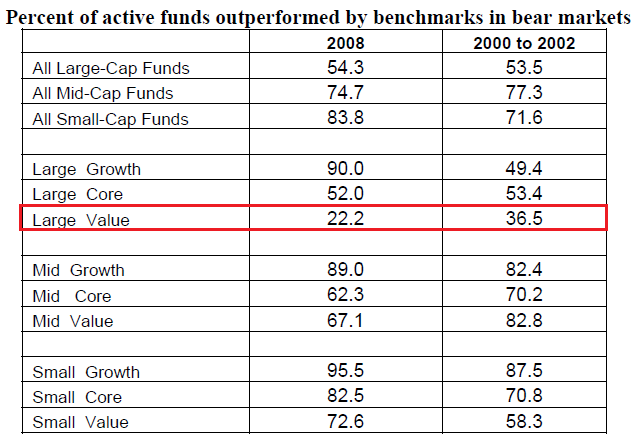
A bear market is commonly defined as a decline of at least 20% from a recent market peak. During these periods, actively managed funds are often promoted as a safer alternative to passive index funds because professional managers can hold cash, avoid troubled companies, emphasize defensive sectors, or hedge part of the portfolio. Those advantages sound impressive, but the evidence delivers a less cinematic answer: active management sometimes performs better during market declines, yet the average active fund does not automatically become a bear-market hero.
The active funds most likely to outperform during bear markets tend to share specific characteristics rather than a magical label. They usually emphasize quality, valuation discipline, low volatility, flexible asset allocation, reliable income, or explicit hedging. Just as important, they charge reasonable fees and follow a strategy that the management team has used through more than one market cycle.
Does Active Management Really Work Better in Bear Markets?
Active managers have more freedom than index funds. They can reduce exposure to overvalued companies, favor businesses with strong balance sheets, increase cash, adjust bond duration, or use derivatives to manage risk. An index fund generally continues holding the securities required by its benchmark, even when some of those holdings appear vulnerable.
However, flexibility is only useful when the manager makes the right decisions. A manager can sell an expensive stock before it collapsesor sell it one week before it rebounds 40%. Active management provides more steering controls, but it does not guarantee that the driver knows where the road is going.
Morningstar research published in 2025 found that active stock funds succeeded more frequently when their benchmarks were declining. Over rolling 36-month periods, active funds outperformed in approximately 51% of periods when their benchmarks lost money, compared with roughly 38% when benchmarks gained. That is an improvement, but it is hardly an unbeatable record. The findings suggest that bear markets modestly improve the odds for active managers rather than transforming the entire industry into Warren Buffett wearing a cape.
The broader long-term statistics remain sobering. Morningstar reported that only 21% of active strategies both survived and beat their passive counterparts over the 10 years through December 2025. In 2025 alone, 38% of active funds survived and outperformed their average passive peer. S&P Dow Jones Indices also found that 79% of active U.S. large-cap funds underperformed the S&P 500 in 2025, while its persistence research showed that maintaining top-tier results over several years remained extremely difficult.
The practical lesson is simple: investors should not ask whether active funds collectively outperform in bear markets. A more useful question is which active strategies are structurally designed to lose less.
Active Fund Categories That Can Hold Up Better
1. Low-Volatility and Quality Equity Funds
Low-volatility active funds seek companies whose share prices have historically fluctuated less than the broader market. Quality-oriented funds add another layer by emphasizing durable earnings, manageable debt, high returns on capital, dependable cash flow, and defensible competitive positions.
These characteristics can be valuable during recessions and credit scares. Companies with healthy balance sheets are generally less dependent on refinancing, while stable businesses may continue generating cash even when economic growth slows. Fidelity notes that lower-volatility stocks and investment-grade bonds have historically fallen less during turbulent markets, although they may also produce more muted gains during strong rallies.
Examples of this broad category include actively managed low-volatility equity funds, quality-focused mutual funds, and defensive equity portfolios. Fidelity US Low Volatility Equity Fund and Fidelity Hedged Equity Fund illustrate two different approaches: one emphasizes less-volatile stocks, while the other combines equity exposure with risk-management techniques. These examples are not automatic recommendations; they demonstrate how fund design can prioritize downside control.
When evaluating such a fund, investors should examine whether its low volatility comes from genuine security selection or simply from loading up on utilities, consumer staples, and other traditionally defensive sectors. Excessive sector concentration can create a new risk while attempting to solve the old one.
2. Equity-Income and Dividend-Growth Funds
Dividend-oriented active funds can outperform during some bear markets because mature, cash-generating companies may be more resilient than speculative businesses whose valuations depend on profits expected far in the future. Dividends also provide part of the investor’s total return while share prices are struggling.
The strongest defensive dividend funds generally focus on dividend sustainability rather than the highest available yield. A company yielding 9% is not necessarily a bargain; sometimes the market is politely warning that the dividend is about to fall through a trapdoor.
Managers should therefore study free cash flow, payout ratios, debt maturity schedules, competitive strength, and management’s history of allocating capital. Dividend-growth funds that favor companies capable of increasing distributions may offer a healthier defensive profile than funds that mechanically purchase the market’s highest-yielding stocks.
Value and dividend investing are not identical to downside protection. Capital Group research has pointed out that broad value indexes have sometimes captured more downside than the S&P 500 because inexpensive stocks can include highly leveraged banks, cyclical manufacturers, or companies facing serious business problems. Defensive results depend on quality control, not merely low price-to-earnings ratios.
3. Disciplined Active Value Funds
Active value funds can perform well when a bear market is driven by collapsing valuations in expensive growth stocks. The 2000–2002 technology bust is the classic example: portfolios that avoided profitless technology companies had a major advantage. Value-oriented managers can also buy financially sound businesses after indiscriminate selling creates unusually attractive prices.
Yet value funds are not universally defensive. Dodge & Cox Stock, for example, lost relatively little during the early-2000s bear market but was hit much harder during the 2007–2009 financial crisis, when financial and economically sensitive value stocks were at the center of the damage. The same strategy can look brilliant in one bear market and bruised in another because bear markets have different causes.
A stronger candidate is an active value fund that combines valuation discipline with balance-sheet analysis, low turnover, reasonable diversification, and the willingness to avoid cheap companies whose fundamentals are deteriorating. MFS Value and Royce Small-Cap Special Equity are examples frequently associated with risk-conscious value investing. Morningstar included Royce Small-Cap Special Equity among lower-risk strategies designed to help manage downside, highlighting its emphasis on clean accounting and low valuations.
4. Balanced and Flexible-Allocation Funds
Balanced funds invest across stocks and bonds, often using a structure near 60% equities and 40% fixed income. They may outperform an all-stock benchmark during equity bear markets for the wonderfully uncomplicated reason that they own fewer stocks.
Vanguard Wellington Fund is a traditional example. Its stated approach generally maintains 60% to 70% in stocks and 30% to 40% in bonds, combining value-oriented equities with government and investment-grade corporate debt. This structure aims for long-term growth and income with moderate risk.
Flexible-allocation managers can go further by adjusting stock exposure, bond duration, credit quality, cash levels, or geographic allocations. This flexibility can help when a selloff is accompanied by recession. It can also hurt when managers become too defensive and miss a rapid recovery.
The 2022 bear market showed the limitation of a conventional balanced portfolio: stocks and bonds declined together as inflation surged and interest rates rose. A balanced fund with long-duration bonds may therefore provide less protection during an inflation-driven bear market than during a deflationary recession.
5. Actively Managed High-Quality Bond Funds
Active bond managers can add value by adjusting duration, analyzing credit risk, avoiding vulnerable issuers, and purchasing bonds that appear mispriced. These opportunities are broader in less-liquid markets, where individual securities trade less frequently and index construction can be awkward.
Morningstar’s year-end 2025 Active/Passive Barometer found that active intermediate-core bond managers had a 55% one-year success rate, although active corporate-bond funds performed much worse. Over the 10 years through 2025, fixed-income categories collectively posted stronger active-management success rates than most equity categories.
During an economic recession, funds emphasizing Treasury securities and investment-grade bonds may benefit from falling interest rates and a flight toward quality. During an inflation shock, shorter-duration funds and inflation-protected securities may be more resilient. The important detail is not simply that a fund is actively managed, but which risks the manager is actively taking.
6. Hedged-Equity, Market-Neutral, and Alternative Funds
Some active funds are specifically built to reduce market sensitivity. Hedged-equity funds may purchase put options, use collars, or reduce net stock exposure. Market-neutral funds pair long positions in favored stocks with short positions in companies expected to underperform. Managed-futures and global-macro strategies can take positions in currencies, commodities, interest rates, and stock indexes.
These approaches have the greatest theoretical ability to outperform during severe declines because they are not required to remain fully exposed to rising or falling stock prices. J.P. Morgan research notes that global-macro hedge fund strategies produced positive returns during several major downturns, including 2022, when global stocks and bonds both declined. Manager dispersion, however, is wide, making selection especially important.
Alternative mutual funds and liquid-alternative ETFs can make similar strategies available to ordinary investors, but they may carry higher expenses, complicated tax treatment, derivative risks, or disappointing performance during calm markets. The SEC advises investors to study the objectives, risks, liquidity, and fee structures of alternative funds carefully.
7. Options-Income FundsUseful Cushion, Not a Force Field
Actively managed options-income ETFs typically hold stocks while selling options to collect premiums. Those premiums can offset part of a moderate market decline and reduce volatility.
However, covered-call income is not complete downside protection. Schwab notes that options-income funds often perform best in sideways, moderately bullish, or moderately bearish markets. During a sharp crash, option premiums may be too small to offset falling stock prices. The strategy can also cap gains when the market rebounds quickly.
These funds may be useful for investors prioritizing current income, but they should not be confused with guaranteed-buffer products or cash substitutes.
How to Identify a Bear-Market-Ready Active Fund
Investors can improve their selection process by examining evidence that reveals how a fund behaves when markets become unfriendly.
- Downside capture ratio: A ratio below 100 indicates that the fund historically lost less than its benchmark during down periods. For example, a ratio of 80 means the fund captured approximately 80% of the benchmark’s decline.
- Maximum drawdown: This measures the largest peak-to-trough loss. Compare it with both the fund’s benchmark and category peers.
- Upside capture: A defensive fund that loses less but participates in almost none of the recovery may not deliver attractive full-cycle returns.
- Expense ratio: Fees are deducted regardless of whether the manager has a good year, a bad year, or a year spent staring thoughtfully at a spreadsheet.
- Manager tenure: Ideally, the current team should have managed the strategy through at least one significant decline.
- Portfolio construction: Review sector concentration, credit quality, cash holdings, valuation measures, derivatives, turnover, and position sizes.
- Benchmark selection: A conservative allocation fund should not be praised merely for losing less than an all-stock index. Compare funds with appropriate peers.
Vanguard research emphasizes capture ratios, costs, turnover, fund size, and qualitative factors such as the investment team, philosophy, firm, and process. It also cautions that quantitative characteristics explain only part of future relative performance, leaving substantial uncertainty.
Why Costs Matter Even More When Returns Are Weak
Suppose an active fund protects capital well enough to outperform its benchmark by 1% before expenses. If the fund charges an additional 1% annually compared with a low-cost index alternative, the entire advantage may disappear.
The SEC explains that operating expenses are deducted from fund assets and directly reduce investor returns. Active funds have historically carried higher management costs, greater turnover expenses, and potentially less favorable tax consequences than passive funds. FINRA’s Fund Analyzer allows investors to compare how these costs accumulate over different holding periods.
Low cost cannot turn a poor strategy into a good one, but high cost can turn a modestly successful strategy into an unsuccessful investment.
Experience-Based Lessons From Past Bear Markets
Historical downturns repeatedly demonstrate that the cause of the bear market matters more than the label attached to a fund. Investors looking only at a fund’s average downside-capture ratio may miss the underlying exposures that produced it.
During the 2000–2002 technology collapse, disciplined value managers and funds with little exposure to speculative technology often performed relatively well. Their success did not necessarily come from making brilliant short-term trades. In many cases, they simply refused to buy businesses with extreme valuations and unproven earnings. The experience showed that avoiding a bubble can be as valuable as finding the next superstar stock.
The 2007–2009 financial crisis taught the opposite lesson. Some value funds owned banks, insurers, industrial companies, and other economically sensitive stocks that appeared inexpensive before becoming dramatically cheaper. Managers who relied on historical valuations without fully accounting for leverage and liquidity risk suffered large losses. Investors learned that a low price is not a margin of safety when the balance sheet resembles a folding chair at a wrestling match.
The rapid 2020 pandemic decline created another challenge. Defensive managers initially benefited by holding cash, high-quality bonds, health care companies, and stable consumer businesses. Yet the rebound began so quickly that funds remaining heavily defensive could not keep pace. Investors who sold a strategy after its worst relative month risked missing the very recovery that could restore long-term performance.
In 2022, inflation and aggressive interest-rate increases caused both stocks and traditional bonds to decline. Many investors had assumed that bond allocations would automatically protect balanced funds. Instead, long-duration bonds fell sharply alongside growth stocks. Strategies with shorter maturities, floating-rate exposure, energy holdings, value stocks, managed futures, or flexible hedges often fared better. The experience made clear that a fund designed for recession protection may not be prepared for inflation protection.
Another recurring lesson is that investors frequently buy defensive funds after the decline has already occurred. A low-volatility or hedged strategy may look attractive after markets fall, but switching at that point can lock in losses and reduce participation in the rebound. Defensive allocations generally work best when selected as part of a long-term portfolio design rather than as an emergency purchase prompted by alarming headlines.
Manager consistency also matters. A fund may have excellent historical bear-market numbers because a former manager ran a conservative portfolio. If a new team increases concentration, changes the valuation discipline, or uses more derivatives, the old statistics may no longer describe the current strategy. Reading the latest prospectus and shareholder reports is less exciting than reading a list of “top bear-market funds,” but it is considerably more useful.
Finally, the most successful experience is not always owning the fund with the highest return. A strategy that reduces drawdowns may help an investor remain invested instead of panic-selling near the bottom. Fidelity notes that defensive portfolios are intended to create a smoother pattern of returns, potentially making it easier for investors to stay committed through volatile periods. Behavioral durability can be a genuine benefit even when a defensive fund does not beat the market every year.
Conclusion: The Best Active Funds Are Built for Specific Risks
No single type of active fund outperforms during every bear market. Low-volatility and quality funds may help during broad equity selloffs. Dividend-growth and disciplined value funds can perform well when expensive growth stocks collapse. Balanced funds may cushion recession-driven declines, while shorter-duration bond strategies can be more useful during inflation shocks. Hedged-equity, market-neutral, and global-macro funds may provide stronger diversification, but they bring higher costs and greater complexity.
The most dependable selection framework focuses on low expenses, downside capture, maximum drawdown, manager tenure, portfolio quality, reasonable diversification, and a clearly defined investment process. Investors should also determine whether the fund’s historical resilience came from repeatable security selection or from a temporary style advantage.
Active management can improve the odds of losing less, but it cannot eliminate market risk. The goal is not to find a fund that never declines. Such a creature belongs in the same forest as unicorns and economists who correctly predict every recession. The realistic objective is to build a portfolio whose losses remain tolerable enough that the investor can stay invested and participate when the market eventually recovers.
Note: This article is provided for general educational purposes and does not constitute personalized investment, tax, or legal advice. Fund performance, strategies, expenses, holdings, and management teams can change. Past performance does not guarantee future results, and all investments involve the risk of loss.














