
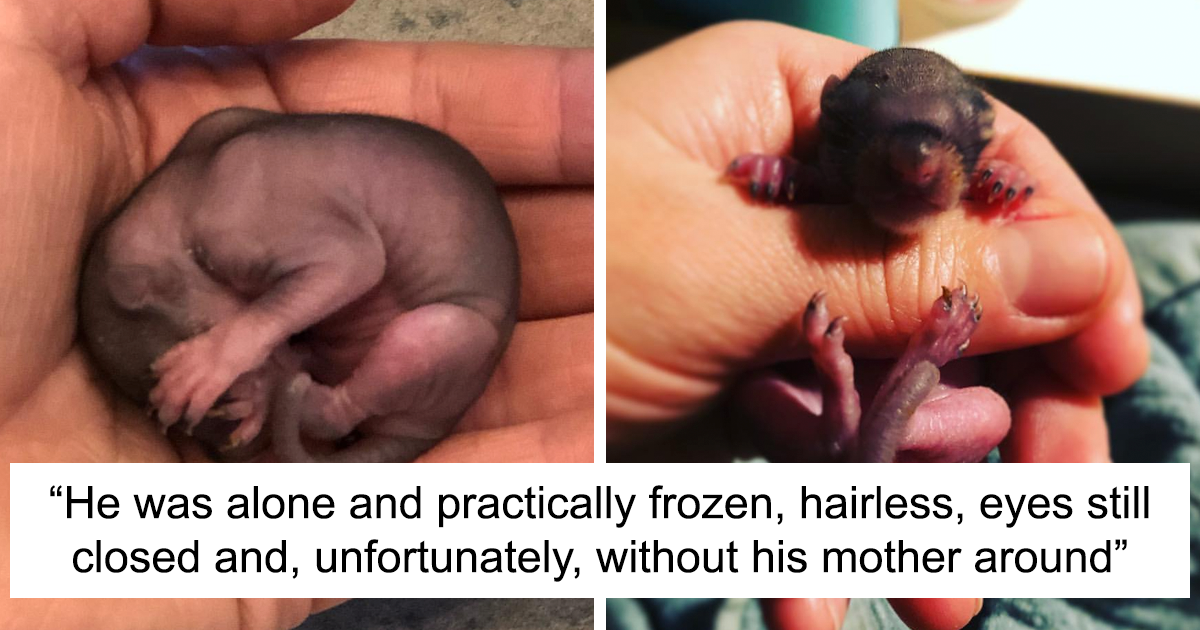
Some rescue stories begin with a dramatic storm, a brave leap, or a movie-worthy soundtrack. This one began with something far quieter: a tiny, helpless baby squirrel lying on a sidewalk, cold, hairless, and alone. He was so small that at first glance, he barely looked like the lively tree acrobat he would one day become. There were no flashing lights, no professional wildlife van waiting around the corner, and definitely no squirrel-sized emergency blanket. There was only a woman named Jessica, a vulnerable animal in trouble, and one very big decision.
That decision changed everything. The baby squirrel, later named Steve, was found in February 2019 with his eyes still closed and signs that he may have fallen from a nest or been dragged out by a predator. He was freezing, fragile, and missing part of his tail. In the wild, a baby squirrel at that stage depends completely on his mother for warmth, food, grooming, and protection. Without help, his chances were close to zero.
Jessica did what many animal lovers would instinctively want to do: she tried to get help. Wildlife rescues are often overwhelmed during “baby season,” when storms, tree trimming, predators, and accidents send young animals tumbling from nests. When immediate professional help was not available, she stepped in to keep Steve alive. What followed was exhausting, messy, surprisingly funny, and deeply emotional. Two years later, the squirrel she rescued still returned to her garden, living proof that sometimes a second chance comes with a bushy tail and an excellent memory for snack locations.
The Day Jessica Found A Tiny Life On The Sidewalk
Finding a baby squirrel on the sidewalk can feel like discovering a secret message from nature, except the message is usually, “Please panic responsibly.” Baby squirrels can fall from nests during strong winds, after tree work, or when a predator disturbs the nest. Sometimes the mother returns for them. Sometimes she cannot. The tricky part is knowing the difference.
In Steve’s case, several warning signs suggested real danger. He was hairless, his eyes were still sealed, and he was extremely cold. A healthy juvenile squirrel with a fluffy tail and strong movement may simply be exploring. But a pink, chilled, weak baby is not ready to handle the world. He cannot regulate his temperature well, cannot find food, and cannot climb back to safety. He is not “independent”; he is basically a bean with a heartbeat.
Jessica later explained that her family was not even completely sure what kind of animal he was at first. That is understandable. Newborn squirrels do not arrive looking like the park comedians we know. They are tiny, wrinkled, nearly naked, and more “mysterious woodland raisin” than “future tree ninja.” Her children were fascinated. Her husband thought she might be a little nuts, which, given the topic, was almost contractually required.
Still, Jessica recognized that this was not a situation where she could simply shrug and keep walking. The baby was cold and vulnerable. His mother was nowhere in sight. He needed warmth, safety, and urgent care. So she brought him inside and began the long, uncertain work of helping him survive.
Why Baby Squirrels Need Careful Help, Not Guesswork
Steve’s story is heartwarming, but it is also important to say this clearly: rescuing wildlife is not the same as adopting a pet. In the United States, laws about keeping or rehabilitating wild animals vary by state, and many areas require licensed wildlife rehabilitators to care for orphaned or injured wildlife. The goal of wildlife rehabilitation is not cuddles forever. The goal is release back to the wild whenever possible.
Wildlife experts generally advise people who find a baby squirrel to keep children and pets away, avoid unnecessary handling, keep the animal warm and quiet if it truly needs help, and contact a licensed wildlife rehabilitator or local wildlife agency. Feeding can be risky when done incorrectly. The wrong food, wrong temperature, or wrong method can cause serious harm. A baby squirrel may look like it needs a tiny buffet immediately, but warmth and professional guidance usually come first.
That is what makes stories like Steve’s both inspiring and complicated. Jessica did not set out to turn a wild animal into a house pet. She was trying to keep a dying baby alive when help was limited. Her care became a bridge between helplessness and independence. The happy ending came not because Steve stayed indoors forever, but because he eventually learned to live outside as a squirrel should.
Meet Steve: The Squirrel With A Big Personality
As Steve grew stronger, his personality began to appear. And apparently, that personality had opinions. Jessica described him as clever, affectionate, playful, and very attached to her. He came when called, enjoyed attention, and developed habits that made him seem almost doglike. Of course, unlike a dog, he also had the ability to climb curtains, stash objects, and make household chaos look adorable.
One of Steve’s funniest quirks was his interest in pens. Many squirrels hide food, leaves, and nesting materials. Steve apparently decided writing instruments were also worth collecting. Somewhere in his small squirrel brain, a pen was not an office supply. It was treasure. Perhaps he was planning a memoir. Possible title: From Sidewalk To Garden: One Squirrel’s Nutty Journey.
He tolerated Jessica’s children but bonded most strongly with her. This is common in human-raised wildlife and one reason experts warn against casual wildlife care. A wild animal that becomes too comfortable around people may struggle later. It may approach strangers, pets, roads, or unsafe spaces. The challenge is to provide enough care to save the animal while still preparing it for the wild.
Jessica seemed to understand that balance. She loved Steve, but she also knew he needed more than affection. He needed climbing practice, outdoor sounds, natural smells, and the chance to become the squirrel he was born to be.
The Slow Road From Shoebox To Trees
Raising an orphaned baby squirrel is not glamorous. Social media may show the cute moments, but behind them are sleepless nights, constant monitoring, cleaning, worry, and the kind of schedule that makes coffee look like a legal requirement. Jessica reportedly kept a timer for feedings and even took Steve to work in a box so she could watch over him. That sounds sweet until you imagine explaining to a coworker, “No, that is not my lunch. That is Steve.”
As he matured, Steve needed more space. A baby animal can be kept safe in a small container for emergency care, but a growing squirrel is built for movement. Squirrels climb, leap, balance, chew, dig, investigate, and occasionally behave as if gravity is merely a suggestion. Keeping one indoors permanently would not meet its natural needs.
Jessica introduced Steve to the outdoors gradually. He explored the backyard, practiced climbing, listened to neighborhood noises, and learned the texture of bark under his feet. These small steps mattered. A squirrel released too suddenly may be unprepared. A squirrel held too long may become too dependent. The sweet spot is careful transition: enough support to build strength, enough freedom to awaken instinct.
Eventually, Steve moved into an outdoor enclosure where he could experience more of the world while still having a safe base. Then came the hardest part: letting go.
The Bittersweet Moment Of Release
Anyone who has cared for an animal knows that love can make release feel impossible. Jessica had watched Steve survive his first night, grow fur, open his eyes, learn to climb, and develop his own squirrel routine. He was not just “a squirrel” anymore. He was Steve, the tiny sidewalk survivor who had turned her schedule upside down and her heart into mush.
But wild animals are not ours to keep simply because we love them. The best rescue stories often end with distance. That is the strange beauty of rehabilitation: success can look like the animal leaving.
When Steve began wanting to spend more time outside, his instincts were speaking loudly. One day, he disappeared. Jessica worried. Had he found food? Could he avoid predators? Did he know where to sleep? Had she done enough? These are the questions every wildlife rehabilitator, rescuer, and soft-hearted human asks when a once-dependent animal steps into the wild.
Then Steve came back.
He returned to the garden looking healthy, confident, and very much alive. That visit was more than cute; it was confirmation. He had not forgotten Jessica, but he had also not failed in the wild. He had become what she hoped he could become: free.
Two Years Later, Steve Still Visits The Garden
Two years after Jessica found him on the sidewalk, Steve was still visiting her garden. He reportedly celebrated birthdays, lived a spoiled outdoor life, and even had a squirrel companion named Jolene. That detail alone deserves a tiny woodland soap opera. “Steve and Jolene: Love Among the Bird Feeders.”
His visits show one of the most touching parts of the story. Steve did not remain trapped between two worlds. He was not a pet in a cage or a helpless animal unable to survive. He was a wild squirrel who chose to stop by a familiar place. The garden became a kind of memory lane with leaves.
Squirrels are known for impressive spatial memory. They bury food in scattered caches and later relocate many of those hidden meals. Their survival depends on remembering trees, routes, smells, and safe spaces. It is not hard to imagine that Steve remembered Jessica’s garden as part of his personal map. To him, it may have been a safe zone, a snack station, or simply the place where his second life began.
What Steve’s Story Teaches About Urban Wildlife
Steve’s journey resonates because squirrels are both familiar and overlooked. In many American neighborhoods, eastern gray squirrels are daily background characters. They race along fences, raid bird feeders, pause dramatically in the middle of sidewalks, and dig holes in lawns with the confidence of tiny contractors. Because they are common, people sometimes forget they are wild animals with complex instincts.
Gray squirrels play an important ecological role. Their habit of burying nuts and seeds helps trees spread when forgotten caches sprout. They are also prey for hawks, owls, foxes, snakes, and other predators. In urban and suburban areas, they adapt to parks, yards, gardens, and tree-lined streets, often nesting in cavities or leafy structures called dreys.
Baby squirrels are usually born in late winter or spring, with some species and regions seeing another wave in late summer. That timing explains why wildlife centers often receive many calls during certain months. After storms or tree trimming, people may suddenly find nestlings on the ground. The right response can save lives, but the wrong response can accidentally make things worse.
How To Respond If You Find A Baby Squirrel
This article is not a do-it-yourself wildlife rehabilitation manual, but readers should know the general principles. First, observe from a safe distance. A young squirrel that is alert, fully furred, mobile, and has a bushy tail may not need help. It may simply be at the age where it is exploring outside the nest.
If the baby is tiny, cold, injured, bleeding, covered with insects, caught by a cat or dog, or lying in danger, help is more urgent. Keep pets and children away. Use gloves or a soft cloth if handling is necessary. Place the baby in a small ventilated box with soft fabric and gentle warmth, then contact a licensed wildlife rehabilitator, humane society, veterinarian, or state wildlife agency for instructions.
Do not assume the animal needs food immediately. Do not offer cow’s milk, random nuts, bread, or water from a dropper without guidance. Baby mammals can aspirate liquid, become chilled, or suffer digestive problems from improper feeding. Good intentions are wonderful; informed action is better.
If the baby appears healthy and the nest location is nearby, professionals may advise trying to reunite it with its mother. Mother squirrels often retrieve babies if given the chance, especially when the baby is warm and placed safely near the original location. Humans may be eager to become heroes, but sometimes the real hero is a mother squirrel who just needed the sidewalk cleared and the family dog moved indoors.
Why The Internet Loves Stories Like Steve’s
Steve’s story has all the ingredients of a viral animal tale: a helpless beginning, a compassionate human, a ridiculous amount of cuteness, and a happy update years later. But beneath the sweetness is a deeper reason people connect with it. It reminds us that small acts matter.
Jessica did not save a forest. She did not launch a national campaign. She saw one tiny creature in front of her and refused to look away. That kind of compassion is powerful because it is accessible. Most people will never run a wildlife center, but many will encounter moments where kindness is possible.
The story also gives readers the emotional payoff we crave: survival. We see a fragile baby become a confident adult. We see care become freedom. We see attachment transform into trust. And yes, we see a squirrel named Steve living his best garden life, which is objectively delightful.
The Funny Side Of Loving A Squirrel
There is something inherently funny about squirrels. They move like they are late for three appointments and forgot where they parked their acorns. They freeze in place as if caught committing tax fraud. They bury snacks with the secrecy of spies, then sometimes forget where they put them, accidentally planting trees like chaotic little gardeners.
Steve seems to have carried that squirrel comedy into Jessica’s life. The pen-stealing, the office visits, the strong preferences about people, the garden drop-insevery detail makes him feel like a character. Not a cartoon character, exactly, but close. The kind of backyard neighbor who never pays rent yet somehow owns the place.
Still, the humor works because the outcome was healthy. Steve was not treated as a toy or accessory. He was cared for, strengthened, and released. The comedy sits on top of respect, which is exactly where animal stories should place it.
Experience-Based Reflections: What This Story Feels Like To Anyone Who Has Helped A Vulnerable Animal
Stories like Jessica and Steve’s stay with people because they mirror a feeling many animal lovers know well: the moment when a small life depends on your next choice. It may be a bird stunned near a window, a kitten crying under a porch, a turtle crossing a road, or a baby squirrel on a sidewalk. In that moment, the world narrows. Errands, emails, and dinner plans suddenly become less important than the breathing creature in front of you.
The first experience is usually uncertainty. Most people want to help, but they are afraid of doing the wrong thing. That fear is healthy. Wild animals are not household pets, and babies are especially delicate. The best rescuers are not the people who rush in with total confidence. They are the people who pause, protect the animal from immediate danger, and seek expert advice. Compassion plus humility is a very good rescue kit.
The second experience is inconvenience. Real care is rarely tidy. It interrupts your schedule. It makes your kitchen look like a supply station. It turns ordinary objectsa towel, a box, a heating pad, a phone callinto emergency tools. Jessica taking Steve to work may sound adorable, but it also shows the practical burden of keeping a fragile animal alive. Rescue is not just a feeling; it is time, patience, and responsibility.
The third experience is attachment. Even when you know an animal belongs in the wild, it is hard not to bond with a creature you have protected. Watching tiny signs of progress can feel enormous. A baby opens its eyes. A weak body grows stronger. A frightened animal relaxes. A climber learns to climb. These milestones may look small from the outside, but to the person caring for that animal, they are fireworks.
The fourth experience is the challenge of letting go. This is where animal rescue becomes emotionally mature. Love wants to keep. Wisdom knows when to release. For wildlife, a happy ending is not always a permanent place in the home. Often, the happy ending is a safe return to trees, soil, wind, and instinct. Jessica’s fear when Steve disappeared was natural. Her joy when he returned was the reward: proof that love had not made him dependent; it had helped him survive.
The final experience is a changed relationship with nature. After helping one small animal, people often notice the living world more closely. The backyard is no longer just grass and fences. It becomes habitat. A tree is not just shade; it might be a nursery. A pile of leaves might shelter insects. A quiet garden may be part of a much larger neighborhood ecosystem. Steve’s visits were not only cute reminders of the past. They were invitations to see the garden as a shared space.
That may be the most valuable lesson in the whole story. We do not have to control wild animals to care about them. We can protect them, learn from them, make safer yards, avoid unnecessary tree trimming during nesting seasons, keep pets supervised, and call professionals when help is needed. We can be neighbors to wildlife without trying to become owners of it.
Conclusion: A Small Squirrel, A Big Second Chance
Jessica’s rescue of Steve the squirrel is more than a cute internet story. It is a reminder that compassion often begins in ordinary places: a sidewalk, a garden, a cardboard box, a worried phone call. Steve’s survival depended on warmth, patience, and care, but his real success was freedom. Two years later, his garden visits showed that he had not only livedhe had thrived.
The best part of the story is not simply that Steve remembered Jessica. It is that Jessica loved him well enough to let him become wild. That is the quiet heroism at the heart of wildlife rescue. Sometimes the most loving thing a person can do is give an animal a second chance, then step back and watch it climb.
Note: This article is written for storytelling and general awareness. Anyone who finds an injured or orphaned wild animal should contact a licensed wildlife rehabilitator, local humane society, veterinarian, or state wildlife agency for location-specific guidance.














