
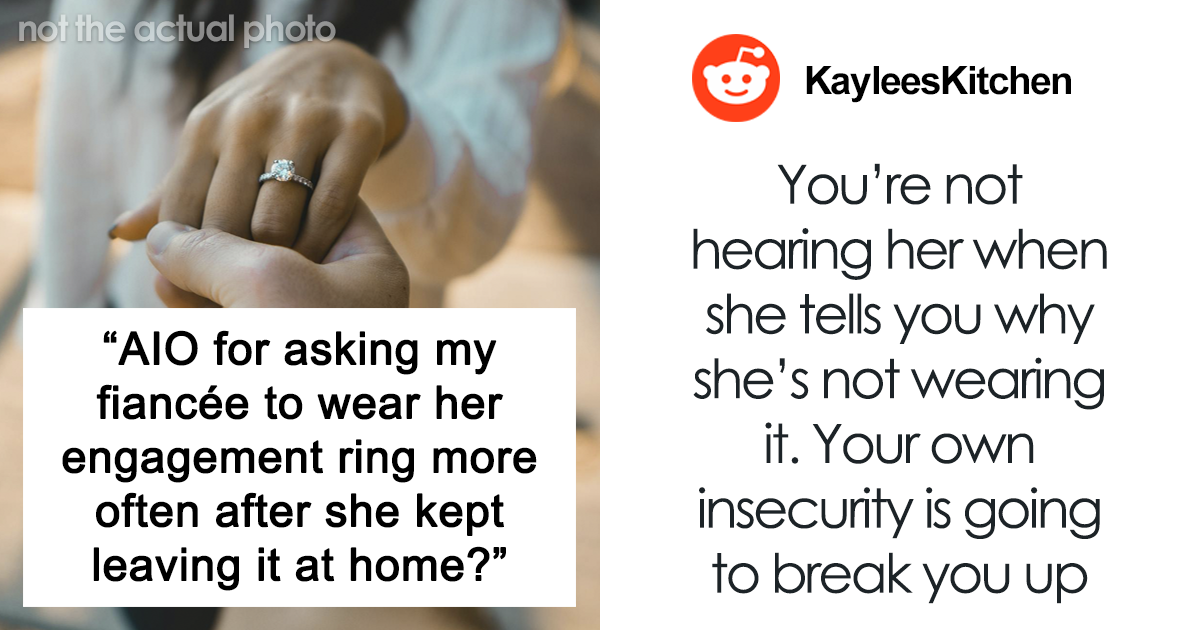
An engagement ring is supposed to be tiny enough to fit on one finger and big enough to carry an entire future. No pressure, little rock. In one viral relationship dilemma, a man was left confused, hurt, and quietly spiraling after his fiancée stopped wearing the $7,000 engagement ring they had chosen together. Her explanation? It was “not that deep” and “just a ring.”
To some people, that sentence sounds perfectly reasonable. A ring is an object. It can scratch, snag, disappear into a gym locker, or meet the tragic fate of being left beside a bathroom sink. To others, especially the person who saved for months to buy it, an engagement ring is not simply jewelry. It is a public symbol, a private promise, and a sparkly little ambassador for the relationship.
That is why this story hit a nerve online. The real argument was not only about a ring. It was about money, meaning, visibility, practicality, and how two engaged people can look at the same diamond and see two completely different things.
What Happened With The $7,000 Engagement Ring?
According to the story, the fiancé spent close to a year saving for the engagement ring. It was not a random panic-buy from a mall counter after three espressos and a pep talk from the sales associate. The couple reportedly chose it together: a classic oval diamond on a simple gold band. In other words, this was not a case of “surprise, I bought you a ring shaped like a pineapple because you once ordered tropical iced tea.”
At first, everything seemed fine. She wore the ring proudly after the proposal. Then, slowly, the ring started spending more time at home. She did not wear it to work because she worked in healthcare and worried about losing it or damaging it. She did not wear it while working out because it felt uncomfortable. Those reasons made sense to him, at least at first. Rings and dumbbells are not famous for being best friends.
But eventually, the exceptions became the new normal. The ring was mostly reserved for nicer outings, while everyday life happened without it. The turning point came during dinner with friends, when someone noticed her bare finger and joked that she looked single again. She laughed it off and said the ring was too pretty to lose.
Later, her fiancé admitted the moment hurt. He told her he wished she would wear the ring more often, not during work or workouts, but during ordinary daily life. He explained that the ring meant something to him: it represented commitment, effort, and the future they were building. Her response was the now-famous emotional grenade: “It’s not that deep. You know I love you. It’s just a ring.”
Why This Argument Became Bigger Than Jewelry
On the surface, the disagreement looks simple. He wants her to wear the ring. She does not want to wear it every day. Easy, right? Just create a spreadsheet, add a ring-wearing schedule, color-code it, and destroy romance forever.
But relationship conflicts rarely stay inside the original box. The ring became a symbol for several deeper questions: Does she value the engagement the same way he does? Does he care more about appearances than her comfort? Is she being practical, dismissive, or both? Is he being sentimental, insecure, or both?
The painful part is that both sides can have a point. A person should not be required to wear expensive jewelry every waking moment to prove love. At the same time, when one partner says, “This matters to me,” a shrug can feel like a door closing. The issue is not only that she did not wear the ring. It is that she seemed to minimize the feelings attached to it.
Is A $7,000 Engagement Ring Expensive?
Yes. For most couples, a $7,000 engagement ring is a major purchase. Engagement ring costs vary widely depending on the stone, metal, setting, location, brand, and whether the diamond is natural or lab-grown. Still, $7,000 is not pocket change unless your pockets are emotionally supported by a trust fund.
That number matters because financial effort often carries emotional meaning. If someone saves for almost a year, researches options, visits jewelers, and chooses a ring with their partner, they may naturally expect the ring to be treated as more than an accessory. The money is not the whole point, but it is part of the story. Love may be priceless, but jewelers do generally insist on a payment method.
However, price should not become a leash. Spending thousands of dollars on a ring does not give one partner ownership over the other partner’s hand. It does not mean the wearer must perform gratitude every day like a customer-service representative for romance. A healthy relationship can acknowledge the financial sacrifice without turning the ring into a sparkly attendance badge.
Practical Reasons Someone Might Not Wear An Engagement Ring Daily
There are many legitimate reasons a person may avoid wearing an engagement ring every day. Some people work in healthcare, food service, laboratories, childcare, manufacturing, or other environments where rings can interfere with hygiene, safety, gloves, or equipment. Others lift weights, swim, garden, clean with chemicals, or simply dislike the feel of jewelry.
Engagement rings can also be surprisingly fragile for something that looks ready to survive a royal curse. Prongs can loosen. Bands can bend. Stones can fall out. Harsh chemicals can damage certain metals and settings. Even a diamond, famous for being hard, can still be chipped if hit at the wrong angle. The ring may be expensive, but it is not a tiny superhero.
There is also the fear of losing it. Many people are less worried about wearing a ring than about taking it off in public. The moment a ring comes off near a sink, locker, glove box, hotel nightstand, or airport bathroom, the universe begins playing suspense music.
But Practicality Does Not Erase Emotion
The fiancée’s practical concerns were understandable. The problem was not that she removed the ring for work or workouts. Most reasonable partners would understand that. The problem was the communication around it. Saying “it’s just a ring” may have been her attempt to calm the situation, but it had the opposite effect. To him, it sounded like “your effort does not matter.”
In relationships, the same sentence can land very differently depending on context. “It’s just a ring” may mean, “My love is not dependent on jewelry.” It may also sound like, “This thing you saved for and emotionally invested in is not important.” That is the dangerous part of dismissive language: it can turn a solvable preference difference into a character debate.
A better response might have been: “I love the ring and what it means. I’m nervous about losing it, and I don’t want to damage it. Can we figure out when wearing it matters most to you and when it makes sense for me to keep it safe?” Same concern, completely different emotional temperature.
Was He Being Insecure Or Reasonable?
He was not unreasonable for feeling hurt. Engagement rings are culturally understood as symbols of commitment. When the person wearing the ring chooses not to wear it, the other partner may wonder what that means. Is it embarrassment? Indifference? A privacy preference? A practical habit? A warning sign? The mind loves filling silence with worst-case scenarios. It is basically a raccoon in a pantry.
Still, feelings are not instructions. Feeling hurt does not automatically mean she must wear the ring daily. It means the couple needs a conversation that separates the emotional need from the specific demand. His emotional need might be: “I want to feel that our engagement matters to you and that you are proud of it.” His specific demand might be: “Wear the ring more often.” Those are related, but they are not identical.
She may be able to meet the emotional need in other ways. She could wear the ring for social outings, keep it insured, store it carefully, post engagement photos, wear a simple band at work, or simply reassure him with more warmth. The goal is not to win a courtroom case called The People v. Bare Finger. The goal is to understand what each person is actually asking for.
Was She Wrong To Call It “Just A Ring”?
She was not wrong to believe love matters more than jewelry. In fact, that is healthy. A ring should symbolize commitment, not replace it. A couple with no ring can have a beautiful marriage. A couple with a massive diamond can still argue over dishes, in-laws, and who keeps changing the thermostat like it is a hostage negotiation.
But she may have been wrong to dismiss his feelings. The phrase “not that deep” often sounds casual, but in an intimate conversation it can feel like emotional bubble wrap over someone else’s vulnerability. He was trying to say, “This represents us to me.” She responded as though he said, “Please worship the ring and address it as Your Majesty.”
That mismatch is where many couples get stuck. One person talks about meaning. The other hears control. One person talks about comfort. The other hears rejection. Without careful communication, both partners end up defending themselves instead of understanding each other.
What The Ring Really Represents
An engagement ring can represent commitment, but it can also represent identity, public status, family expectations, personal style, money values, gender roles, and social pressure. That is a lot of work for a small object. No wonder rings occasionally need a day off.
For the giver, the ring may say, “I chose you, planned for you, saved for you, and want people to know we are building a life together.” For the wearer, the ring may say all of that, but it may also say, “Please do not rob me in this parking lot,” or “I hope this does not rip another medical glove,” or “My finger feels trapped in a luxury handcuff.”
Neither interpretation is automatically silly. The healthiest couples make room for both symbolism and real life. They do not treat the ring as meaningless, and they do not treat it as the relationship’s battery pack.
How Couples Can Avoid This Exact Fight
1. Discuss lifestyle before buying the ring
Before spending thousands of dollars, couples should talk about how the ring will actually be worn. Does the wearer like jewelry? Do they work with gloves, tools, chemicals, patients, children, or food? Do they exercise often? Are they likely to wear a ring daily, occasionally, or only for events?
2. Set realistic expectations
The proposer may imagine the ring being worn every day. The wearer may imagine wearing it only when safe and comfortable. Neither assumption should remain hidden until after the proposal. Expectations are cheaper to discuss before the receipt is printed.
3. Consider a backup band
Many couples use a simple wedding-style band, silicone ring, or lower-profile ring for work, travel, workouts, or errands. This can honor the symbolism while protecting the expensive ring. It is not a downgrade; it is a practical understudy.
4. Insure and maintain the ring
If a ring costs thousands of dollars, insurance and regular inspections can reduce anxiety. Knowing the ring is covered for loss, theft, or damage may make the wearer more comfortable using it. Regular cleaning and prong checks also help keep it secure.
5. Talk about feelings without insults
“You’re materialistic” and “You’re hiding our engagement” are both conversation grenades. Better versions sound like: “I feel hurt when you rarely wear it because I connect it with our commitment,” and “I feel anxious wearing it daily because I worry about losing or damaging it.” The difference is huge. One starts a fight. The other starts a conversation.
The Public Symbol Versus Private Commitment Problem
One reason engagement ring disputes become so emotional is that rings are visible. They tell the world a story before either partner says a word. That visibility can feel romantic to one person and uncomfortable to another.
Some people love being publicly recognized as engaged. They enjoy the compliments, the congratulations, and the sense of shared identity. Others are more private. They may not like strangers commenting on their relationship status, judging the size of the stone, or asking when the wedding is. For them, not wearing the ring may be less about the partner and more about escaping the social circus.
This is why couples should not assume that public display equals love. Some people are deeply committed and private. Others are loudly romantic and emotionally unavailable. A ring can communicate commitment, but it cannot do the entire job. That still falls to honesty, reliability, kindness, and not rolling your eyes when your partner says something matters.
What Online Reactions Often Miss
Online debates love villains. They want one person to be selfish and the other to be saintly, preferably by paragraph three. But real relationships are rarely that tidy. In this case, the fiancé is not automatically controlling because he wants the ring worn more often. The fiancée is not automatically unloving because she does not want to wear it every day.
The more useful question is not, “Who is the bad guy?” It is, “What are they each protecting?” He may be protecting the meaning of the proposal and the pride he feels in their engagement. She may be protecting comfort, safety, and peace of mind. Once those motives are named, the couple can negotiate. Without naming them, they just keep arguing about a circle of gold like it has personally betrayed the family.
Experiences And Lessons From Similar Ring Conflicts
Many couples discover that the engagement ring becomes their first major lesson in shared symbolism. One partner may see the ring as a daily emotional signal. The other may see it as a precious item that should be protected, not tested against every grocery cart, treadmill, and aggressive sweater sleeve in America.
Consider a nurse who loves her engagement ring but works long shifts, washes her hands constantly, and wears gloves throughout the day. She may leave the ring at home not because she is ashamed of being engaged, but because she has seen what repeated sanitizer, glove friction, and frantic workdays can do to jewelry. Her partner might initially feel rejected until they agree that she will wear a plain band at work and the engagement ring outside the hospital. Suddenly, the issue is not love versus jewelry. It is teamwork versus assumptions.
Or think of someone who lifts weights five days a week. A raised diamond setting can be uncomfortable under gym equipment and risky during heavy lifts. Wearing the ring during exercise may feel romantic in theory and deeply impractical in practice. A silicone band or ring necklace can become a compromise that says, “I am engaged, and I would also like to keep all my fingers functioning.”
Another common experience is the near-loss scare. Someone removes a ring to wash dishes at a friend’s house, forgets it beside the sink, drives home, and spends the next thirty minutes aging spiritually. After one episode like that, even the most sentimental person may become cautious. The partner who bought the ring might interpret that caution as avoidance, but it may actually be respect for the ring’s value.
Financial history also matters. A person who grew up with money stress may feel uncomfortable wearing something expensive every day. A $7,000 ring can feel beautiful and terrifying at the same time. It may attract compliments, but it may also create anxiety. In that case, the conversation should include money emotions, not just ring habits. The wearer might need reassurance that the ring is insured and that occasional non-use will not be treated as emotional failure.
Then there are style issues. Some people choose a ring while swept up in proposal excitement and later realize the setting does not fit their daily wardrobe or sensory preferences. Maybe it catches on clothes. Maybe it feels too flashy. Maybe the band spins. Maybe the wearer loves the meaning but not the experience of having it on all day. Instead of turning that into shame, couples can resize it, adjust the setting, choose a lower-profile option, or create a plan for when it is worn.
The biggest lesson is simple: objects in relationships become powerful when people attach stories to them. One partner may attach the story of sacrifice and devotion. The other may attach the story of responsibility and fear of loss. Both stories can be true. The couple’s job is to stop arguing over which story is valid and start building a shared one.
Final Thoughts: It Is A Ring, But It Is Not Only A Ring
The fiancée is right that a ring is not the relationship. A marriage cannot survive on sparkle, no matter how flattering the lighting is. But the fiancé is also right that symbols matter. People keep wedding photos, save love letters, wear family heirlooms, and remember proposal details because human beings attach meaning to things. That is not shallow. That is being human.
The healthiest answer is not forcing her to wear the ring every day or telling him to stop caring. The answer is a better conversation: when will she wear it, when will she not, what does it mean to each of them, and how can they reassure each other without turning the ring into a scoreboard?
Because yes, it is just a ring. But when two people are planning a life together, “just” about anything can become deep if it touches love, effort, money, identity, and respect. The ring does not need to be on her finger every second. But the feelings behind it do need a safe place at the table.














